It is well established that the Internal Security Act (ISA) should be abolished on grounds of violation of fundamental human and legal rights, enshrined for the legal and constitutional protection of Malaysians.
However, it is considered insufficient and indeed unrealistic, to call for its abolition purely on these grounds alone.
For these basic rights to be effectively and meaningfully implemented through the apparatus of government and bureaucratic system, it is a necessary condition that avenues for social reforms should be facilitated and enhanced.
 The ISA, in being used by the government as an instrument to deny and suppress possibilities for reform, has laid the authorities open to the accusation that they have deliberately stifled social change to maintain the status quo in the interests of the ruling class
We do not need to be reminded that even in a practising democracy, it is said that ‘all power corrupts; absolute power corrupts absolutely’ .Therefore, there is no question that on this basis alone - because it is essentially a reform-killer - the ISA must be abolished in toto .
But there is also an equally important dimension to take into account - that the use of the ISA to block and suppress reform is inimical to the effective functioning of a multi-cultural society where reforms are inherently essential and fundamental to nation-building.
Given the complex process of accommodating inter-ethnic and intra-ethnic interests that overlap and override social class and racial identities in such societies, it can be fatal to their maintenance and even survival if such permutations and combinations fail to be satisfactorily overcome.
Indeed, some published works have drawn attention to situations in contemporary Malaysia where such accommodations have failed to achieve the desired objectives because of the use of the ISA.
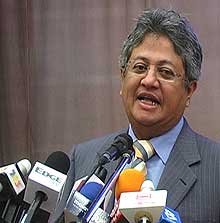 I have previously written about two important ‘cases’ as being particularly relevant. I am grateful to (former
de facto
law minister) Zaid Ibrahim for including these situations in his
Open Letter to the Prime Minister
calling for the ISA to be abolished. By so doing, he has given credibility and indeed legitimacy to these situations in a manner that only he could give.
I have previously written about two important ‘cases’ as being particularly relevant. I am grateful to (former
de facto
law minister) Zaid Ibrahim for including these situations in his
Open Letter to the Prime Minister
calling for the ISA to be abolished. By so doing, he has given credibility and indeed legitimacy to these situations in a manner that only he could give.
The two scenarios are the cases of Dr Burhanuddin Al-Helmi and that of certain leaders of the reform movement known as Hindu Rights Action Force (Hindraf). In both situations the ISA was used to detain them.
Each situation essentially involved leaders calling for reform in the political economy and it is important to present the cases in some detail, as an analysis within a wider perspective of the ISA.
Dr Burhanuddin Al-Helmi
(Former premier) Dr Mahathir Mohamad wrote the lead foreword to my book ‘The Finest Hour: Malaysian - MCP Peace Accord in Perspective’. In it, he emphasised the defining and pivotal role played in the independence struggle by leaders of Islamic political parties such as Burhanuddin.
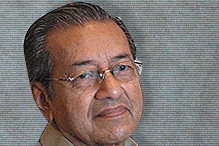 Mahathir recognised that these anti-colonial resistance movements were “unanimous that despite the negative impact that the immigrant communities had in working within the colonial economy against that of the indigenous economy, this was due to no fault of their own, and that therefore, the non-Malay should find a place in an independent free Malaya”.
But more importantly Burhanuddin clearly argued that reforms were essential to forge a sense of common identity among Malayans if political independence was to be meaningfully achieved. Therefore the status of ‘non’ applying to any locals would be unacceptable.
He accordingly called for a distinction to be made between bangsa (race) and kebangsaan (nationality) so that the citizenship status of ‘Melayu’ becomes jointly available to both Malays and non-Malays.
Burhanuddin’s call for such reforms for the “integrity of our national existence’ was unanimously endorsed by the Constitutional Commission comprising Putera and AMCJA (interestingly including Tan Cheng Lock representing the Chinese Chambers of Commerce).
The calls for reform will be recognised in the forthcoming publication of my Malaysian Chapter of the World Wide Encyclopedia on Protest and Revolution by Blackwell (Oxford) in January.
Hindraf movement
In his ‘open letter’ Zaid also made the comment that the government had yet to provide any evidence that the detained leaders of Hindraf movement had anything to do with “terrorist activities”.
 On this basis, and considering the enourmous negative public concern over their continued detention, the government has opened itself to the charge that they are being held due to the widespread call for reform, particularly for the marginalised and powerless groups among low-income groups in all communities.
However, it needs to be pointed out in no uncertain terms that the demand for such reforms is not new. There has been a consistent and significant amount of published material on the need for reforms that pre-date to at least the early 1960s.
The problem is that neither the government nor its delegated agencies - such as the former ministry and department of national unity - seem to have given any attention to these well researched reports and recommendations because of their lack of capacity and capability to meaningfully implement these, let alone understand the meaning and significance for nation-building and national unity.
It is not proposed to repeat details of some of the more important publications here for the simple reason that anyone seriously concerned and interested in calling for a review of the continued detention of the leaders with a view to their unconditional release had better do their home work before presenting the case to the prime minister.
Zaid himself had made an excellent case on the meaning and significance of the Hindraf movement in his article entitled ‘Fresh Thinking Needed’ in his recent book titled ‘In Good Faith’.
I have also attempted a holistic appraisal of the entire ‘Indian Question’ and Hindraf, with particular reference to the dire and urgent need for reforms in the books titled ‘Speaking Out: Insights into Contemporary Malaysian Issues’ (Utusan 2006) and ‘Speaking Out Loud For National Unity: Social Change and Nation-building in Contemporary Malaysia’ (Sird 2008).
I believe that the titles of the topics covered especially in the Utusan publication will give readers an insight into the nature and extent of the problems, with suggestions and recommendations as to what might be done to hopefully overcome some of the problems.
The titles are:
- The Curtain Falls on the Malaysian-Indian Estate Community: From Coolie Rubber Tapper-to-Squatter-to-Gangster
- Evacuation from the Estates: A Case for Urban Proletarianization?
- Indian-Malaysian ‘Gangsterism’: Reform the Estate Stucture
- New Thinking Vital to Create a Viable Plantation Sector
Relevant articles in the SIRD publication are;
- Uprising Against the System - Not the Government
- Help All Deprived Groups
- Open Letter to the Prime Minister
This is not the place to enter into a deliberation on the question of ‘predicting’ or ‘prescribing’ certain outcomes in social issues and problems.
However, I am taking the liberty of suggesting that had the government should have given serious consideration to the plight of the marginalised low-income and powerless groups. Had it done so, the Hindraf movement would not have evolved the way it has.
DR COLLIN ABRAHAM holds a doctorate in race relations from Oxford. Initially a civil servant attached to the welfare ministry, he later undertook research projects with the rural development ministry and economic planning unit. He was seconded to Universiti Sains Malaysia as associate professor in sociology and, more recently, visiting fellow. He is currently pro-tem president of the Malaysian Association of Social Impact Assessors.