

Siti, who makes her living as a home-based worker, was busy weaving a net around a shuttlecock, moving her two hands quickly and skillfully along with the other women workers at her house.
It was already late afternoon but the sun was still shining into the houses in Arjosari, a village in Malang, East Java province.
Siti, a worker in the sub-contract production system for local factories, used to work directly for a company, but recently made the transition to self-employment. She invites neighbours to work for her and pays them on a piecework basis.
"We sell the products to retail shops, which give us a better price than a company, such as a sports club, sports shop or stationery shop. If it cannot be sold, the shop will give it back to us but if they can sell it, they will pay us. Also, anyone can come and buy our product here as well" she said.
 Such home-based factories are found all over the village. They mainly employ women as informal labourers, who make up two-thirds of the Asian labour force and therefore contribute significantly to regional economic growth.
Daily, a household should finish making about 50 dozen shuttlecocks and payment is made for the nature of each person's work.
For instance, putting feathers around the shuttle cock will give workers about 1,500 Rp (about US$0.15) per 12 pieces. Those who tie string around the feathers will get 600 Rp (about US$0.06) per dozen.
The quality of the final pieces determines the price. For medium quality the price is about 10,000 Rp, while better quality will sell for 20,000 Rp and the highest quality is about 25,000 Rp per box of a dozen.
Sri is another self-employed person who strings badminton rackets in the village. She spoke openly about the unstable orders from the company which means the income for her family is also unstable.
"Many years ago, around 1997-1998, we didn't get any orders at all for months, which was a tough time for us all. When we finally got a job order we just worked; we don't care at all about the brand name of the product or what company we worked for, we just continued working," she said.
But she complained that sometimes, "we have been paid very poorly, and sometimes mistakes happen. The company always asks for the best quality, even though they don't want to pay for it. That makes me really angry."
Nevertheless, Siti and Sri have to deal with all production costs and the rising cost of living. For home-based workers, there is no labour protection law. They do not have access to social security, and there is no minimum wage or living wage for them.
Support for workers
Sutarti, the chairperson of the Association of Indonesian Home-based Women Workers and herself a home-based worker, said: "Home-based workers are invisible to our government. We have been trying to do the best for our families and our communities to provide a better standard of life, and to earn income and take good care of our family."
The association was founded by the home-based women workers in Malang, and aims to support and enhance women workers' capacity.
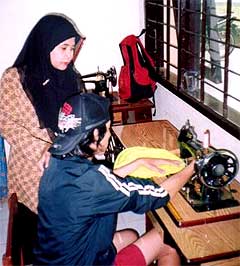 It works directly with home-based women workers in order to support them in a variety of ways. It conducts many workshops and training courses, such as technical/skills development, marketing strategy, policy and law and leadership.
"(But) it is hard for home-based women workers to stop their daily work and come to join the training or participate in other social or political activities,” Sutarti said.
"We also have been trying to empower home-based workers in many ways in order to increase their bargaining power and be able to set up their own business. Still, it is hard for home-based women workers to collect capital to set up their own business.
"We also try to find new techniques and equipment to make our products look nicer. We brainstorm and create new designs to make ours different from others so we can be paid more.”
In the current economic downturn, foreign-investment oriented policies seem to be the way to boost the economy by taking advantage of cheap labour.
The home-based work system leads to more and more lay-offs of formal workers, who then become informal contract labour. At the same time, the informal labour force lacks bargaining power or workers' rights. The workers do not have any economic, social or legal protection.
 In addition, under the Asean economic blueprint, the vision of 'one market' pushes an Asean Free Trade Agreement, while the free flow of financial and foreign investment in the region is leading to a rise in informal labour.
Today, China's commodities flood not only global markets. China has already started to export batik (traditional Javanese textile) to Indonesia, which harms local businesses and the labour force as well.
"The number of informal workers is rising significantly in Asean, because of the weakening of industrial relationships. The factories reduce the number of their formal workers and give the work to informal home-based workers who used to be the formal workers" said Daniel S Stephanus, Head of the Accounting Department at Ma Chung University.
Indonesia has a population of 224 million with the percentage of people working in the informal economy increasing yearly. It has a significant income gap, as shown by the 93 percent of workers who are informal, most of whom are women.
According to a 2006 World Bank report, an estimated 17.8 percent of Indonesians live below the poverty line, and 49 percent live on less than US$2 per day.
In addition the unemployment rate is 9.75 percent, based on the Indonesian Central Statistics Bureau (2008). It reports that 63.41 percent of those counted as poor live in provincial areas.
Hesti R Wijaya, an Indonesian researcher, pointed out that the informal labour framework that seems to be working well in Asean member-countries will lead to more illegal businesses employing immigrant and migrant workers in sweatshops. These workers will not receive any protection of their employment status or health care either.
"We need to gain bargaining power for these workers, decent wages, and for people put more value into women's work," Sutarti said.
This is an abridged version of an article written under the 2009 Southeast Asian Press Alliance Journalism Fellowship Programme
