

The path of death and destruction wrecked by the Indonesian tsunami recognized no national boundaries and granted no ethnic or social groups any special privileges. There is a greater force out there that we have to contend with, a higher authority that we must be respectful of, and a stronger bond that binds us all as inhabitants of this world.
Thousands who stood in the tsunami's path were destroyed. The victims included destitute villagers who looked to the ocean for their sustenance, a monarch's grandson out to enjoy the pleasures of the sea, and affluent First World tourists who sought in the pristine tropical beaches a temporary respite from their daily grind back home.
There were, however, lucky survivors. While they might understandably attribute their miracle to an Almighty God, it is important that we do not, as some are wont to, get carried away with this line of thinking. Were we to do so, we would in effect be condemning the innocent thousands who perished as being unworthy of His Benevolence. That would not be consistent with my belief of a merciful and compassionate Allah.
With this tragedy we were thankfully spared the sanctimonious comments of local pseudo religious leaders. They were quick to attribute the 1999 Turkish earthquake to God's retribution for the country's sinful secular ways. How offensive!
God has indeed blessed us. He has conferred uniquely upon humans an intellect, an ability to think, and thus to learn from our own experiences as well as from those of others.
Saved hundreds
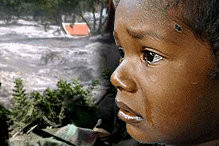 At the individual level, there was the perceptive resort manager who, on seeing the dramatic receding of the tide, sensed its devastating portend and warned everyone to clear the beach. His insight saved hundreds. He used his God-given intellect to explore ideas and learn from others. Reading about or viewing documentaries on earthquakes and tsunamis may contribute nothing towards being a competent manager, but as was evident, it was precisely this knowledge that was most beneficial for the well being of his guests and others.
At a higher level, the United States Geological Service detected the quake within minutes. It took a while longer to locate the epicenter and to ascertain the probability of a catastrophic tsunami. The Australian and Indonesian agencies knew of the danger much sooner. This crucial information could have been widely disseminated almost instantaneously in this Internet age. It may not have saved the Sumatran coastline, but it would have been the critical difference between life and death for thousands in India, Sri Lanka and elsewhere.
In addition, there are satellites overhead and hundreds of ships equipped with modern communication that could relay in real time the conditions of the ocean, including the speed, magnitude and direction of the waves. These modern wonders are a tribute to the human intellect.
 If that one resort manager could save hundreds of lives with a warning time of only a few minutes, imagine the immense good a time lag of a few hours known to thousands would have done.
Alas, having the information is one thing but doing something with it is another. We will soon know what the various authorities did with the information they had. Only then would we be able to apportion the blame and responsibility between human foibles and nature's fury.
'No man is an island'
This disaster dramatically demonstrates that artificial political boundaries are just that - artificial. The tsunami respected none of them. Those poor Indian villagers could not have imagined that an event occurring thousands of miles away in a foreign country could have such a devastating impact on them. We had intimations of this before, but never had it been so forcefully demonstrated as with this recent catastrophe. John Donne's "No man is an island" applies to nations as well.
Previously, we were reminded of this when poor Indonesians, in trying to carve out a subsistence living by burning their jungle, wrecked millions worth in economic losses and health damages elsewhere from the ensuing haze.
We could condemn those ignorant Indonesians, or we could divert some of the revenues that would have been lost because of the haze to help them better their conditions so they would not have to resort to slashing and burning.
To have this mindset however, we would first have to think of ourselves less as Indonesians, Singaporeans or Malaysians, and more as citizens of the region and the world. Before that could happen, we would have to think of ourselves less as Malays, Chinese and Indians, and more as Malaysians.
Even after having lived through the horrors of a few earthquakes in California, I still cannot imagine the destruction of one registering 9.0 on the Richter scale. It is a thousand times stronger than the Loma Prieta earthquake of 1989 that tore apart the San Francisco Bay Bridge and the adjoining expressway.
Right thing
What stands out about natural disasters in the Third World is their devastating toll on human lives. The same magnitude earthquake in Mexico killed thousands; a similar one in California exacted considerably fewer. This does not mean that God favours the Americans rather that America has more stringent building codes, better communication facilities, and responsible public agencies. American contractors are mindful that they are answerable to the building inspectors; the inspectors in turn are answerable to the public. There are no short cuts. You can bribe an official, but you cannot bluff your way to a higher authority that can demonstrate its awesome power at any time.
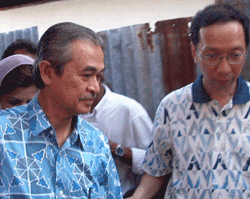 Prime Minister Abdullah Ahmad Badawi was correct in cutting short his vacation to be with the people. They needed him in their time of grief. His canceling of the traditional New Year's celebrations was also appropriate.
I am less enamored with his call for Malaysians of different faiths to lead separate prayers. This is a time for us to come together, to help and comfort one another, to think of ourselves as part of a greater community. This is not the time to retreat into the comfortable shell of our ethnicity or nationality. The loss is being felt as far away as Stockholm and Palo Alto. The outpouring of help from around the world is an acknowledgement that we are in this together.
I am also not comforted by his banning of firecrackers. I am confident that Malaysians have the dignity and common sense not to partake in such exuberant displays in this time of great tragedy. Besides, as this calamity amply demonstrates, there is a limit to what we mortals can control.
