


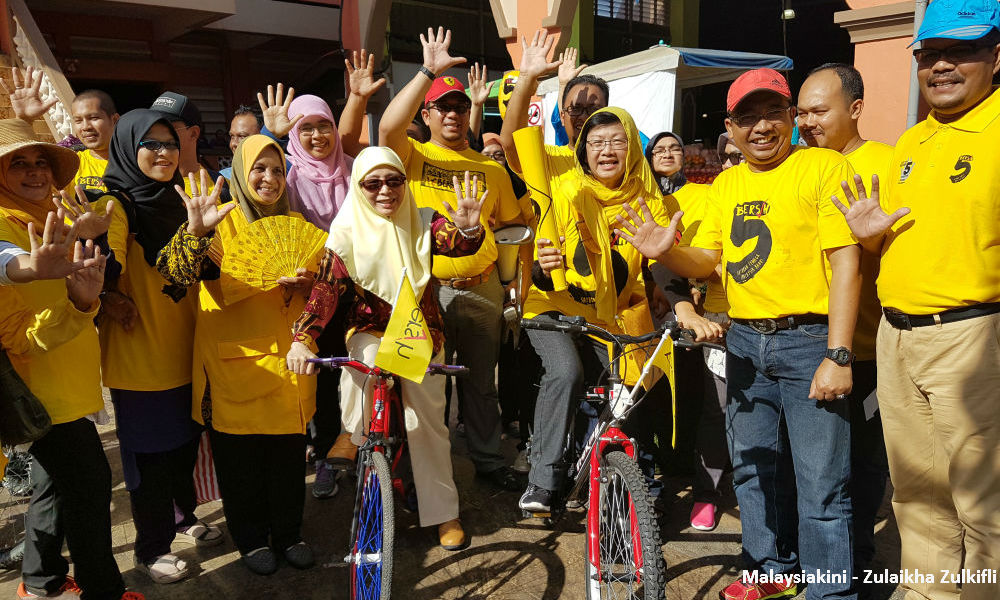

So what if Bersih is partisan
“The individual cannot bargain with the State. The State recognises no coinage but power: and it issues the coins itself.”
- Ursula K Le Guin, ‘The Dispossessed’
There is this rather disingenuous meme amongst a certain section of the punditry class that likes to go on about how Bersih has strayed from its original goal hence they are not in support of the upcoming rally. Add to this, statements from the Umno state that Bersih has become the tool of the opposition.
When people talk of clean and fair elections, what they are really talking about is a system of governance. Elections do not exist in a vacuum. While people may vote in corrupt governments (as many Malaysians did and still do), corrupt governments in order to maintain their hegemony seek to ensure that elections are rigged in their favour.
This rigging is part of a system of governance that does violence to the democratic processes. In other words, it is not in the interest of corrupt governments to have free and fair elections, even though citizens may vote in corrupt governments in compromised electoral processes. It goes without saying that democracy is messy and electoral systems are plagued with inconsistencies.
Now we either believe in democracy or we go the so-called Asian values way, as Singapore’s Harry Lee articulated back in the day - “It is necessary to try and put some safeguards into the way in which people use their votes to bargain, to coerce, to push, to jostle and get what they want without running the risk of losing the services of the government, because one day, by mistake, they will lose the services of the government... You unscramble Singapore, well, you'll never put Humpty Dumpty together again.” - On tweaking the one-man one-vote system after losing two seats to non-PAP candidates, The Straits Times, Dec 24, 1984.
Understand now, I am not arguing against independent institutions. I am not arguing against organisations being independent of political parties. I am not arguing against so-called watchdog organisations. I am not arguing against non-partisanship. I am making the argument that partisanship does not necessarily carry the implications that critics of Bersih say it does.
Of course, when people speak of non-partisanship what they really mean is “independence”. Independence is normally defined as being separate from whatever forces that are shaping the system. Independence implies credibility, which is fine and something that democratic societies require. However, partisanship does not necessarily mean devoid of credibility.
The idea that Bersih has strayed from its original intent is symptomatic of the myopic vision of our political elites and the intelligentsia which services a cottage industry of non-governmental lobbies, each concerned with protecting its own turf. As I said, free and fair election and governmental corruption are not mutually exclusive.
Would it have been better if Bersih remained an electoral watchdog and remained silent as to why we need free and fair elections or why we need to voice our discontent?
I made this argument during the last Bersih rally - “They should continue advocating the idea that peaceful demonstrations of public discontent are the foundation of liberty and that everyone has the right - even those people whose views we disagree with - to use our public spaces to voice their discontent. Now you could argue that this is not the stated goal of Bersih but anyone familiar with their literature and public statements would realise that this has been the backbone of their rhetoric which so far has translated into action.”
Would it have been more credible to remain silent in the face of the systemic breakdown and merely be content with advocating electoral reform? Would it have been credible to not align the organisation with like-minded organisations, individuals and political parties and using the resources of those groups and individuals to mobilise not only their bases but also non-aligned citizens? Would it have been more credible to not ask for systemic reforms that are integral to electoral reform?...
“The individual cannot bargain with the State. The State recognises no coinage but power: and it issues the coins itself.”
- Ursula K Le Guin, ‘The Dispossessed’
There is this rather disingenuous meme amongst a certain section of the punditry class that likes to go on about how Bersih has strayed from its original goal hence they are not in support of the upcoming rally. Add to this, statements from the Umno state that Bersih has become the tool of the opposition.
When people talk of clean and fair elections, what they are really talking about is a system of governance. Elections do not exist in a vacuum. While people may vote in corrupt governments (as many Malaysians did and still do), corrupt governments in order to maintain their hegemony seek to ensure that elections are rigged in their favour.
This rigging is part of a system of governance that does violence to the democratic processes. In other words, it is not in the interest of corrupt governments to have free and fair elections, even though citizens may vote in corrupt governments in compromised electoral processes. It goes without saying that democracy is messy and electoral systems are plagued with inconsistencies.
Now we either believe in democracy or we go the so-called Asian values way, as Singapore’s Harry Lee articulated back in the day - “It is necessary to try and put some safeguards into the way in which people use their votes to bargain, to coerce, to push, to jostle and get what they want without running the risk of losing the services of the government, because one day, by mistake, they will lose the services of the government... You unscramble Singapore, well, you'll never put Humpty Dumpty together again.” - On tweaking the one-man one-vote system after losing two seats to non-PAP candidates, The Straits Times, Dec 24, 1984.
Understand now, I am not arguing against independent institutions. I am not arguing against organisations being independent of political parties. I am not arguing against so-called watchdog organisations. I am not arguing against non-partisanship. I am making the argument that partisanship does not necessarily carry the implications that critics of Bersih say it does.
Of course, when people speak of non-partisanship what they really mean is “independence”. Independence is normally defined as being separate from whatever forces that are shaping the system. Independence implies credibility, which is fine and something that democratic societies require. However, partisanship does not necessarily mean devoid of credibility.
The idea that Bersih has strayed from its original intent is symptomatic of the myopic vision of our political elites and the intelligentsia which services a cottage industry of non-governmental lobbies, each concerned with protecting its own turf. As I said, free and fair election and governmental corruption are not mutually exclusive.
Would it have been better if Bersih remained an electoral watchdog and remained silent as to why we need free and fair elections or why we need to voice our discontent?
I made this argument during the last Bersih rally - “They should continue advocating the idea that peaceful demonstrations of public discontent are the foundation of liberty and that everyone has the right - even those people whose views we disagree with - to use our public spaces to voice their discontent. Now you could argue that this is not the stated goal of Bersih but anyone familiar with their literature and public statements would realise that this has been the backbone of their rhetoric which so far has translated into action.”
Would it have been more credible to remain silent in the face of the systemic breakdown and merely be content with advocating electoral reform? Would it have been credible to not align the organisation with like-minded organisations, individuals and political parties and using the resources of those groups and individuals to mobilise not only their bases but also non-aligned citizens? Would it have been more credible to not ask for systemic reforms that are integral to electoral reform?
(With regard to political parties, I still think my point I made for last year’s rally is still extremely important: “What Bersih has to ensure is that opportunistic political parties curtail their rabble rousing and ensure to the best of their abilities, that people get what they signed up for - a peaceful protest. Having been to so many of these demonstrations, I can attest that generally Malaysians are well-behaved and not prone to causing public mischief or at least that is the general sentiment of those who attend these rallies.”)
Bersih’s credibility
However, the question of credibility is an important one. It is extremely important to ask this question. It is not for Umno to question the credibility of Bersih because although they have every right to do so ultimately what they think of Bersih is irrelevant. How they respond to Bersih determines if Umno/BN is a credible government but that is the other part of the equation and democratic process.
By attempting to blacklist companies and lawyers who support Bersih, the Umno state demonstrates that this is not a question of Bersih’s credibility but rather the perceived threat towards the Umno hegemon. The so-called red-shirts are not a response to Bersih's agenda but rather intimidation against anyone who attempts to assert their democratic right. A right that the red-shirts have but want to deny others.
The opposition has always warned that it is reluctant to publicly name financial donors in case of Umno retribution and this blacklisting is clear evidence that the Umno state rejects the right of choice and expression.
It is important for those who support the agenda of Bersih to question the organisation and remind Bersih to be a credible oppositional voice.
How is this done? The latest Bersih rally is about (1) clean elections, (2) clean government, (3) strengthen parliamentary democracy, (4) right to dissent, and lastly issues concerning Sabah and Sarawak, which I honestly believe should not be hijacked by organisations from the peninsula.
(I do, of course, have my own preferred agenda for Bersih - “What this Bersih rally needs to be about is the dignity and integrity of the Malays. It needs to address the reality that Malay leadership has failed this country and the only way to restore any semblance of dignity to the Malay polity would be for the so-called “leaders” of the Malay community, with the help of their non-Malay counterparts, to mobilise the Malay demographic into coming to the mother of all street parties.” Which, in my opinion, makes strategic sense but perhaps is not as palatable as the official agenda.)
So, the question is has Bersih applied the same standards to the opposition it has seemingly aligned itself with? Has Bersih applied a cold rational eye on how PKR, DAP and PAS run its election systems? Are opposition-controlled state governments “clean” and does the opposition do its best to “strengthen parliamentary democracy”?
These questions should not be dismissed or answered in a flippant manner. These questions should not be dismissed with the excuse that Umno is the greater threat. These questions should not be buried under a mountain of spin of how the political process is against the opposition.
Ultimately how these questions are answered, determines the credibility of Bersih, but more importantly those who support Bersih and the opposition.
S THAYAPARAN is Commander (Rtd) of the Royal Malaysian Navy.


Report this comment
Are you sure you want to delete this comment?
This action cannot be undone.