




Kelantans little lost dragons
It was really only because of the high stakes involved in the Pengkalan Pasir by-election that the Chinese there had been courted beyond the strength of their numbers. Comprising 863 of 18,411 registered voters, the 4.7% Chinese electoral segment would, under other circumstances, constitute an insignificant percentage.
Making up 2% of the state's projected 1.4 million population, the estimated 28,000 Chinese in Kelantan are an even more negligible fraction of the whole. Common sense dictates that such a small community lacks political clout. Insiders would admit that they generally accept their subordinate position in the Malay-dominated power structure.
A more interesting speculation is how the Kelantan Chinese view their place in the political scheme of things vis--vis Umno and PAS. The Dec 6 face-off in Pengkalan Pasir between the parties' candidates can provide a starting point for discussion. Insofar as concerns race, the Islamist party has somewhat shown its egalitarian credentials by accepting Chinese converts into its fold. PAS state executive councillor Anuar Tan Abdullah, a Chinese, was in fact tasked with weaning away a third of the Pengkalan Pasir Chinese voters.
It was really only because of the high stakes involved in the Pengkalan Pasir by-election that the Chinese there had been courted beyond the strength of their numbers. Comprising 863 of 18,411 registered voters, the 4.7% Chinese electoral segment would, under other circumstances, constitute an insignificant percentage.
Making up 2% of the state's projected 1.4 million population, the estimated 28,000 Chinese in Kelantan are an even more negligible fraction of the whole. Common sense dictates that such a small community lacks political clout. Insiders would admit that they generally accept their subordinate position in the Malay-dominated power structure.
A more interesting speculation is how the Kelantan Chinese view their place in the political scheme of things vis--vis Umno and PAS. The Dec 6 face-off in Pengkalan Pasir between the parties' candidates can provide a starting point for discussion. Insofar as concerns race, the Islamist party has somewhat shown its egalitarian credentials by accepting Chinese converts into its fold. PAS state executive councillor Anuar Tan Abdullah, a Chinese, was in fact tasked with weaning away a third of the Pengkalan Pasir Chinese voters.
On the other hand, Umno with its raison d'etre of Ketuanan Melayu (Malay supremacy) will never open its doors to Chinese, as Umno's sidelined founder Onn Jaafar learned. A man ahead of his time, Onn was consigned to political wilderness for his visionary attempt at inclusiveness.
To put it another way, PAS is okay in theory with the Chief Minister being Chinese as long as he is Muslim. For Umno, any paramount leader must be Malay (or at least convince the party and public that he is Malay) Umno's rallying cry of "Untuk Bangsa, Agama dan Negara" puts race first and country last.
Race dynamics
Some Kelantan Chinese say they experience less racism under a PAS administration which granted them legal titles to Malay reserved land and permitted them trading and other licenses without undue discrimination. Accepting that PAS has shown itself to be fairer rulers of the East Coast state, then MCA's claim that total support from the Chinese community swung the scale in favour of Umno in Pengkalan Pasir indeed poses some food for thought.
According to MCA vice-president and Kelantan state liaison chief Fong Chan Onn, initial feedback (if it is to be believed) showed that his party delivered 95% of Chinese votes to Barisan Nasional (BN) in the closely-fought by-election. MCA's federal bigwigs had descended on the constituency's Chinese pockets to stump for their Umno overlord; the campaigning along communal lines an ugly example of BN's divisive ethos.
 Had the MCA politicos, parachuted from the capital, had any tenable and far-reaching promises to offer besides the one-off development carrots and largesse which would resonate with the remote Chinese villagers? What lies in store for the community in the long-term after the political circus has moved on?
Whereas in other parts of Malaysia, Chinese are known by their dialect groups like Hokkien, Cantonese or Hakka, in Kelantan they are instead distinguished by their place of residence: town Chinese and village Chinese. Malays generally see urban Chinese as "Cina luar" or "Cina benua" (from outside or the mainland) as these relatively more recent immigrants have stronger ties to their motherland culture. Peranakan Chinese, some having settled in the countryside in earlier waves long before the 19th century, are seen as "Cina sini" and "orang Cina kita" (local Chinese, our very own Chinese) and are more socialised to their Malay neighbours. The elders are accepted as "orang Kelantan betul" (true Kelantanese).
The town Chinese speak good Kelantanese; the village Chinese like the Baba Nyonya of Malacca speak the dialect like natives. Being fluent in the language and well-versed in "budi bahasa" (code of courtesy) and "adat" (customs) are among the main factors why Kelantan Chinese enjoy better race relations with Malays compared with Chinese of other states.
Kelantan standout
Kelantan presents a unique case not only because it is the sole state to be ruled by the opposition. The Kelantanese are arguably different from other folks. Well-known for loyalty to their home state, it is this clannishness that fosters the affinity among Kelantanese of different races. The camaraderie that Kelantan Chinese share with Malays is more than skin deep, not something superficial arising from puerile National Service coercion.
Assimilation of the minority in language, manners and dress came about from a natural process of the rural Chinese successfully accommodating themselves to the Malay environment. Sociologist and academic Teo Kok Seong in his book The Peranakan Chinese of Kelantan makes a telling observation of Kelantan's parochial attitude.
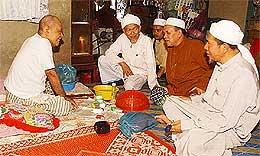 "The fact that Kelantan Malays place great emphasis on village membership is evident in instances where Malay members of a village show a greater solidarity toward their co-resident Peranakan Chinese than Malay outsiders from another village. Often, when open conflicts occur between Peranakan Chinese of the village with Malays of another village, Malay members of the village will take the side of their Peranakan co-villagers," writes Teo. "There are instances when Peranakan Chinese candidates are proposed, seconded, and supported by a majority of the Malay members of the village in the event of district level elections, such as positions in organisations at municipal level," he adds in a footnote.
This facet of mutual trust is, needless to say, unrepresentative of the more prevalent bigoted behaviour that exists elsewhere in the peninsula. Some would even venture to say that featured here is the template for the nebulous concept of Bangsa Malaysia. Yet while the better interethnic solidarity in Kelantan is indisputable, Islam still is a polarising factor. One religious taboo not to be underestimated is the consumption of pork. From my own numerous stays in Kota Baru with a Malay family of PAS supporters, the Kelantanese I've met appear more tolerant of non-halal Chinese food outlets, not displaying the overt aversion that other Malays show.
I believe that this tolerance is reciprocated by the Chinese who keep "un-Islamic" (for want of a better word) social behaviour in the background so as not to offend. The generally excellent bi- racial friendship in Kelantan goes so far as to extend to intermarriage. "Were it not for Islamic requirement of conversion where non-Muslims marry Muslims, Chinese-Malay intermarriage would have been much more common," comments Prof Tan Chee-Beng in a paper titled "Ethnicity, Intermarriage and identity: Lesson from Malaysia and Beyond".
However, this is not to say that mixed-race romantic relationships are encouraged by Chinese parents. "In Kelantan where Malays are in overwhelming majority, my Chinese informants often worried about their daughters in senior secondary school being wooed by Malay students," writes Tan who concludes: "This, in fact, reflected the insecure minority status of the Chinese there."
The conjoining of Malay identity with Muslim is so institutionalised, in Kelantan as in Malaysian officialdom, that the phrase "masuk Melayu" has come to mean "convert to Islam" when its literal translation actually reads "become a Malay". It is this issue of faith that is the barrier impeding further assimilation of Kelantan Peranakan Chinese who have remained Buddhist in conjunction with Toaist-Confucianist traditional practices.
Wedge called NEP
Aside from religion and this factor has come increasingly to the fore in recent years as both Umno and PAS up the ante in Islamisation the other man-made barrier is the New Economic Policy (and its perpetual incarnations under other names). Teo, himself a Kelantan Peranakan Chinese, postulates: "In some sense, Peranakan Chinese are victims of the irony of their own historical development. There is constant widespread resentment amongst Peranakan Chinese for not being recognised as bumiputera."
 The Siamese of Malaysia's northern states, the Portuguese of Malacca, recent arrivals among Indonesians, and various Muslims of Arab, Indian, Pakistani or other origin can avail themselves of bumiputra special privileges. But the village Chinese, despite their far longer residence in Kelantan than some of the examples above, will always be viewed by BN bureaucracy as "non" (the non-Malay, non-Muslim negative classification) although for centuries having regarded Tanah Melayu as their homeland. They have no recourse to the bumiputra schemes to help the disadvantaged although they are no better off than their poor Malay neighbours.
To further complicate matters, their Malay orientation makes them a minority within a minority of ever shrinking mainstream Chinese overall. It is perhaps not coincidental that minority communities elsewhere are also at a tipping point in their dilemma of trying to fit in and failing. When you think about it, how much more Malaysian can one get than the Peranakan Chinese of Kelantan? The irony of their plight has, interestingly enough, an echo in the Muslims of France.
"How much more French can I be?" Time magazine featured this arresting viewpoint by a 22-year-old Muslim rapper.
The youth lamented that those who lived in projects where the French riots raged last November were "treated as second class citizens" and those born and raised in France but of darker skin, had "less access to the rights and services of the republic". "People like me the descendants of immigrants, whether Arab, black or Asian are turning to our roots and embracing our heritage, just the opposite of what our parents did when they arrived," wrote the second generation Frenchman.
How much more disgruntled then are the Peranakan Chinese who can trace their roots back many, many more generations? Just as the marginalised Muslims of Europe are now starting to define themselves through Islam, so too might the Peranakan and Chinese Diaspora here begin to retrace their heritage to gain a sense of self. Across Malaysia, Chinese parents a generation ago were open to sending their children to government primary schools, including those with Christian antecedents like Convent, Methodist and La Salle, where the medium of instruction was Malay.
 Today, you'd be hardpressed to find any Chinese child who does not attend a Sekolah Rendah Jenis Kebangsaan (SRJK) where they are taught in their mother tongue. Becoming more fully Chinese through acquiring a greater competency in Mandarin and readopting Chinese mores seems to be the direction of the future, in the light of that Dragon now awakening. If China's rapid emergence as an economic powerhouse and global superpower is to be considered the pull factor for a returning pride in being Chinese, the push factor surely comes from the strong sense of being unwelcome in one's country of birth.
Speaking of his Kelantan Peranakan Chinese community, Teo says they see gradual integration into the wider mainstream Chinese society of Malaysia as the only option left to them. For the mainstream, a similar shift to a wider Chinese socio-cultural awareness and allegiance may well be another parallel first step taken by the unwanted ones to "going back where they belong". The Kelantan Chinese could have been the vanguard pioneering a Bangsa Malaysia that arises not through artificial political pressure but genuine goodwill. For them to decide on back-tracking their natural historical development will be a painful opportunity lost for the rest of us in this country.


Report this comment
Are you sure you want to delete this comment?
This action cannot be undone.