




Bolehlands religious landscape
Malay saying: Kuman di seberang lautan nampak, gajah di pelupuk mata tiada nampak.
In Bolehland, some people can spy a mote from across the sea while at the same time missing the elephant before their eyes. They see 'apartheid' in faraway Israel, for instance. However considering the race-bias policies on home soil, their moral high ground is a slippery sand dune indeed.
Actually, the towering ability that these Bolehlanders really possess is the blessed gift to remain oblivious to any inherent self-contradictions in what they think and say.
 Self-reflection is one elusive trait sorely missing in our '
Cemerlang, Gemilang, Terbilang
' philosophy. In recent days, a number of angry people have demanded that everyone treat the Muslim traditions they hold sacred with the same solemnity and gravity they themselves would accord it.
Self-reflection is one elusive trait sorely missing in our '
Cemerlang, Gemilang, Terbilang
' philosophy. In recent days, a number of angry people have demanded that everyone treat the Muslim traditions they hold sacred with the same solemnity and gravity they themselves would accord it.
So against this scenario, a reciprocal respect for worshipers of other faiths cannot be amiss. Consistency is after all a virtue.
Malay saying: Kuman di seberang lautan nampak, gajah di pelupuk mata tiada nampak.
In Bolehland, some people can spy a mote from across the sea while at the same time missing the elephant before their eyes. They see 'apartheid' in faraway Israel, for instance. However considering the race-bias policies on home soil, their moral high ground is a slippery sand dune indeed.
Actually, the towering ability that these Bolehlanders really possess is the blessed gift to remain oblivious to any inherent self-contradictions in what they think and say.
 Self-reflection is one elusive trait sorely missing in our '
Cemerlang, Gemilang, Terbilang
' philosophy. In recent days, a number of angry people have demanded that everyone treat the Muslim traditions they hold sacred with the same solemnity and gravity they themselves would accord it.
Self-reflection is one elusive trait sorely missing in our '
Cemerlang, Gemilang, Terbilang
' philosophy. In recent days, a number of angry people have demanded that everyone treat the Muslim traditions they hold sacred with the same solemnity and gravity they themselves would accord it.
So against this scenario, a reciprocal respect for worshipers of other faiths cannot be amiss. Consistency is after all a virtue.
 Allow me to quote an ancient wisdom: There is a time and place for everything. I'd like to hope the Barisan Nasional shares the sincere belief that there should be a proper place wherein a non-Muslim Malaysian can freely worship. Am I indulging in wishful thinking?
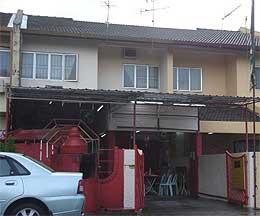
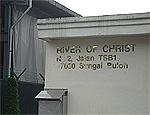
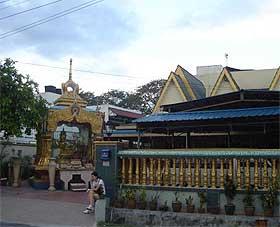
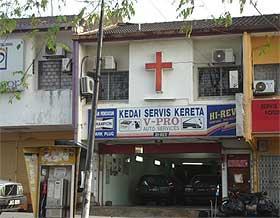
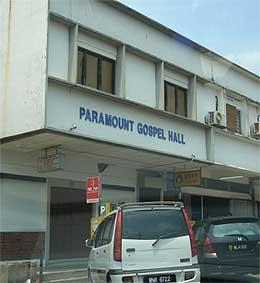
But whether improperly located or not, prayer halls in Bolehland certainly represent a unique school of architecture. A look at this collection of some dozen photographs is illustrative.
Plain human decency
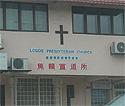 A lone, amateur shutterbug snapped the photos in a small area of the Klang Valley. These shots are only the tip of the iceberg as I'll bet my precious petrodollars that
malaysiakini
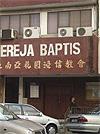
readers can direct us to more places further afield where sorry sights such as these are repeated many times over. The Logos Presbyterian (
pix, left
) is located beside a motor repair worksshop and the Baptist Church (
pix, third below
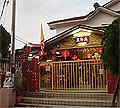
) is located besides a sundry shop. The first photo at the top of this page shows a temple that is actually a residential house.
A lone, amateur shutterbug snapped the photos in a small area of the Klang Valley. These shots are only the tip of the iceberg as I'll bet my precious petrodollars that
malaysiakini
readers can direct us to more places further afield where sorry sights such as these are repeated many times over. The Logos Presbyterian (
pix, left
) is located beside a motor repair worksshop and the Baptist Church (
pix, third below
) is located besides a sundry shop. The first photo at the top of this page shows a temple that is actually a residential house.
Perhaps our city councillors cocooned in affluent, gated communities should consider taking an inexpensive ' lawatan sambil belajar ' (study tour) preferably using public transport - of the poorer neighbourhoods.
Then they can see how non-Muslims gather in upper-storey shoplots for religious fellowship, for this is precisely the physical infrastructure that services the spiritual needs of their non-Muslims constituents. And perhaps our city councillors would hang their heads in shame at their dereliction of duty wishful thinking again?
 I'm not highlighting these photos because I'm a Christian, as has been alleged in some local Muslim weblogs which have picked up my previous articles. I've never been a Christian nor have I any intention of becoming one.
Similarly I do not take part in ceremonies at Taoist 'temples' wedged between link houses or contained in ramshackle shacks. However, I do support the right of all segments of society to spiritual sustenance, a right that is being increasingly sidelined.
Additionally, I believe respect to be a universal value, and a two-way street. It is only an insular, parochial mindset that smarts at injustices directed their own faith but feels not a twinge of conscience for what touches others. So how about an equal show of outrage against an uncaring government that merely mouths pious platitudes?
We can, you can't
 In the wake of the contentious Danish cartoons, Prime Minister Abdullah Ahmad Badawi asked for the 'building of bridges' and mutual respect among the major religions. He speaks for the global Muslim community as chair of the OIC (Organisation of the Islamic Conference), and his voice is heard on an international platform.
The PM's call has been echoed by his deputy Najib Abdul Razak who urged the rakyat to be sensitive of the government's stance on the matter. Given this politically-correct posturing, will the powers-that-be now express a modicum of regret for its earlier insensitive manner of demolishing small Hindu shrines in Selangor?
 And will the civil servants controlling the relevant departments - or in other words, regulatory agencies with the authority to stamp or deny approval - actually heed the top leadership and permit the building of new churches and other religious centres in suitable locations?
Or will Pak Lah establish another of his Royal Commissions of Inquiry, this time to look into the unfair legislation as well as inhibiting criteria that impede the setting up of places of worship other than mosques and suraus? Will the federal and state governments now begin to allocate even a pinch of public funds for the raising of temples and gurdwaras? And by practising what it preaches persuade us that the BN does truly respect the lesser religions in this country?
 Some Malaysians perhaps feel there's no point in waiting for durians to fall from trees. That's why the photographs on this page embody the intrepid spirit that moved the faithful to fend for themselves as best they can, and in the process invent a new movement in religious architecture.
They do so possibly in the realisation that official go-ahead may not be forthcoming even for a house of worship to be privately funded by religious organisations or philanthropists.
My great-grandfather, the late Penang millionaire Cheah Leong Keah, had left a large piece of land (today prime real estate) for a Chinese temple to be built. I'm told this by an uncle who is an estate trustee, as well as by other relatives. Yet as far as I'm aware, the plan is stymied despite protracted discussion between the Cheah estate and the state regulatory bodies over many long years. While other of great-grand dad's good intentions have come to fruition there is a hall named after him in a Penang old folk's home why is it that his last wishes to endow a temple cannot?
Walk the talk
 The first tenet of the Rukun Negara is '
Kepercayaan kepada Tuhan
' or 'Belief in God'. Seeing that this is the foremost national precept, it is not incongruous that faith studies (apart from Islam) have not been incorporated into the regular school timetable?
The first tenet of the Rukun Negara is '
Kepercayaan kepada Tuhan
' or 'Belief in God'. Seeing that this is the foremost national precept, it is not incongruous that faith studies (apart from Islam) have not been incorporated into the regular school timetable?
Non-Muslim children are separately taught Morals instead, as if morality is not contained in the religions of their forefathers! Why have not the non-Muslims, in tandem with their Muslim classmates, been allowed to do faith studies in school?
Interestingly enough, the PM on April 23, 2004 launched a laudable initiative he termed the National Integrity Plan. The 'Integrity Agenda' incorporates among its objectives the promotion of moral and religious values.
 Contained in the plan is this statement: "The institution of faith is very important to the uplifting of individual, communal and national integrity" (my translation from Bahasa Melayu).
We see the ruling parties pay lip service to a spiritually-centred national community founded upon a family that prays together and stays together. Now if only the path of the government's noble intentions were not paved with these unique testaments to the Bolehland religious landscape.
And instead of spending billions constructing a Crooked Bridge to Singapore, how about building an honest bridge to reach out to marginalised peoples clamouring for a place of worship of their own?


