




Voice of the people
There are 27 million of us populating Malaysia according to the Department of Statistics. So it's impossible to aggregate public opinion despite agents of Barisan Nasional putting up a valiant ventriloquist act as the people's voice.
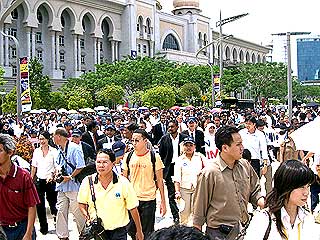
Though the cat has generally got our tongue, a few segments of the public are willing to speak for themselves. Yesterday's Walk for Justice was one significant, heartening instance.
The march in Putrajaya was an expression of the Malaysian Bar's effort to nudge the judiciary back on track. It was a best foot stepping forward on the proverbial thousand-mile journey to reform.
There are 27 million of us populating Malaysia according to the Department of Statistics. So it's impossible to aggregate public opinion despite agents of Barisan Nasional putting up a valiant ventriloquist act as the people's voice.
Though the cat has generally got our tongue, a few segments of the public are willing to speak for themselves. Yesterday's Walk for Justice was one significant, heartening instance.
The march in Putrajaya was an expression of the Malaysian Bar's effort to nudge the judiciary back on track. It was a best foot stepping forward on the proverbial thousand-mile journey to reform.
Abdullah Ahmad Badawi as prime minister and First Gentleman (correspondingly, given that his wife has been fawningly anointed First Lady) naturally had first dibs on the Lingam tape. His all too predictable response a week ago was: "I am disappointed. The video was released with the aim of getting the people angry with the country's judiciary system" (reported in The Sun , Sept 21).
 True to form, the PM was 'disappointed' that the tape surfaced but did not convey dismay at its contents. Anwar Ibrahim released the video on Sept 19 and because digital technology is lightning fast, it was immediately the talk of town.
Interestingly enough, the Star's top news on Sept 20 this is Malaysia's largest circulation English tabloid and a media organisation that styles itself 'The People's Paper' was a banner headline meant to get people angry but not at the judiciary.
The Star had screamed "Get the beasts!" (I think 'scream' is a fair description given the paper's use of the large and bold exclamation mark). The bloodcurdling cry is like something Goebbels (that would be Joseph, Nazi Propaganda Minister) would shriek to galvanise Brownshirts and a lynch mob.
'Beasts' is how the People's Paper calls perpetrators of the torture on the little girl whose body was found in a sports bag. It's easier to sound the horn against mere animals than VVIPs and I suppose after the beasts are 'gotten', the next logical step would be to draw and quarter the suspect(s).
Channelling public anger
 The poor girl had been subjected to an appalling death and a lot of Malaysians sympathise with her bereaved family but not it seems the Inspector-General of Police who announced police was investigating the parents for negligence or
de facto
Law Minister Nazri Aziz who concurred that the said parents could be charged with negligence.
The poor girl had been subjected to an appalling death and a lot of Malaysians sympathise with her bereaved family but not it seems the Inspector-General of Police who announced police was investigating the parents for negligence or
de facto
Law Minister Nazri Aziz who concurred that the said parents could be charged with negligence.
I do wonder how malleable public opinion is and in what hither-thither direction the Star and other mainstream media had been trying to shepherd this perplexed flock called public opinion over the murder.
Killers who commit depraved acts on their victims in addition to murder are an aberration or at least one would hope so. There is the Altantuya trial now in progress but the last I can remember of another sensational killing was bomoh Mona Fandey and her accomplices years ago chopping up an overly ambitious Umno state assemblyman into pieces.
On the other hand, corruption which is what the Lingam tape could be evidence of is not an aberration but has instead been described as 'systemic'.
That our country is suffering from systemic corruption is the belief of Transparency International-Malaysia founding president Tunku Aziz Ibrahim.
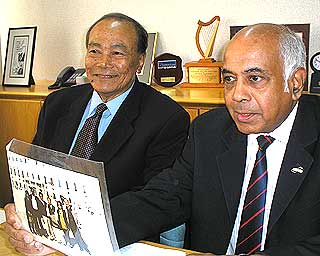 In his keynote address yesterday in conjunction with the release of TI's annual corruption perception index, Tunku Aziz said, "Today, we are in the grip of widespread institutional fatigue" and that every major institution of governance in Malaysia had been ethically compromised to the point where "public confidence in these institutions has all but evaporated".
Tunku Aziz and former UN Special Rapporteur on the Independence of Judges and Lawyers, Param Cumaraswamy, had jointly lodged a report with the ACA over alleged judicial impropriety last week. But from the mainstream media's agenda setting on big news, Malaysia appears to have no more serious problems than 'negligent' parents who lose their young children, flag burners and YouTube rappers.
Shaping public opinion
Recently I came across a posting which so cogently encapsulates my own thoughts on the shaping and shapers of public opinion that I've sought permission of its author, the noted intellectual Rustam Sani to reproduce his writing here.
'I am not an "objective" blogger and not apologising for it', Rustam confesses in his blog 'Suara Rakyat' (Vox Populi). He explains: "Sadly enough, the majority of the so-called professional journalists serving our mainstream media both print and electronic, even digital have been so indoctrinated to believe in this erroneous perception of objective journalism.
"Wittingly or unwittingly, to these journalists a piece of writing that supports the status quo is generally considered to be neutral and is not questioned in terms of its objectivity, while one that challenges the status quo tends to be perceived as having a 'point of view' and therefore 'biased'. Statements and assumptions that support the existing power structure are regarded as 'facts' while those that are critical of it tend to be rejected as 'opinion'."
My opinion, then, is that mainstream media playing down the gravity of Batu Burok earlier, and the Lingam tape and the Walk for Justice presently, while conversely and one-dimensionally playing up sensational crime stories is an indication of their BN-serving subjectivity.
 My other opinion is that reporters have played it too safe by functioning as stenographers. Rustam provides an insight into why our local brand of journalism tends to dispense with interpretation and analysis: "Journalists who accurately report what their sources say can effectively remove responsibility for their stories onto the people they interview and quote."
"The ideal of objectivity [in Malaysian terms] therefore encourages uncritical reporting of official statements and those of authority figures. In this way, the individual biases of individual journalists are avoided but institutional biases are reinforced," he writes.
Ensuing from this orientation where the establishment is ensured the right of reply (or avenue for their excuses), government and corporate interests are "guaranteed access to the media, no matter how flimsy their argument or how transparently self-interested" while "no such access is guaranteed to critics, however".
Burying scandals under sand
Institutionalised superficiality inherent in reportage on scandals potentially damaging to the BN incumbency (if and when it becomes impossible any longer to pretend ostrich-like that nothing happened) works to the advantage of official obfuscation and defusing public anger by watering down and diffusing the real foci of issues.
Rustam has observed that "to counter claims that society was being, in effect, brainwashed by this media monopoly, government-controlled corporate publishers and to a certain extent the journalists themselves promote the idea of 'professional journalism' (a concept defined narrowly to be confined to journalistic activities of those who work full-time in newsrooms of the mainstream newspaper establishments)."
It is a situation of government-sanctioned journalists qualifying themselves and at the same time trying to disqualify others.
Others refer to 'unprofessional', unaccredited with Ministry of Information news sources like web portals and blogs, and the ragtag of online writers and bloggers, i.e. ones targeted in Umno's cyber war against monkeys.
 These are the two sides of the government-legitimised-and-not divide currently tugging at public opinion.
The pro-establishment point of view is that the three-member 'independent' panel announced by Deputy Prime Minister Najib Razak to probe the authenticity of the Lingam tape is proof of the government taking action and there is no further need for any royal commission of inquiry as the PM says.
The alternative point of view is that the panelists, like the rest of our fatigued institutions, do not inspire public confidence and this muhibbah Malay-Chinese-Indian panel is a delaying tactic to fob off more pressing demands. After a suitable interval enough for Malaysian memory to recede, the matter will be housekeeping as usual swept under the carpet.
If you are willing to challenge the status quo and assumptions supporting the existing power structure, please walk to the People's Parliament here. Find there a people's petition drafted by civil rights lawyer Haris Ibrahim to the Yang Dipertuan Agong.
You are public opinion. We have a voice.


Report this comment
Are you sure you want to delete this comment?
This action cannot be undone.