




Wither MCA in Umno's clasp
Despite its symbiotic relationship with the ‘mainstream’ Chinese media and the abundant supply of spin doctors, MCA failed miserably to establish itself as the party of the Chinese in the general election last March.
Since then, there have been calls for it to quit the ruling Barisan Nasional (BN).
Before MCA – or other BN component party for that matter - jumps to such a conclusion, it should do some earnest soul searching and re-examine the nature of its pact with Umno. The crux of the issue is: Is MCA on equal footing with the Malay party?
Despite its symbiotic relationship with the ‘mainstream’ Chinese media and the abundant supply of spin doctors, MCA failed miserably to establish itself as the party of the Chinese in the general election last March.
 Since then, there have been calls for it to quit the ruling Barisan Nasional (BN).
Before MCA – or other BN component parties for that matter - jumps to such a conclusion, it should do some earnest soul searching and re-examine the nature of its pact with Umno. The crux of the issue is: Is MCA on equal footing with the Malay party?
When Ling Liong Sik - MCA president for 17 years - resigned abruptly as transport minister in May 2000, Khoo Boo Teik, whose seminal work The Paradoxes of Mahathirism remains the most insightful study on the political ideology of the former prime minister, wrote that Ling’s quitting the cabinet hardly mattered for the simple reason that “MCA scarcely penetrates the inner policy-making loop of the Umno-dominated government.”
In the same vein, Ong Ka Ting’s recent announcement that he would not seek reelection as MCA president in the upcoming party election has caused negligible political ripples.
Both Abdullah Ahmad Badawi and Najib Razak, the two top Umno leaders, are yet to say something substantive to that effect. As Abdullah has unveiled his own succession plan, all eyes are now on Umno rather than MCA.
Meanwhile, the public seems more intrigued and fascinated by the cut-throat power struggle between Anwar Ibrahim and Najib, and is hungry for more. Even the Chinese community appears to be indifferent, as evidenced by a handful of flattering articles in the major Chinese dailies expressing regrets at Ong’s scheduled departure.
Noticeably, words like “shocked” or “stunned” are nowhere to be found.
Strangely, even those “community leaders” whose business interests are intertwined with MCA’s fortunes are silent too.
Umno’s valet
MCA has been persistently denied being Umno’s valet, yet it is unable to explain its failure to convince the BN government to build vernacular schools based on need.
When the country was confronted with a host of religious disputes, all that Ong could do was present a memorandum to the cabinet as a member of the cabinet. A comic irony indeed.
 When MCA was split down the middle in 1984, the then deputy prime minister Musa Hitam
(pic)
remarked it might be wise for the Chinese party to stay out of BN until it could resolve its issues, a piece of ‘advice’ that sent chills through MCA leadership.
When MCA was split down the middle in 1984, the then deputy prime minister Musa Hitam
(pic)
remarked it might be wise for the Chinese party to stay out of BN until it could resolve its issues, a piece of ‘advice’ that sent chills through MCA leadership.
When MCA was afflicted with internal disputes in 2002 Mahathir had to step in and resolve it, making a mockery of the party’s credentials.
If BN was indeed an equal partnership, why have there been no calls on the part of MCA for Umno to temporarily leave the coalition as in 1987 - when the Malay party was engaged in its most intensive power struggle in history - in the interest of the government and the country?
Why was MCA muted when Mahathir exhausted the entire state machinery to persecute his nemesis Anwar and to crush the reformasi movement, making our judiciary a laughing stock in the eyes of the world?
Quite clearly, the ‘power-sharing model’ as propagated by Umno entails minimal political costs and risks. With this fig leaf in place, Umno needs not interfere directly in the internal affairs of the non-Malays, and the buck is conveniently passed to the respective race-based parties when things go wrong.
Wasn’t MIC made to bear the brunt when more than 30,000 Indian Malaysians took to the streets last November? Be it MCA, MIC or Sapp that has been plucked from the abyss of oblivion with its audacious no-confidence move against the prime minister, they share the same home truth: in government, but not in power.
No doubt, MCA scored well in the 1995, 1999 and 2004 general elections. However, with the benefit of hindsight, BN secured unprecedented Chinese votes in these elections in spite of, not because of, MCA.
A booming economy and a relatively liberal political environment under Mahathir won the heart of the Chinese community in 1995, while the economic crisis, the highly-charged political climate of reformasi and the anti-Chinese riots in Indonesia frightened the Chinese into voting for BN.
Fixed at four
With Mahathir stepping down and the advent of a new era under Abdullah, cautious optimism prevailed. The illusive 'feel good factors' managed to convince the Chinese to again opt for stability in 2004.
 But all these victories brought only insignificant changes to the Chinese community.
On the other hand, Umno’s hegemony continued to loom large – until March’s events checked its march.
Tragically, MCA was not rewarded with more cabinet posts even when it did well for Umno, not to mention being given the chance to run certain key ministries such as defence, finance and education.
For better or for worse, the cabinet quota for MCA is fixed at four. No more, no less.
So, is it time for elegies? Not quite.
If the MCA leadership is genuinely desirous of staying relevant, it must do its utmost to show the public that it is not only in government, but in power too. To that end, a reform agenda – both within MCA and the government – must be initiated.
Since some MCA top brasses are mulling making the party multiracial, why not begin with issues that transcend race and religion, such as proposals to amend or even abolish evil laws like the ISA, the OSA, the PPPA, the Police Act and other legislations that stifle academic freedom and ingenuity?
Would MCA be - from now on - able to assert its right to participate in inner policy-making, instead of covering the loopholes as it has been doing all this while? Would MCA leaders be bold enough to call for BN meetings to expel racist lawmakers?
If Umno remains recalcitrant, quitting BN is the only option. After all, any political coalition must allow its members the liberty to enter or leave – save for an indenture.
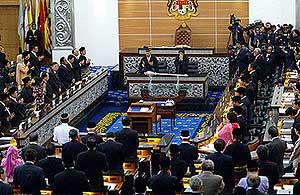 In fact, it is Umno that now badly needs other BN component parties to stay in power, while Pakatan Rakyat is desperately seeking new partners to take over the federal government. Having been haunted by Umno for decades, MCA should seize this window of opportunity to re-assess the new realities and seriously contemplate playing a kingmaker role.
What if the departure of MCA left the government with no Chinese representation? I would be least concerned.
If token presence was all that the Chinese coveted, there would be no need for MCA in the first place, for the government could always appoint a Secretary for Chinese Affairs as was the case with the Straits Settlements and Hong Kong under British colonial rule.
Similarly, has anyone noticed the wonderfully dressed ethnic minority delegates when China’s National People’s Congress convenes in Beijing every spring? They are certainly very glamorous, exotic and enchanting, but desperately powerless.
Short spell of agony
Dr. Colin Abraham may have been right in saying MCA’s decision not to accept any cabinet posts after May 13 in 1969 was a tactical error, as it gave Umno a free hand to push through the New Economic Policy.
But wasn’t the then MCA President Tan Siew Sin a member of the National Operations Council and a Minister with Special Functions? Why couldn’t he tone down the controversial policy?
This failure was made more poignant by the fact that the rights of the Chinese community continued to erode even when MCA was winning one election after another.
 No, the Chinese community would not stand to lose if MCA pulled out of BN. Such a drastic action would most certainly destabilise Umno and hasten the end of its dominance. Given that a new government would again compose of members of all races, a short spell of agony of not having a Chinese cabinet minister would be tolerable and a small price to pay for a greater say in the future, especially when the Chinese have put up with BN’s misrule for years.
As an idealist, I would even argue I need no Chinese faces in high office if the government could prove itself to be capable, fair and judicious!
Would there be a racial backlash after MCA quit? Again, hadn’t we been fearful of another May 13 should BN be denied a 2/3 majority in parliament? And who is in disarray now? The government, or the rakyat?
There will always be those who are worried about the consequences of MCA quitting BN, and these are, more likely than not, people with vested interests, such as Ong Tee Kiat, touted to be a potential contender for party president, and Chua Soi Lek, who has been quietly seeking to make a political comeback.
Of course, media owners and community leaders whose relationships with MCA are more than friendly would be losers too in this eventuality.
All the MCA power struggles in the past were driven by selfish interests, bereft of vision and ideology. Still reeling from the historic shock losses, this is perhaps an opportune time for the MCA leadership to open up a genuine and far-reaching debate on the party’s future.
Enough of self-pity. Let the show begin.


Report this comment
Are you sure you want to delete this comment?
This action cannot be undone.