




All about intellectual property & defamation law
At eLawyer’s first forum on Blogging and Law held today at Auditorium Tun Suffian, Faculty of Law in University of Malaya, speaker Foong Cheng Leong, a KL-based attorney spoke on the topic of “Blogging and Intellectual Property Law”.
At eLawyer’s first forum on Blogging and Law held today at Auditorium Tun Suffian, Faculty of Law in University of Malaya, speaker Foong Cheng Leong, a KL-based attorney spoke on the topic of “Blogging and Intellectual Property Law”.
Foong first introduced the audience to intellectual property: “Intellectual property covers trade mark, patent, copyright, industrial designs and trade secrets. In Malaysia, main intellectual property issues revolve around trademark and copyright.”
As rule of thumb, Foong advised: “Don’t use trademark as domain name or blog name. Don’t sell counterfeit products.”
The lawyer cited a British case where Hanna Barbara sued scoobydoo.co.uk to illustrate his point. Scooby Doo is a trademark of Hanna Barbara. Speaking on copyright, Foong stated that copyright provides for the right to make copies and it is licensed.
Copyright acts and works
Where laws are concerned, copyright is protected in Malaysia under the Copyright Act 1987, Copyright Application to Other Countries Regulation 1990 and Berne Convention .
The works included are literary, musical, artistic, films, derivatives and sound. Foong revealed that copyright owners are authors, employer and people who commission the work as stated under section 26 of Copyright Act 1987.
At this point he put a word a caution reminding those who commission work to have documented evidence such as receipts or agreement.
Moving on Foong elaborated that a copyright owner is empowered, among others, to reproduce and communicate a work. All copyright is valid for a duration of 50 years.
Foong, a blogger himself, stated that bloggers are “liable for their posts as well as comments on the blogs”. Using an example of his blog, he revealed that “HTML codes are also copyrighted.”
He also elaborated on an issue of concern to bloggers – copyright infringement. “Copyright infringement happens when reproduction or communication of a work is done without permission.”
For bloggers, copyright infringement happens when they use a photo from Google Image or host Bit Torrent files on their sites. As for Hotlinking, Foong referred to a case, Shetland Times Ltd vs Jonathan Wills & Another (1997) where a court granted an injunction against the defendant.
Legal protection
In defence of bloggers, Foong referred to section 13(2) of the Copyright Act 1987 on fair dealing. Fair dealing provides for reproduction of work for non-profit research, private study, criticism, review and reporting of current events. Users, however, must acknowledge title and author of the work concerned. This can be used for all works except sound recording and film broadcast.
As for legal action, parties can opt for injunction and claim damages as well as legal costs.
In case of infringement, Foong called for immediate removal of the work, deny liability and negotiate for settlement. He also reminded all to give due to the author or owner of the work.
During the Q&A session, a member of the audience asked about Creative Commons to which Foong explained that it gives away copyright in the form of creative works for public use.
To another question, Foong urged the forum’s participants to always obtain written consent to avoid infringement. He also observed that the copyright law in Malaysia was underdeveloped for Internet users.
Bloggers have rights too
Nizam Bashir, a member of the Malacca Bar was the second speaker. His topic was “Defamation Law and Blogging in Malaysia”.
“Statements that injures reputation is defamation. There is liability for speech and expression for defamation.”
“Investigation and prosecution can be carried out under the Sedition Act, detention under the Internal Security Act (ISA) and actions can be taken under the Communications and Multimedia Act.”
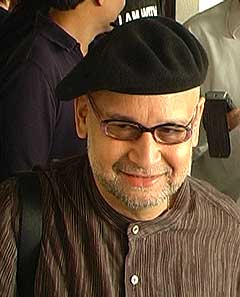 “There have been seven civil defamation suits between 2007 and 2008”. He added: “RPK is a familiar name that you would hear in these cases.”
Raja Petra Kamaruddin was charged for criminal defamation in July 2008. Recently there were investigations against Jed Yoong and Rocky Bru under the Sedition Act for comments against the Sultan of Perak.
As for the ISA, Nizam revealed that “RPK is the only blogger to have been detained under ISA”.
The Communication and Multimedia Act also provides for Internet service providers to block access to a website.
Nizam also said that bloggers, however, have rights under 10(1) of the Federal Constitution but it does not extend to matters of security of the Federation as stated in Article 10(2) and the rights are residual under Article 10(4).
In defence against defamation
Hence, Nizam elaborated that in defence of defamatory statements: “The statements must be true, privileged, qualified, and fair comment in the public interest. Naming of sites is alright but not URLs. Tags, keywords, categories, images pointing towards defamatory statements also amount to defamation.”
In the case of a criminal defamation, Nizam said: “Fact of truth is not enough. It must have civil interest.”
He also revealed that bloggers “can point to a mistake made by a ruler or errors and defects in the government and constitution to remedy errors and prevent ill will” under Section 3(2) of the Sedition Act.
On the usage of the ISA against bloggers, Nizam commented: “ISA wasn’t meant for civilians. Moderating the blog is the most sensible thing to do.”


Report this comment
Are you sure you want to delete this comment?
This action cannot be undone.