




Flogging a white elephant
Health Minister Liow Tiong Lai, has become entangled in a controversial bail-out involving federal funding for an unused private hospital in Sarawak.
Health Minister Liow Tiong Lai has become entangled in a controversial bail-out involving federal funding for an unused private hospital in Sarawak.
The cost of the rescue for the Sarawak International Medical Centre (SIMC), is predicted to be RM480 million, according to ministry sources.
The sum is minuscule compared to the RM12 billion cost over-run of the Port Klang Free Zone, an albatross around the neck of Liow’s fellow MCA minister Ong Tee Keat.
 However, Sarawak PKR information head See Chee How told
Malaysiakini
: “The projected sum for the SIMC is a huge amount to pay for a white-elephant hospital, plagued by endless delays in construction. Why did the Sarawak government make such an expensive mistake, that it must now appeal to the federal government to bail them out?”
However, Sarawak PKR information head See Chee How told
Malaysiakini
: “The projected sum for the SIMC is a huge amount to pay for a white-elephant hospital, plagued by endless delays in construction. Why did the Sarawak government make such an expensive mistake, that it must now appeal to the federal government to bail them out?”
The Sarawak government launched the SIMC in 1998, but construction did not begin in earnest until 2003. The state government established the Sarawak Specialist Hospital and Medical Centre Sdn Bhd (SSHMC) in 2001, to build the private hospital. Deputy Chief Minister George Chan was chairperson.
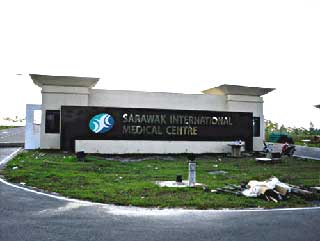 Industry estimates place the amount spent on the SIMC thus far to be between RM350 million and RM400 million. A Bank Negara posting on Jan 11, 2008 described the SSHMC bonds issues “raising net proceeds of approximately RM380 million”.
Sarawak Chief Minister Abdul Taib Mahmud said in his winding-up speech to the state assembly on June 23, 2004: “In the health sector, we are now focusing on the tertiary services through setting up SIMC which will position the state to become the centre of excellence for tertiary medical training and services as well as tapping the potential for health tourism.”
However, the “setting up” of the SIMC has never been completed. The work was dogged by protracted delays. The US-based Mayo Clinic performed the feasibility study and the Vamed Healthcare and Health Tourism Group from Austria was a partner.
But the foreign partners have declined to involve themselves in the running of the hospital. They have remained silent regarding their reasons for staying out.
Political rivals have made allegations of inflated costs and cronyism. The SIMC bid to attract health tourism has failed badly.
Throughout this period, Malaysia’s foray into health tourism has drawn sharp criticism. The Coalition Against Healthcare Privatisation, a group of NGOs, trade unions and political parties, says health tourism draws doctors, nurses and other healthcare professionals away from government service.
The coalition argues that the haemorrhage of professionals aggravates staff shortages in government hospitals and causes suffering to low-income and middle-income Malaysians.
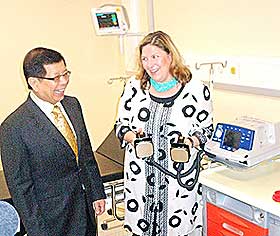 Chan
has claimed on several occasions that the building will be operational soon. During a tour of the SIMC with Austrian Health Minister Dr Andrea Kdolsky in November 2007, he promised the private hospital would be up and running in six months.
Chan
has claimed on several occasions that the building will be operational soon. During a tour of the SIMC with Austrian Health Minister Dr Andrea Kdolsky in November 2007, he promised the private hospital would be up and running in six months.
In the state assembly, on Nov 23, 2007, Chan attributed the slow progress to “inclement weather, shortage of critical construction materials, revision of design to meet new requirements under the Private Health Care Facilities and Services Act and delay on the part of the civil works contractor and sub-contractors”, but completion was “expected to be in the middle of 2008”.
Finally, on June 19, 2009, after a Sarawak Barisan Nasional meeting with Prime Minister Najib Abdul Razak, Chan announced that the Health Ministry would be asked to take over the troubled SIMC to reduce congestion at the Sarawak Hospital (SH), the main government hospital in Kuching.
“As a quick measure to overcome the overcrowding, we have asked the prime minister for the federal government to take over the SIMC,” Chan said. He claimed the health minister would discuss this in detail with the state government soon.
Reservations about the SIMC
The ministry appears to have strong reservations. DAP MP for Bandar Kuching, Chong Chien Jen, announced on June 20 that he had received a reply on June 17 from the ministry to a question he had asked in Parliament: whether the state government had asked the federal dovernment to take over the SIMC.
 Chong
(right)
quoted from the letter which said the SIMC, in its current form, is not suitable as a public hospital: “The federal government is still looking into problems and logistic aspects of SIMC - (for example) the centre is too far away from public places, the service it will offer is a duplicate of that of SH and there is a lack of human resources.
Chong
(right)
quoted from the letter which said the SIMC, in its current form, is not suitable as a public hospital: “The federal government is still looking into problems and logistic aspects of SIMC - (for example) the centre is too far away from public places, the service it will offer is a duplicate of that of SH and there is a lack of human resources.
“The new medical centre has individual and twin-sharing wards…it is more suitable to be a private hospital.”
Chong then argued: “It is absolutely unacceptable that the government has spent a few hundred million ringgit to build a hospital catering for the needs of the rich and not of the poor.”
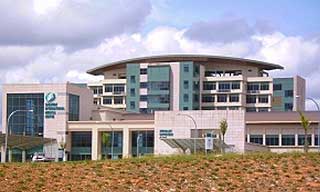 The SIMC was meant to be a small, luxurious, exclusive hospital, housing between 160 and 170 beds. The cost of construction per bed was approximately RM2 million. This was far in excess of the RM1 million per bed considered the standard cost for government hospitals in Malaysia.
Another concern is the location of the SIMC in Samarahan, 40 minutes’ drive from Kuching’s city centre, and from the SH. Public transport is primitive. Many poor patients already find it hard to pay for travel to the SH to seek treatment. They would be despondent if they were forced to commute to the SIMC.
The medical equipment in SIMC has also been left untouched for years. A senior administrator in the health ministry has pointed out that the Magnetic Resonance Imaging machine, the beds and the monitoring equipment, for example, have all aged and have become outdated.
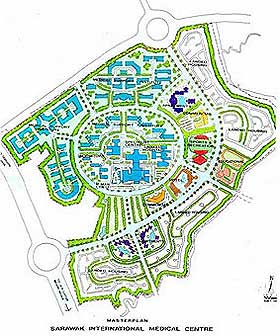 The official said, “Hospitals in Sarawak are already understaffed. New doctors and nurses for the SIMC will be hard to find. But we have already been instructed to look for staffing to take over the SIMC. We were told to comply because of the likelihood of state elections next year.”
Abdul Taib admitted publicly on May 31, 2008, that Sarawak is desperately short of doctors. He said there are no specialists’ posts for some divisional hospitals serving a vast catchment area, such as Sri Aman, Sarikei and Kapit.
Taib said the shortage of medical officers was even worse: only 510 of the 1,334 hospital posts are filled, while only 83 of the 373 health clinic posts are filled.
Calls for a large, well-staffed public hospital to be built in Kuching to complement the SH, instead of an expensive buy-out of the small SIMC in Samarahan, have gone unheeded. Many predict the bail-out will proceed.
Questions remain unanswered
The ministry has promised to buy the private Sabah Medical Centre (SMC) in Kota Kinabalu, to relocate services from the crumbling tower block of the ministry’s Queen Elizabeth Hospital (QEH). The SMC will cost a hefty RM280 million, with an additional RM90 million - the icing on the cake - for renovations.
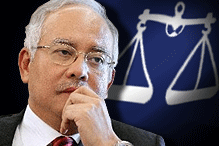 The SMC takeover was made public by Najib during his visit to Sabah in March. It is unlikely to be coincidental that Chan’s announcement on the proposed SIMC bail-out took place during Najib’s Sarawak visit last week.
Liow’s SMC purchase price of RM280 million, announced last month, was higher than Najib’s estimate of RM245 million, put forward in March. Neither minister has offered any explanation for the large discrepancy in their estimates.
The ministers have not elaborated, either, why the QEH tower block, built in 1981 with public money, is collapsing. They have not explained why some RM400 million of public money has been wasted on the SIMC debacle.
The cabinet must have some answers to the questions raised, including why colossal amounts of money have been squandered, in two of the poorest Malaysian states - while patients, and standards of public health care, remain poor.
KERUAH USIT is a human rights activist - anak Sarawak, bangsa Malaysia. His ‘The Antidote' column, which appears in Malaysiakini every Wednesday, is an attempt to allow the voices of marginalised people to be heard all over Malaysia. The writer can be contacted at keruah_usit@yahoo.com


Are you sure you want to delete this comment?
This action cannot be undone.