




'Five reasons to stop sex tape probe'
A day after attending the MCA disciplinary board hearing on his sex tape scandal, Dr Chua Soi Lek made public his submissions to the board, listing five main reasons to dismiss the probe.
A day after attending the MCA disciplinary board hearing on his sex tape scandal, Dr Chua Soi Lek made public his submissions to the board - listing five main reasons why the probe should be dismissed.
In the lastest posting in his blog yesterday, the embattled MCA deputy president revealed that his lawyer had written three letters to the disciplinary board in the last week of July.
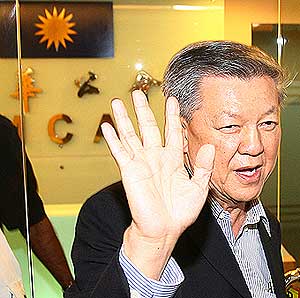 The case against him pertains to a DVD which portrays Chua having sex with an unknown woman, widely distributed in January 2008.
The charge is that the scandal has tarnished the party's image.
Chua ( left) summarised those letters and gave five main grounds, explaining why the complaint againt him should be dismissed.
1 The complainant Eng Cheng Guan had withdrawn his complaint against him and did not attend the hearing. This had denied Chua's right to question his accuser.
Due to the absence of a complainant, the disciplinary board is acting as both judge and prosecution, which is against the party constitution which requires the board to deliberate and consider all complaints in an independent, impartial and unbiased manner.
Complainant had no 'locus standi'
"How can the disciplinary board do so in this instance if it is both prosecutor and judge in the matter?" asked Chua.
"...it would overstep the bounds stated in the constitution of the MCA and act unconstitutionally, illegally and wrongly."
2 According to the MCA constitution, Eng has no locus standi to lodge a complaint against Chua as he is from a different division (Simpang Renggam) from Chua's (Batu Pahat).
3 Chua would be penalised twice if the complaint is heard again.
Chua said he had resigned from all government and MCA posts when the tape surfaced in January 2008, and the resignation was accepted by both the government and MCA.
When he constested the party deputy president's post in October 2008, none including Eng questioned his candidacy and eventually he made it as the number two in the party.
"This conduct of the MCA, its disciplinary board and the complainant all leads to one irresistible conclusion: That the complaint had been dealt with and is over."
MCA members vindicated me
"It is clear to all, in any event, that the General Assembly (and the members of the MCA) have vindicated the respondent (Chua)," he stressed.
4 The party constitution requires that a written complaint must be 'initiated and referred' by the party presidential council to be heard by the disciplinary board.
Chua further questioned whether the presidential council could "take over a complaint that has been made and then withdrawn" by "a member who had no standing to initiate the complaint".
5 Eng's complaint alleged that Chua had breached the 'Code of conduct for MCA members' which is not recognised or referred by the party constitution.
"Since the disciplinary function and powers of the disciplinary board are based on articles 123 and 124 of the constitution of the MCA, and not from the ‘Code of conduct for MCA members' these entire proceedings are, with respect, a non-starter," said Chua.
"The code is the legacy of former president Ong Ka Ting. However, he did not amend the party constitution to include the code.
"The reasons outlined here are all good reasons for dismissing the complaint," said Chua.


