




The Umno dilemma
History is an unpredictable beast that moves and twists in time in very strange ways. The evolution of collective human affairs, unlike events in the natural physical world, does not seem to be governed by any fixed law of nature.
History is an unpredictable beast that moves and twists in time in very strange ways. The evolution of collective human affairs, unlike events in the natural physical world, does not seem to be governed by any fixed law of nature.
What is predictable is that those in the ruling class in any totalitarian society would dream of their rule lasting 10,000 years. The dynastic empires in China dreamed of that, and so did the Nazis in Germany. Fortunately for mankind, both those dreams were shattered by historical forces beyond the control of empire builders.
Part of the reason for this is that in any society, subtle subterranean currents of political change go on undetected because of equally subtle socio-economic and cultural change that shifts the power-relation within the body politics.
Great political leaders will want to manage that change according to their vision of what is good of the country one way or another. Barack Obama is one such leader. He did not make that change happen; he seized that opportunity at a critical moment in American history and became a catalyst for national change.
 Malaysia too reached such a critical stage without our knowing it beforehand. For some strange reasons best left to political scientists, many Malaysians agitated for new ways of political decision making in the silent privacy of their skulls, despite the usual deluge of spin in the mainstream media.
Then, in the general election last year, voters decided spontaneously to discard their long-held assumptions about politics and voted across racial and religious lines. The opposition coalition was there as a viable alternative, and the voters instinctively seized that opportunity en masse to create history, as if they had a consensus beforehand!
It is easy to be wise after the event. After the March 8 political tsunami, many leaders in BN component parties made open calls for their reform, and warned of the perils of drowning in the sea of change if they failed to do so. A year and four months later, they are mostly wallowing in the mud of internal power struggle.
The Taiwanese example
Not many authoritarian ruling regimes can reform themselves. One such exception is the Chinese Nationalist Party of Taiwan, the Kuomintang KMT.
Taiwan politics is always complex, chaotic, and parochial. Simply put, the KMT enjoyed uncontested authoritarian rule from 1949 onwards under the iron fist of their strongman Chiang Kai Shek, a relic of the old China warlordism. His rule was oppressive, heavy handed, and bloody.
Then the KMT went through a series of reforms under Presidents Chiang Ching Kuo and Lee Teng Hui, allowing more democratic practices and opening up public spaces. Taiwan became one of the four Asian Tigers in the 1980s, and the voters there had their political expectations raised beyond measure.
In the presidential election in 2000, the KMT lost to the People’s Progressive Party (PPP) candidate Chen Shui Bian.
Much happened in the KMT during this period. The long and short of it is that Ma Ying-jeou – the popular mayor of Taipei, became the first elected president of KMT in the party’s 93 year history in 2005.
Ma defeated the PPP candidate in 2008, and became the new Taiwan President, thereby regaining KMT glory in the island republic. I followed that election closely, and watched Ma speaking the language of change, democracy, accountability, and good governance, that kind of narrative undreamed of by old KMT campaigners and that which would turn Chiang Kai Shek in his grave.
What happened in Taiwan cannot be duplicated in Malaysia or anywhere else in the world. Every nation-state has to find its own way to its destiny.
The Malaysian case
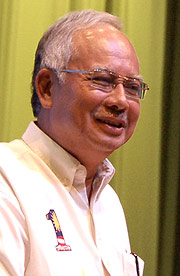 In the case of Malaysia, BN top leaders too detected the change of mood among Malaysians these days. The new Prime Minister Najib Abdul Rajak knew too that he had to manage this change to his advantage, and there must be a new political narrative to win back the middle ground.
After all, the newly formed Pakatan Rakyat has offered the national electorate an inclusive narrative of Ketuanan Rakyat as an alternative to Umno’s Ketuanan Melayu.
They have demonstrated that political agenda in the four or five states they control, more or less, providing a show case for all to see, especially for those voters in states still under BN rule! Everybody’s eyes are cast on 2013.
Najib immediately announced plans for Umno's reform. The top party leadership was to be elected directly by the grass-root members in future, to eradicate money politics during party election, a measure that was first mooted by Ku Li.
He then proposed a series of “liberalisations”, and created the new old 1Malaysia slogan. Sloganeering is part and parcel of Malaysian politics, and gullible middle-ground Malaysians with a tendency for wishful-thinking are particularly susceptible to it.
For a while, it looked like the new Najib administration did have a fresh new mask to change the public perception of Umno.
Usually, when the Umno and BN boss come ups up with a new slogan, you hear it being echoed ad infinitum down the line by leaders at various levels like loyal parrots. This time though, the various proposals by the new PM were welcome by a deafening silence from his own people. The only voice was the stinging remark by the former PM Dr Mahathir Mohaham, reiterating Umno's communal ideology, as if to rebuke Najib's 1Malaysia policy.
This is significant. Utusan Malaysia , the bastion of Umno propaganda machinery and official organ of Umno ideology, was seen soon after to make every political issue into racial one, from Teoh Beng Hock’s death, to the anti-ISA mass rally on Aug 8.
They had quoted Muhyiddin Yassin as calling Anwar Ibrahim a traitor to the Malay race. Comments on the Utusan have also described PAS as a tool of the DAP to divide and rule the Malays. In an attempt to play reverse psychology, Malays were called “cowards’ for not standing up to defend the rights of the race.
Many commentators are immediately alarmed. They fear that this tactic of race baiting would raise the temperature of race relations by several notches. The knee jerk reaction of many non-Malays is fear for the worst.
Too many warlords
I harbour no such fears, but see opportunity in the recent racial outburst emitting from the bowels of Utusan.
They see the various races as monolithic entities going at one another’s throat. Apparently, they are stuck in the time capsule of the 1960s. In reality, there are no such monolithic racial entities. The social economic changes in the country in the past decades have allowed the various ethnic entities to evolve into very complex, diverse, and multi-layered organisms.
I looked at dramatic images of the mostly Malay police force beating down on the mostly Malay anti-ISA protestors, and I see the deep wound inflicted by Umno on the Malay soul. Such a scene was unthinkable mere decades ago!
In short, political propaganda must fit some of the reality of lived experience. The chief worry of the Malay men and women, especially those in the urban centres of Malaysia, is the task of keeping or seeking a good job, rising price hikes in all things necessary for basic daily living, avoiding criminals, and the children’s education. In this struggle for survival, many see the government as the culprit of their sufferings, and not the Chinese or the Indians, who suffer alongside them.
But the racial tirade is also revealing. It shows the inability of Umno to create a new narrative to meet the changing reality of Malaysia. When provoked into action, their reflex reaction is to revert back to the tired, archaic, irrelevant, fossilised and outdated, discourse of their past.
In effect, their racial discourse can only please the believers, but will do nothing to win over converts from the non-believers. It will alienate the Chinese and the Indians even more, thereby negating all BN effort to win back the middle ground.
It all goes to show how hard it is for an old political party that is used to enjoying political hegemony to reform itself when it is on the decline. Simply put, Umno is full of too many warlords with too much political baggage and too much vested interests. It has become like a dinosaur with a small head and a huge body, that finds it simply too sluggish to move anywhere, metaphorically.
That is where I see the opportunity. The political dinosaur’s small brain cannot see beyond the next general election and the next negotiated contract. If only the people and the opposition politician can seize upon the opportunity, and avoid the pitfall of too much politicking, but instead work hard in articulating their new inclusive narrative, they can make the political dinosaur extinct in the foreseeable future.
SIM KWANG YANG can be reached at kenyalang578@hotmail.com.


Report this comment
Are you sure you want to delete this comment?
This action cannot be undone.