




100 days of thunder for Penang's Mansor
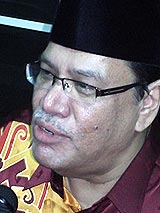
Penang's DCM 1, Mansor Othman, has been in the seat for the last 100 days. He speaks to Malaysiakini about the trying times and challenges.
It has been 100 days since former academician-turned-politician and PKR state deputy leader, 59-year-old Mansor Othman was sworn in as Penang Deputy Chief Minister 1.
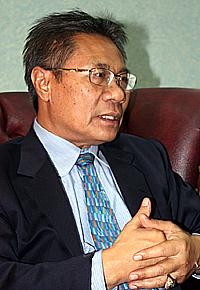 He
won
an electoral battle in Penang when he took the Penanti state seat in a by-election in May this year.
He
won
an electoral battle in Penang when he took the Penanti state seat in a by-election in May this year.
After previously losing in three successive general elections in Penang - Balik Pulau parliamentary contest (1999), and state battles in Seberang Jaya (2004) and Pulau Betong (2008), he finally won the by-election on May 31.
The seat fell vacant when its incumbent representative, former DCM1 Mohammad Fairus Khairuddin, resigned on April 16.
Mansor, 59, secured 6,052 votes against Nai Khan Ari (494), Aminah Abdullah (392) and Kamarul Ramizu Idris (56) to score a comfortable 5,558-vote majority over three independent candidates.
Mansor, a former associate professor at Universiti Sains Malaysia, was handpicked by the PKR supremo, Anwar Ibrahim, to be the perfect partner to Chief Minister Lim Guan Eng, in implementing social programmes for lower-income groups, especially in rural areas.
He holds the portfolios of international trade and industry, cooperative and community relations as well.
He was also tasked to improve PKR's performance in the DAP-dominated Pakatan Rakyat state government, largely to make up for the disappointment with Mohammed Fairus, who came under heavy criticisms for allegedly underperforming.
But Mansor also needed to earn the respect of current Pakatan state executive councillors especially from the DAP and his own party - Abdul Malik Kassim and Law Choo Kiang.
He earned a Masters degree in social science from USM, and a Masters in Arts and a Masters in Philosophy from Yale University.
Mansor, the PKR Balik Pulau division chief, is married to housewife Aishah Zainul, 58, and has three sons - Mohd Fadzli, 28, Mohd Ashraf, 19 and Mohd Afnan, 18.
He was the founding chairperson of Penang PKR from 1998 until 2006.
He has served in PKR's supreme council for 10 years and is currently the party national election machinery deputy director.
PKR chose Mansor for the coveted hot seat because the party needed a capable leader to work closely with Lim and contribute efficiently to the state administration.
Malaysiakini spoke to Mansor on his tasks, challenges and future plans after assuming the DCM 1 position after 100 days.
Malaysiakini: After winning the Penanti state seat last May, you were appointed deputy chief minister 1. It's like an ‘express' promotion in your political career. What are your thoughts about your new responsibilities in the state?
Mansor : It's not really an express promotion. I was the PKR state founder chairperson and served in that capacity from 1998 until 2006. The other pioneer leaders and I built the party from scratch when there was not even a single branch. Those who joined the party later are actually enjoying the benefits of our hard work. So I felt I was being duly rewarded for the hard work I put in for the party's growth.
You were appointed DCM1 to replace Mohd Fairus Khairuddin because the party wanted a stronger PKR leadership in the Penang Pakatan Rakyat government. Do you relish this challenge?
It's a tough challenge. Public perception is that DAP has successfully filled in the void left by MCA and Gerakan while PKR has yet to fully replace Umno in the state government. This is the main reason behind the party changing guards to correct the perception.
What have you done so far to correct the public perception?
I have started to empower the grassroots through the village security and development committees (JKKKs). I have given basic training to the 109 JKKKs in the state that will help them build their knowledge in setting up and running a cooperative society.
So far, nine JKKKS have set up cooperative societies. By next March, I am targeting some 50 JKKKs to form the cooperative societies. Eventually I want to amalgamate them under a single consortium of cooperative societies.
This is to empower the grassroots with knowledge and economic activities to make them more vibrant, resilient and dynamic under a multi racial concept.
My second programme is to introduce a micro credit programme for the small traders. The state government has started it for the hardcore poor group for amounts below RM5,000 through the Penang Development Corporation.
But I would also want to start a micro credit programme for amounts ranging between RM5,000 and RM10,000 for small traders.
I am holding negotiations with several banks and hope to finalise and implement the programme soon.
 Thirdly, I am overseeing many outstanding land issues left by my predecessor such as the recent Kampung Buah Pala and the double-track railway issues.
Other pending issues are Mengkuang Dam, Kampung Pisang Awak, Kampung Melayu Tanjung Tokong and Sungai Nibong.
All these are land issues just waiting to explode. So these issues must be resolved fast. They are taking a lot of my time.
I am also working out on a public housing scheme for the lower income groups earning less than RM1,500. I am looking to have maybe 10000 units available for all communities in each of the state's five districts.
During emergency relief exercises in event of disasters like flood and fire, we need to relocate the people into transit houses.
The purpose of a public housing scheme must meet this objective too. It can be operated either for rental or rent-to-buy basis.
On international trade and industry portfolio, I have set up a committee with InvestPenang as its secretariat. I am working closely with Malaysian Investment Development Authority (MIDA) and various business chambers to accumulate information and feedback.
I have visited Singapore and now plan to visit Taiwan to woo investors. I am looking into foreign investments in all areas such as manufacturing, education, medical, eco-tourism, information technology and public transport.
The state government has recently received a proposal from a domestic company to introduce Light Rail Transit (LRT). We are impressed by the company's layout plan. But we will open up the project for tender. We are seriously looking into the proposal.
Another company has also proposed to set up a fun theme park in Teluk Bahang.
We also plan to upgrade the Penang International Sports Arena (PISA) into an international trade centre.
What about having local government elections in Penang?
The state government is working on holding local government elections. We have already passed a resolution at the state legislative assembly calling on the federal government to make way for local government elections.
But to hold elections at lower levels like in JKKKs, JKKKPs, Rukun Tetanggas (RTs - neighbourhood watch groups) and residents associations (RAs) would be difficult.
RTs, RAs and JKKKPs are all under the federal government. For JKKKs, it would not be advisable to hold elections because it might deprive certain groups the chance to be represented in the decision making process due to popularity-based electoral politics.
I would prefer appointments for these committees by consensus through discussions with elected representatives and local leaders. We need to empower the grassroots on decision-making.
Elections may exclude some of them. This will not be proportionate representatives for the people. Only those elected would attend meetings. For instance, by electing members to qariahs (mosque committees) only some 200 would take part in the decision making process.
Is this representation reflective of some 2,000 people involved in the mosque?
When there is no problem, why create a problem? Sometimes elections may not be solutions for all problems. However, we need local government elections because councils are different. There are justifications for it.
Before the Penanti by-election, you said you wanted to become a Malay leader for all, not just for the Malays. What are the programmes you have carried out so far to realise your vision?
Well, I have set up multi-racial based cooperative societies under the JKKKs. Now I plan to have public housing for all communities, not just for one particular community. During the Hari Raya, I handed out Ramadhan goodies not just for needy Muslims, but also to Chinese, Indians and even the Siamese communities in my constituency.
Immediately after you became the DCM1, you faced two major political challenges. One was the PKR's municipal councillor Johari Kassim controversy and the other was the Kampung Buah Pala crisis. What were the roles you played to resolve the problems?
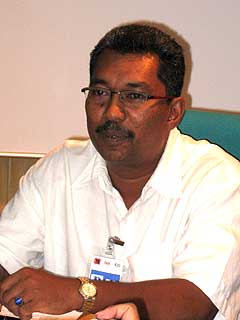 Johari
(right)
brought up an issue that the
party agreed
on and supported strongly.
Johari
(right)
brought up an issue that the
party agreed
on and supported strongly.
My role was to bridge the party with the state administration. We managed to resolve it. My policy was engaging rather than confrontational.
Do you think the state administration could have handled Johari's case differently?
I think we have resolved and buried the issue. It's in the past now. Let's not delve too much into it. (Laughter)
You made the announcement on the appointment of Mokhtar Mohd Jait, a civil servant, as Seberang Perai Municipal Council (MPSP) president on the same day you were sworn in as DCM1. It was against your party's stand for political appointments to be made to that position. Do you think you were tricked into announcing it?
Nothing wrong in making an announcement. The party was unhappy with the state government's decision to appoint a civil servant. The controversy was caused by miscommunication and misunderstanding between PKR and DAP.
When Pakatan Rakyat formed the state government last year, I was offered by the PKR leadership to take up the post of either the MPSP president or the state legislative speaker. But the party thought I could perform and contribute more to the government by being the MPSP president.
But when I became DCM1, I learnt that this party plan was never communicated to the state government and DAP. There was a communication breakdown. The DAP claims that the party never gave any assurance on the political appointment but PKR claims there was an understanding forged on the issue.
As a result of the miscommunication, a misunderstanding occurred. Now we will again raise this subject at the state Pakatan council level and find an amicable solution.
Do you agree with the sacking of Johari from MPSP by the state administration?
The provision is available for the administration and Chief Minister to sack Johari as MPSP councillor. The chief minister has the power to sack him.
How is the working relationship between PKR and DAP in the state government?
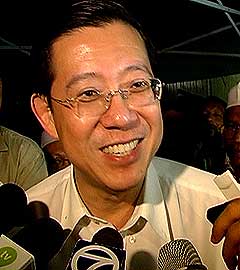 Well, my relationship with the Chief Minister Lim Guan Eng
(left)
is good. Both of us are professionals. We have strong professional ties.
Well, my relationship with the Chief Minister Lim Guan Eng
(left)
is good. Both of us are professionals. We have strong professional ties.
I like engagement. I can talk to him on any issues and vice-versa. This is party politics. So far we have managed it quite right. But there is still room for improvement such as on policy discussions, the decision making process, participation and engagement in the Pakatan coalition government's policies and party to party relationships and meetings. We shall organise more joint Pakatan functions. Perhaps we should organise the long overdue Pakatan election victory celebrations in Penang attended by the coalition national leaders. State Pakatan councils should hold more meetings and be given more opportunities to take part in the state government's decision-making process to provide input, information, ideas and feedbacks.
Has the Johari episode damaged the PKR - DAP relationship?
This sort of political issue will happen now and then in party politics. It's inevitable and we cannot sweep the issue under the carpet. We have got to address and resolve it. We cannot let the issue to affect inter-party relationships and coalition unity. We shall bury it fast.
What about the Kampung Buah Pala issue?
This village issue was a leftover from the previous government. When I joined the state government, the residents approached me and requested for my help to end their predicament.
We set up a committee to resolve the problem. Right from the beginning, I was pushing for a good and amicable settlement on the issue. Finally, we managed to broker a deal with the developer to build double-storey houses on the same site as requested by the residents.
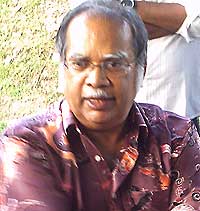 P Ramasamy (DCM2)
(right)
and I worked with the developer to provide the residents landed properties as compensation. Many accepted the offer and I expect the remaining to take it up soon.
P Ramasamy (DCM2)
(right)
and I worked with the developer to provide the residents landed properties as compensation. Many accepted the offer and I expect the remaining to take it up soon.
Under the circumstance, we managed to broker a good deal . I don't understand why some hardcore residents are still refusing the offer. We couldn't preserve the village as wanted by the residents because it would need a larger acreage which the developer and landowner were not prepared to give.
You formed a task force to probe into the alleged Kampung Buah Pala fraudulent land deal? Can you reveal its findings?
My stand from the start was to find an amicable solution to the issue, not to delve into the past and find faults with the previous administration. It will not resolve the issue. We, of course, lodged a report at the Malaysian Anti-Corruption Commission (MACC) and police. But that's the way it is . . .
Are you saying that all those reports lodged were mere ‘wayang kulit'?
Well sometimes the government has to do certain things to please and impress the public in order to do damage control on negative publicity and perception.
Kampung Buah Pala was demolished while people were still living in their homes. This was unprecedented. Why did the state government allow this to happen?
Well one must also appreciate that the double-storey house offer was also unprecedented. Never before any affected residents were compensated with such a lucrative offer. In certain cases I am handling now, the compensation offers are only for RM40,000 and RM70,000 houses in Sungai Nibong, a prime land.
The offer to Kampung Buah Pala residents was unprecedented. On the demolition, we told the residents that we cannot stop the land owner and developer from demolishing the houses because they have the Federal Court order. We only can deny approval to the development plan. Other than that, our hands were tied.
Anyway, we tried to stop the demolition. That's why the demolition exercise was postponed a few times. We could not obtain a court injunction to stop the demolition because of the Federal Court order.
We tried our best to stop the demolition . But Kampung Buah Pala eventually had to go.
What is the state government's plan for the Tanjung Tokong Malay village issue?
We are formulating an acceptable solution for all parties on the issue. We are setting up a special task force to look into the problem. The villagers have seen me and the Chief Minister as well.
The state government is now working to hatch an amicable solution to the issue. The problem is some villagers demand heritage preservation while some don't.
 Similar to the Kampung Buah Pala issue. Some villagers also went to the prime minister. They were seeing everybody. So we don't know what they actually wanted.
If they wanted us to help them, they should discuss this with us and not go round and round in circles. The villagers have to be a single united voice for their collective demand.
They must be united and come to see us as one entity group. Only then, can the state government work out a plan to help them. Anyway, we will not wash our hands. We will still help them to resolve the issue even if they were seeking help from the federal government.
After all, they must know that land matters come under the state government's purview.
Public perception is that DAP dominates the state government. What's your view on such a perception?
Well the DAP has won more seats, 19 altogether against PKR's eight. So obviously the DAP state representatives looked stronger and noisier than us. But even though DAP has 19 seats, the party cannot rule on its own. It still needs PKR's support.
It's still a Pakatan government (laughter). PKR needs to win more seats to have more political clout and strength. PKR needs more seats from Umno in the next election. Only then, can we clinch a better deal in fresh rounds of negotiations the next time.
That said, we are still playing an effective and decisive role in the current state government setup even with only eight seats. The state government has and will continue to implement programmes across racial, religious and party lines to eliminate public perception on the so-called DAP's dominance.
For instance, the state government has carried out programmes for religious schools, including providing a RM2.5 million fund. Despite public perception on DAP's dominance, evidence exists to the contrary.
PKR also lacks media publicity on its state government activities. Perhaps we should look into it. We have done a lot for the people, but we lacked media attention.
Do you think the state government needs to unveil a blueprint on Penang's future development?
We have outlined certain principles to guide the state government in development policies. The state government's main principles are pro-growth, pro-jobs and pro-poor. These principles guide our socio-economic policies.
These principles were behind the state government's austerity drive to cut costs like directing executive councillors not to travel in first class and stay in budget hotels.
Our austerity drive was so effective that we managed to save RM20 million that we could give back to the people. The savings would fund the state government's RM13 million senior citizen programme, in which each senior citizen above 60 would receive RM100 in cash gifts from March next year.
Each family will receive RM1,000 upon the death of a senior citizen. We are also formulating a comprehensive policy now to resolve the squatter issue. We should be able implement it by next year. Of course Kampung Buah Pala has taught us a lesson on the need to have a standard policy to handle, address and resolve such issues.
What do you mean by pro-growth?
Basically, to create economic growth in the state and to re-distribute the earnings back to the people.
Without growth we can't do that. There must be more commercial activities and projects, including physical projects such as transportation, property development, agricultural and human development. More funds and factories should come in to create more jobs.
Are you satisfied with the state government's performance so far?
The record shows that we are doing well. Even the recent Transparency International report commended our performance.
It's a boost to the state government. Of course there is still room for improvement. Firstly, we must promptly respond to the people.
We must act fast and address any issue before it gets out of hand. We must be responsive to people's call and needs. For instance, in land application, we should be able to process the application fast.
The processing time must be short. Whether we approve or reject an application, we should do it fast. When rejecting, we must also give acceptable reasons to the applicant.
We must respond fast to the business communities and international investors as well. We must strive on efficiency. We must also be transparent. We have to act and respond fast to enable the public to know the results, for instance, within a week.
Does the state government allocate constituency funds for Pakatan state representatives?
Each Pakatan state representative gets an annual RM200,000 constituency allocation. But the allocation to each state representative is not enough.
We don't provide the funds for parliamentarians and Barisan Nasional state representatives. The federal government allots each BN elected representative between RM500,000 and RM1 million yearly.
That's the reason why the BN representative can travel and provide funds everywhere, even in my constituency.
Many journalists feel that certain state government leaders are over sensitive and touchy when there are media reports putting them in bad light and when criticisms are levelled at them. What is your take on this perception?
Well, I think that's more of a personal standing, not a collective state government policy. In today's politics, the media and professional journalists are powerful tools.
They make and unmake, and shape the world's politics. So politicians would see journalists as either enemies or friends. Not just in Malaysia, but also in America. Remember what happened to former American president Richard Nixon?
What do you think about the sudden surge in Barisan Nasional politicians joining Pakatan Rakyat? Some Pakatan local leaders have voiced reservations about this trend.
When people have decided to leave BN and join Pakatan, they have actually abandoned their previous political culture or don't believe any longer in their former parties' struggle.
Many people only point to those who have left Umno. But they don't talk about those who left the MIC, MCA and Gerakan.
What political culture are they are talking about? I don't think these people can come in and enforce their Umno or other previous party culture in Pakatan. It simply can't work that way. We are here to bring about change. So we too must change to accept these people.
We have moved away from the old politics. To stop others from coming in, it's a bit arrogant.
Perhaps these people are afraid of others coming in. Some division leaders fear losing their places. If one were to do their job, they need not worry about others.
How helpful have the two PKR executive councillors in the state government, been to you?
I have been their leaders prior to this by virtue of being the state party chairperson.
That made a big difference. They have already accepted me as their leader before I joined the state government. Secondly, the party leadership picked me to lead the state government.
 Finally, I think I am
credible
enough to earn their respect and derive their cooperation. I am getting full support from the excos and my party as well.
Finally, I think I am
credible
enough to earn their respect and derive their cooperation. I am getting full support from the excos and my party as well.
I am doing the job as DCM1 while PKR state chairperson Zahrain Md Hashim (right) is doing his political work for the party. Differences of opinions and views will always exist. But that does not mean we are having conflicts or disputes.
It's also unnecessary for me to take over the state party leadership. Not being the state chief does not stop me from carrying out my work as DCM1.


Are you sure you want to delete this comment?
This action cannot be undone.