




Fury over 'disowned bumiputeras' in Sarawak
Marina Undau, a talented 18-year-old Sarawakian, has been on a sickening roller-coaster ride of emotions.
On Oct 29, she was denied access to a university matriculation course, despite being a top student, because the federal government had classified her as a non-bumiputera.
Marina Undau, a talented 18-year-old Sarawakian, has been on a sickening roller-coaster ride of emotions.
On Oct 29, she was denied access to a university matriculation course, despite being a top student, because the federal government had classified her as a non-bumiputera.
A faceless committee deep in the bowels of the Ministry of Higher Education had decided Marina (whose father is Iban) did not warrant bumiputera privileges because her mother is Chinese.
Sarawakians of all ethnic origins voiced outrage at Marina's ordeal. The Federal government refused to recognise Marina, and other Sarawakians of similar mixed parentage, as bumiputera.
Those left in bureaucratic limbo include children of marriages between Dayaks or Malays to Chinese or Indians, for example.
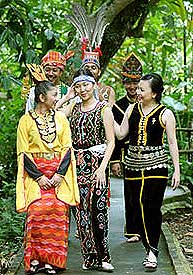 Mixed marriages are common in Sarawak and ethnic relations among Sarawakians are far more easy-going than elsewhere in Malaysia.
Then, on Nov 15, the Federal Cabinet hurriedly wheeled out an 'administrative ruling' to bestow bumiputera status on Marina, after the furore.
Marina now awaits news whether the federal government will allow her into a matriculation programme, or if the state government will sponsor her place in some other institution of higher learning.
The Cabinet ruling has demonstrated the arbitrary nature of bumiputera status. The term bumiputera, and the myriad privileges associated with it, were created after the New Economic Policy (NEP) came into force in 1970.
These privileges were purportedly aimed at reducing the socio-economic disparities between Malays and non-Malays in Peninsular Malaysia.
Dayaks in Sarawak and Kadazans, Dusuns, Muruts and other natives in Sabah have been accorded a small measure of these privileges too, as they are recognised as 'natives' under the constitution.
Yet even here, confusion reigns. Under the constitution, in Sabah or Peninsular Malaysia, any Malaysian citizen who has one native parent, is a native. In Sarawak, both parents must be natives, before their offspring qualifies as a native.
The reason for this discrepancy is far from clear. It may have been an oversight among those who drew up the constitution.
'Bumiputra' not mentioned in constitution
Angry Sarawakians have called for a constitutional amendment, so that native, and presumably bumiputera, status is made standard throughout the country.
However, it remains to be seen whether such an amendment will be high on the list of legislators' priorities, after the media circus dies down.
It is notable that 'bumiputera' is a political and administrative term, created by the NEP, and was never mentioned in the constitution. Therefore, the Cabinet can argue it is free to designate any Malaysian it chooses as bumiputera, according to its whim.
Sabahans and Sarawakians often complain that they are treated as 'second-class bumiputeras' and are not allowed the same access to bumiputera quotas in business, education and the civil service as Muslim Malays in Peninsular Malaysia.
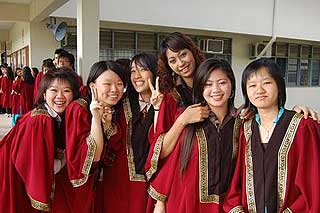 Many Sabahan and Sarawakian natives eke out a living as cheap labour, working as construction workers, cleaners and waitresses, in Peninsular Malaysia, because of the lack of economic opportunities at home.
It is inevitable that these underprivileged natives resent the fabulous wealth of the Peninsular Malaysian bumiputera elite.
Most Sarawakian and Sabahan natives earn wages in Peninsular Malaysia similar to undocumented immigrants from Indonesia and Bangladesh.
Marina studied at SMK Simanggang, a humble rural school, but still achieved nine A's and one B in her Sijil Pelajaran Malaysia (SPM) examinations last year.
Other high-achieving Sarawakians have faced similar obstacles. Daniel Ibau, born to a Kayan father and Chinese mother, and Awang Adrian Awang Salleh, born to a Malay father and Chinese mother, both obtained 10 A's in last year's SPM, but were refused entry to matriculation courses.
Many other Sarawakian students of mixed parentage have been denied bumiputera status in the past, but have never stepped forward to complain.
Marina, Daniel and Awang Adrian and their families have been brave enough to make their plight known to the public, in the hope that justice will be done.
The Cabinet has not clarified the bumiputera status of other students of mixed parentage besides Marina.
Controversy prods government reply
The changing political scenario in Sarawak, driven by information and debate on the internet, and by the new prospect of a Pakatan Rakyat alternative, is likely to have contributed to the increased public awareness of these Sarawakians' difficulties.
The resulting widespread publicity may then have prompted the response by state and federal governments in recognising Marina Undau as bumiputera.
In one of his first public statements after taking over the helm of Sarawak PKR, lawyer Baru Bian offered on Nov 1 to help Marina and her family sue the government over what he called its 'arbitrary and unjust' rejection of Marina's application for university entrance.
He said children from Sarawakian families with low incomes should not be deprived of education, since Sarawak enjoyed abundant natural resources. He voiced his party's support for free education for Sarawakian children up to tertiary level.
"What is the meaning of 1Malaysia if things like this happen?" he asked, quoting Marina's father, Undau Liap.
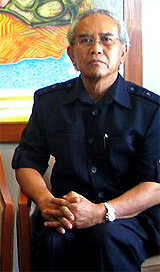 "We must all ask this same question, regardless of our ethnic origin," he urged. "All children, whatever their ethnic origins, are our children. Their education is of paramount concern to us, for their future as well as that of our country."
In an intriguing development, government figures such as Joseph Salang, deputy Federal Minister for Energy, Green Technology and Water, and Sarawak's deputy Chief Minister Alfred Jabu ( right) announced that they had written to the Federal government regarding Marina's predicament, after Baru Bian's public show of support for Marina.
Sarawakian politicians in government claim they support Sarawakians' rights, and contrast themselves with the PKR and DAP, which they label as 'Peninsular Malaysia-based' parties.
The Sarawak government, however, has been noticeably reticent on this issue.
They refrained from making public comments on Marina's plight when other Sarawakians were expressing their anger publicly, until Baru Bian's statement.
It may not be mere coincidence that government figures only spoke out in public after Baru Bian, the first Dayak leader of PKR in Sarawak, made the headlines with his offer to help Marina.
It is equally telling, though, that none of Sarawak's politicians, government or opposition, ventured to question the effectiveness and relevance of bumiputera status.
Despite 46 years of bumiputera status for the majority natives of Sarawakians and Sabahans, they remain among the most deprived and least educated people in Malaysia.


Are you sure you want to delete this comment?
This action cannot be undone.