




GST bill accords 'obnoxious' power to finance minister
The Goods and Services Tax (GST) Bill is set to spark more controversy in Parliament when sessions resume in March, especially over the finance minister's power in deciding the rate of the new tax.
 The 180-page bill, which was
tabled for its first reading
at Dewan Rakyat earlier this month, stipulates the powers of the finance minister in section 10 (2)(a).
The 180-page bill, which was
tabled for its first reading
at Dewan Rakyat earlier this month, stipulates the powers of the finance minister in section 10 (2)(a).
"The minister may, by order published in the gazette, fix the rate of tax to be charged on the supply of goods or services or on the importation of goods," said the bill.
In addition, under Section 10 (2)(b), the minister has the powers to "vary or amend the rate of tax".
This provision however applies after the new tax is passed in the Dewan Rakyat, where ruling coalition Barisan Nasional holds the majority.
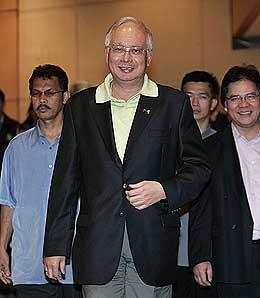 Kuala Selangor parliamentarian Dzulkefly Ahmad considered it "obnoxious" to give the finance minister, who incidentally is the prime minister, such extensive powers.
"Although the government intends to introduce GST at four percent, the minister still has the power to fix or change (it) whenever he sees fit."
The PAS politician cited Singapore as an example where the GST was introduced at three percent in 1994, but this has since increased to the current level of seven percent.
Checks on finance minister
Meanwhile, stockbroking firm OUB-Kay Hian head of research Vincent Khoo said certain controls over the finance minister's powers to "fix, vary or amend" the GST rate should be put in place.
"There should be some regulation that would (prevent) him (from raising) the rate too much," he said when contacted.
According to him, it was a bit "odd" that the minister will be given such blanket powers.
However, Khoo defended the government's move to impose GST and dismissed criticisms that the new tax will punish the poor. He said the GST could be implemented in a way that would not hurt the less well-off.
"For instance, basic items are already exempted from GST. Also, funds collected from GST can be channeled to specific programmes to help the poor," he said.
The government said it would be introducing GST at four percent beginning 2010 to replace the existing sales and services tax.
Finance Minister II Ahmad Husni Hanadzlah said that the government would be earning an additional RM1 billion in revenue in the first year of its introduction.
He added that the GST would see businesses saving RM4 billion, while exporters would be able to save up to RM1.4 billion under the ‘zero-rate' system.
The new tax is aimed at reducing the government's dependence on revenues from state oil giant Petronas, which has contributed about 40 percent of the nation's annual budget.
Need to increase real wages
Even before the GST bill was tabled, the opposition has argued that the tax would burden the poor as all Malaysians - whether rich or poor - are forced to pay the tax.
There are also fears that the GST would be increased in the coming years.
Dzulkefly said the GST would be workable only if real wages of Malaysian workers have increased in recent years.
He lamented that wages had instead been flat in the past decade.
Between 1994 and 2007, there was a 2.6 percent domestic wage growth and 2.8 percent in the export sector. He called it "a shame" that wages had grown so little over those 13 years.
It would be nevertheless difficult for the government to increase wages as the nation is trapped in a middle-income economy.
Dzulkefly attributed this to the country's addiction to two million low-cost foreign workers, resulting in businesses having little incentive to innovate and upgrade both skills and technology.
According to the PAS leader, World Bank figures indicated that Malaysia's service sector represented 46.2 percent of the economy in 1987. Ten years later, the share has only grown by 0.2 percent.


