




Don't copy M'sians, Indonesian Muslims told
Indonesians have expressed concern that the spate of church attacks in Malaysia will spill over to the world’s largest Muslim country.
Nahdlatul Ulama (NU) and Muhammadiyah - the country’s two biggest Muslim organisations - have called on Muslims not to draw inspiration from the Malaysian church attacks.
Indonesians have expressed concern that the spate of church attacks in Malaysia will spill over to the world’s largest Muslim country.
Nahdlatul Ulama (NU) and Muhammadiyah - the country’s two biggest Muslim organisations - have called on Muslims not to draw inspiration from the Malaysian church attacks.
“Don’t be influenced by the incidents in Malaysia. Don’t attack churches. It is against the teachings of our religion and the laws of our state,” NU deputy chairperson Shalahuddin Wahid was quoted as saying by Koran Jakarta daily on Saturday.
Noted Muslim scholar Azyumardi Azra said while Indonesia is more tolerant regarding the use of 'Allah' by non-Muslims, there remained the possibility of similar attacks by a few radical Muslim groups in the country.
 “It could likewise happen in Indonesia because there are a few small groups here that might go to such lengths. They have often caused disturbances, albeit on a small scale,” Azyumardi told
Jakarta Post
over the weekend.
“It could likewise happen in Indonesia because there are a few small groups here that might go to such lengths. They have often caused disturbances, albeit on a small scale,” Azyumardi told
Jakarta Post
over the weekend.
Indonesia has a history of church attacks, especially in outer-lying islands where there is sizable population of Christians.
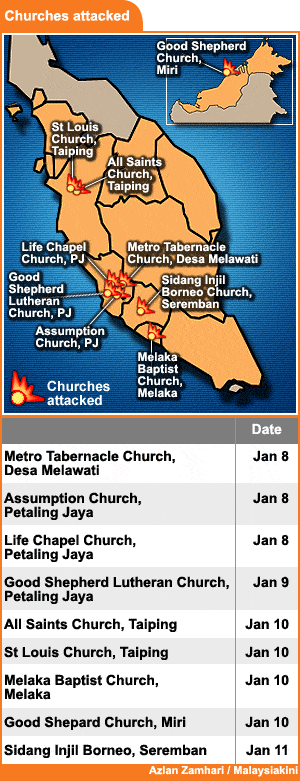
At least nine churches have been attacked in Malaysia since last Friday in the wake of the High Court decision to lift the ban on the use of ‘Allah’ by Catholic weekly The Herald in its Bahasa Malaysia section.
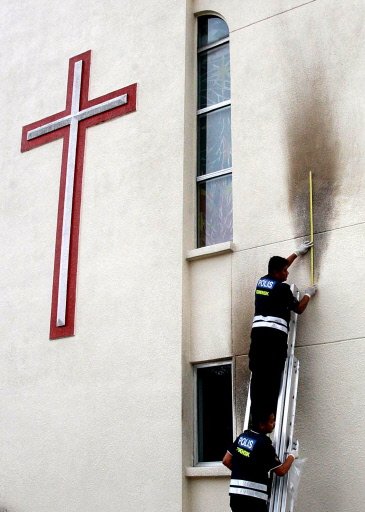
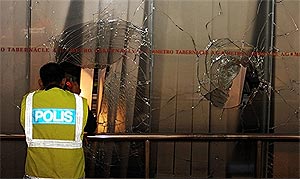
Seven churches were firebombed - four in the Klang Valley, two in Taiping and another in Seremban. The worst hit was Metro Tabernacle Church in Desa Melawati, Kuala Lumpur, where the ground floor of its three-storey building was gutted.
An additional two churches were attacked - a church in Malacca was splashed with black paint, while stones were thrown at a church in Miri, Sarawak, breaking one of its glass windows.
Azyumardi called for Muslim organisations to work with the police and the Religious Affairs Ministry to campaign against church attacks.
 “What’s important is to inform the public not to let similar incidents happen in Indonesia,” Azyumardi said.
Former Muhammadiyah leader M Syafii Maarif stressed the need for NU and Muhammadiyah to call on their followers to avoid settling problems through violence.
“Having NU and Muhammadiyah communicate directly with their followers is a more effective approach as these organisations can reach the grassroots,” said Syafii.
NU, the largest Muslim organisation in Indonesia, claim to have a membership of 40 million, while Muhammadiyah has 20 million followers.
Don’t be influenced by Malaysia
Indonesian Bishops’ Council executive secretary Father Benny Susetyo said the Malaysian issue was merely a problem involving the Bahasa Malaysia language.
“A group says the use of the word 'Allah' is exclusive to Islam. Yet the naming of God is a supernatural matter, in which mankind gives a name to a power beyond their own,” Benny said.
According to Muhammadiyah activist Ichwan Situmeang, the use of the word ‘Allah’ by Christians had never been an issue with Muslims in Indonesia.
 Yet there are religious tensions, most are related to unhappiness over allegations that churches are being built without permits in predominantly Muslim areas.
Ichwan said the use of ‘Allah’ by Christian Indonesians would not confused Indonesian Muslims.
He also said that Indonesian Muslims would not feel suspicious that the term was being used in a hidden attempt to convert Muslims to Christianity.
Meanwhile, Catholic activist Theo Bella urged Indonesian Muslims not be influenced by the controversy in Malaysia.
“For centuries we have been using ‘Allah’ in our prayers and at church services without any problems from our Muslim friends and brothers.”
Editorial: M’sian gov’t responsible
In an editorial published today, Jakarta Post disputed that the Malaysian controversy was merely a linguistic problem.
The roots of the problem “are much deeper”, it said.
“It is clear the ruling government in Malaysia is the most responsible party in the violence. It was widely suspected, including by opposition parties and international media, that the government tried to use the sensitive issue between Muslims — by the Constitution, all Malays are Muslims — and non-Muslims to regain popularity there.”
However, Jakarta Post also slammed Indonesian religious leaders of “self-denial” for implying that Indonesia has no religious conflict.
“Just click on Google and you will easily find out how many churches have been burned and damaged in this country over the last few years, including very recently.
“While it is true that freedom of religion and freedom of expression is much more guaranteed in Indonesia — Malaysia’s constitution is discriminatory to non-Muslims and non-Malays — but the facts show that religious violence is much higher here...”.
The editorial said the Indonesian government too is the party most responsible for inter-religious conflicts in Indonesia “because of its refusal or inability to act firmly against law breakers”.
“We can easily count the number of people who attacked places of worship and were punished. The police often seem powerless against such troublemakers for several reasons, including the cowardice of its generals to deal with people who use religious jargon to justify their barbaric acts.
“And like Malaysia, the government here often uses sensitive issues to divide people and cheaply boost its popularity.”


