




French lawyer fears no threats in Scorpene probe
French lawyer Joseph Breham believes that there will be "pressure and threats" during the course of his investigations into Malaysia's purchase of two French submarines, but believes that the international spotlight on the case will provide him some protection.
French lawyer Joseph Breham believes that there will be "pressure and threats" during the course of his investigations into Malaysia's purchase of two French-made submarines, but believes that the international spotlight on the case will provide him some protection.
"For example, if something were to happen to me here in Malaysia, it will attract such an international media attention, political pressure and so on, that it would be very counter-productive.
"I am not a Mongolian translator. If there were a problem, all the French newspapers will carry headlines such as ‘French lawyer inquiring into allegation of corruption disappeared in Malaysia'. No one can afford to have this," said Breham, in a recent interview.
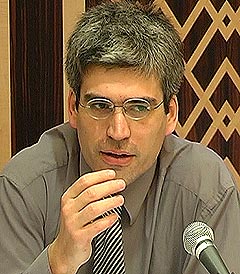 Breham
(left)
and two others, in representing Malaysian human rights organisation Suaram, have filed complaints in a Paris court over Malaysia's purchase of two Scorpene-class submarines from French defence giant DCN.
Breham
(left)
and two others, in representing Malaysian human rights organisation Suaram, have filed complaints in a Paris court over Malaysia's purchase of two Scorpene-class submarines from French defence giant DCN.
Though the Parisian authorities are looking at several allegedly dodgy sales by DCN, the submarine deal with Malaysia has reignited discussions concerning the murder of Mongolian national Altantuya Shaariibuu.
Excerpts from the interview follow:
Malaysiakini: Please tell us about your background and how you became involved in human rights work?
Joseph Breham: I am a French lawyer specialising in international criminal law and human rights. I am also a university lecturer in international criminal law in Toulouse. I teach three weeks per year.
I am also quite specialised in terrorism, and did quite a lot of terrorism cases. In fact, I was working with the government in the terrorism-prevention branch, training judges and prosecutors in terrorism while respecting human rights. That is how I became involved in human rights work.
I have always been interested in human rights since I was born in 1978, and since I was at the age of understanding. For example, (after) the fall of the Berlin Wall, the world became complicated and there was a new kind of disorder, which was terrorism and profit globalisation.
This new trend is that multinational companies do not respect any kind of rules. They have such power that they can compel governments to oblige them. They have become more corrupt and governments cannot make them (abide by) any obligations. That is how I came to work in human rights.
Tell us about your experience in handling corruption cases.
My work in corruption was mostly linked to African countries. Every human rights case related to multinational companies was also linked to allegations of corruption.
We, at Sherpa (the organisation he represents) did not begin work in corruption. But if we wanted to be efficient, we have to address this issue. 'Sherpa' means ‘helping people in the South to achieve justice'.
I worked for Sherpa in 2006 and currently, I am a member of the board. It was started by William Bourdon, the former secretary-general of the International Federation of Human Rights (FIDH) in 2001. Since FIDH does not sue companies, we started Sherpa.
Why were you interested particularly in African corruption cases?
It is not that we were more interested about corruption in African countries more than others but most of the French's ex-colonies are in Africa, and that is where the French are linked. More than half of Africa (consists of) former French colonies.
What is your success rate in your fight against corruption, for example in Africa? Have you indicted anyone?
We met with a lot of success, but it depends on what you call 'success'. If you are talking about legal cases we won, then no (there was no success). But if you consider the fact that there is a trial, and that the inhabitants of countries are aware there is strong corruption and fight against it themselves, then we are successful.
The best (most successful) case is the "misappropriation of public assets" case, where we pursued three African heads of state - dictators - for misappropriation of public assets. All these assets, or some of them at least, were in France, where they bought properties, have nice beautiful cars, and very full bank accounts.
The opposition in these countries became more powerful, empowered, stronger and become more aware of these corruption cases (after we raised the issue). Everyone knew of the corruption, but now we have enough proof for an inquiry.
For example, we have a copy of the cheque taken from the national taxes bank account which directly paid for the car of the daughter of the Gabonese president.
This is something new and this case was very exemplary. We won the first stage (of the trial) because the instruction judge considered that there was sufficient evidence.
The prosecution made an appeal and lost it, and the case is currently pending at the Supreme Court. This is the first time that I see (that after) an appeal was made, the case (still) went ahead. Usually, an appeal is made when they want to drop the case.
What kind of pressure or threats have you experienced so far?
We do receive (all) kinds of pressure. For example, once I had a case against a big uranium mining company. At that stage, I had just finished my Bar exams, and I was a jurist, not yet a lawyer.
When I finished my Bar exams, I received a proposal to work for one of the best commercial law firms in Paris with a salary I would never meet anywhere else. Of course, I felt a bit of pleasure. I went to see the guy who made the offer and said, "Okay, I will receive this amount of money, I am very happy, but why me?"
The guy said, "Well, we want to reinforce our corporate social responsibility (CSR) department and you are very well-known in CSR..."
Okay, of course, I (later) gathered some information and found out that this law firm was one of the firms that was working for the uranium mining company. Oh yes, I was pretty sure they were interested in my vast amount of knowledge and my ability, but in fact it was also a way to bribe me. This, I was very sure.
Did you accept the offer?
No.
Coming back to allegations of corruption in the DCN case, this is a highly risky thing you are doing. Are you expecting the same kind of pressure, threat?
Yes. For sure, there will be pressure, there will be threats but as French lawyers, we are protected. Or at least, I hope so. For example, if something were to happen to me here in Malaysia, it will attract such an international media attention, political pressure and so on, that it would be very counter-productive.
I am not a Mongolian translator. If there were a problem, all the French newspapers will carry headlines such as "French lawyer inquiring into allegation of corruption disappeared in Malaysia." No one can afford this.
Please clarify your function in this case. You are here to help Suaram gather evidence and reports in order to make a strong basis on why DCN should be investigated, and this will be submitted to the prosecutors...?
My function here is more to collect and translate into media language all the information we have collected.
You said that on the French side, this case has ‘nothing to do with Altantuya', but isn't her murder very much linked to the alleged DCN deal?
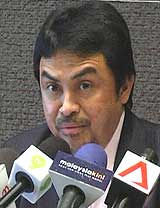 Yes, it is very much tightly linked to it. But due to the French jurisdiction, we need either a French victim - (and) this is not the case - or that the crime happened in France. This is not the case either.
Or we need a French author. The authors here are two policemen. And the accomplice is Abdul Razak Baginda (right) , a Malaysian. DCN can only be considered an accomplice of an accomplice.
This is not sufficient, and moreover, we do not have yet the means or the intention (that DCN wanted Altantuya dead). Even though DCN may have approved it, or DCN paid the commission, I am pretty sure that DCN did not want that (the murder).
I am sure they did not care whether she was killed or not, but (the point is that) they did not want it, they did not intend and I am pretty sure they did not know she was going to be killed.
But you are eventually going to investigate whether there was indeed a meeting in Paris, a photograph of Altantuya taken with Najib and Razak Baginda at the same table, and whether this meeting involved DCN?
If they (Altantuya, Najib and Baginda) were meeting DCN, if there were DCN members at this meeting and if we can incidentally prove there was a meeting between the trio at the same table, we will not be inquiring into this aspect and we cannot force the judge to inquire into this aspect.
But once we obtain the information, it can be made public.
But do you know if there was indeed a meeting, a photograph of a dinner between Baginda, Najib and Altantuya in Paris?
If during the investigation, for one reason or another, we need to know if there is a meeting between DCN, Najib, Baginda and Altantuya, and if this meeting is linked to any corruption and commission, fine, it will be enquired by the judge, not me.
If this information can be used, then we will use it freely, but the purpose of the enquiry cannot be to inquire about the absence or presence of Altantuya in the meetings.


Are you sure you want to delete this comment?
This action cannot be undone.