




EC plans to move against election offences
EXCLUSIVE More stringent control will be exerted over campaign-related offences if the Election Commission (EC) succeeds in lobbying for amendments to a 56-year-old law.
EXCLUSIVE More stringent control will be exerted over campaign-related offences if the Election Commission (EC) succeeds in lobbying for amendments to a 56-year-old law.
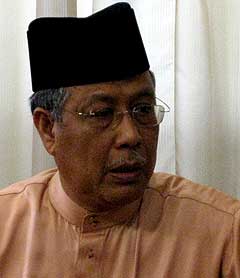
EC chief Abdul Aziz Mohd Yusof said changes are required to the Election Offences Act 1954 in light of numerous complaints about discrepancies and misconduct during campaigns.
The EC is considering several proposals but the process is still at the preliminary stage. The focus is on tightening the provisions.
 “(For instance) the Act covers the act of bribery (and) definition of bribery before, during and after an election,” said Abdul Aziz, singling out a particular area of concern.
“We are proposing to implement a cut-off point, for instance, by clarifying the terms 'before', 'after' and 'during' and specifying the time frame for each.”
The Act is also not specific as to when campaigning begins or ends, he said.
Its definition is ‘the period during which any candidate or his election agent is allowed to hold an election campaign in the candidate’s constituency, being the period commencing from the time the returning officer declares that a poll will be taken in the constituency for which he is appointed and ending on the expiration of the day before polling day’.
Abdul Aziz described this definition as vague: “Before is when? After is when? After an election the candidate wants to throw a thanksgiving dinner, but under the law it is bribery.
“We want to amend it so that the term 'before' is from nomination day to polling day and 'after' is after the election results are announced and the election ends.”
Another push factor behind the proposed amendments is the often unruly behaviour of supporters during an election campaign.
“Have you seen the way they (supporters) behave on nomination day and on polling day? Maki hamun (They harangue), bising-bising (are very noisy) and cause unnecessary provocation by jeering and showing rude gestures,” said Abdul Aziz.
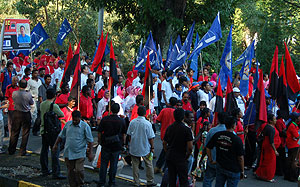 To curb unruliness, he said the EC is looking into restricting the number of supporters near the nomination centre while candidates file their papers.
“Maybe we can allow 100 supporters from both sides near the centre. The rest can gather at the party office, but not march from there to the nomination centre... so much money and time is wasted on crowd control,” he said.
Postal voting stays
Asked if the abolition of postal votes is on the cards, Abdul Aziz indicated this is unlikely.
“To abolish postal votes we have to go to Parliament as (the right to vote) is enshrined in our constitution. In my opinion, postal voting is a process that is very rigid, troublesome and creates lots of mistakes (that lead to spoilt or rejected votes.)
“(But) it is for those who cannot be present on polling day. We can't abolish it as those living overseas still require this mechanism to cast their votes.”
He dismissed outright the claims that postal voting opens up opportunities for cheating.
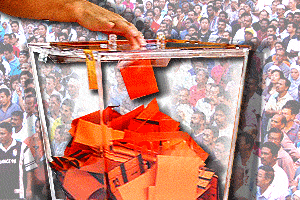 “How to cheat? Each ballot paper has a serial number on it ... and the number is copied onto a separate sheet of paper (thereby enabling a tally of the number of ballot papers issued and the number of votes cast),” he said.
Critics have long called for the abolition of postal votes on the basis that the process is misused by the government of the day, which allegedly has undue influence on the civil servants involved.
Postal votes are cast by essential enforcement personnel who are on duty on election day, as well as the security forces personnel and those residing abroad at the time of election.
The EC is also considering the introduction of the thumb-print system to remove lingering doubts about fraudulent votes.
 “But by introducing a biometric solution, other factors will come into play. We will have to make sure there is power supply and Internet connection in remote places, and this will cost money,” he said.
However, the use of indelible ink is no longer an option for Malaysia in dealing with the alleged problem of ‘phantom voters’.
“We have consulted experts on this issue and they say that the use of indelible ink will not solve alleged problem, as chemicals can be used to remove the stain (of the ink applied to the finger),” added Abdul Aziz.
A proposal to bring in the use of indelible ink for the 2008 general election was reversed four days before polling day by then EC chairperson Abdul Rashid Abdul Rahman.
By then, about 48,000 bottles of indelible ink worth RM2.4 million had been bought from India.
Yesterday: ‘EC is no Superman’
Tomorrow: Second chance for election observer Mafrel?


Are you sure you want to delete this comment?
This action cannot be undone.