Past and future of the 'cursed dam'
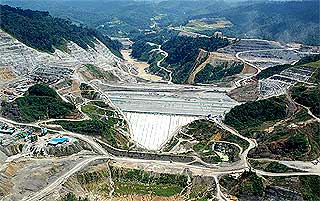
BAKUN SERIES The Bakun dam, the brainchild of former prime minister Dr Mahathir Mohamad, will be completed by December after 16 years of construction.
BAKUN SERIES The Bakun dam, the brainchild of former prime minister Dr Mahathir Mohamad, will be completed by December after 16 years of construction.
 The mega-project - dubbed the “cursed dam” by critics - has never been free of problems, and there is still the likelihood of crises to come.
Questions are still being asked about the federal government’s ability to cover the exorbitant capital cost, the delays, and the underlying risks involving two proposed aluminium smelters. These are casting a shadow over the future of the dam.
Malaysiakini revisits the controversies that have dogged the dam since its inception and explores the challenges lying ahead.
How the project was awarded
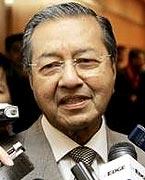 The project, announced in 1986 by Mahathir, was shelved twice and the cost ballooned from an initial RM2.4 billion to around RM7.3 billion.
It was initially abandoned by Mahathir in 1990 due to the economic downturn which led to decreased projections for electricity usage.
Mahathir announced just before the UN Conference on Environment and Development (or Earth Summit) in Rio de Janeiro, Brazil, that this was “proof of Malaysia’s commitment to the environment”.
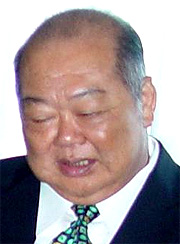 The longest-serving prime minister was to change his mind after three years. The project was revived and awarded to Ekran Bhd, owned by Sarawak timber tycoon Ting Pek Khiing (
left
), without an open tender.
The longest-serving prime minister was to change his mind after three years. The project was revived and awarded to Ekran Bhd, owned by Sarawak timber tycoon Ting Pek Khiing (
left
), without an open tender.
The project was to cost RM2.4 billion and Ting proudly pledged that it would be completed in six years.
The selection of Ting as well as the way the government awarded the project drew flak from both the opposition and civil society.
Cronyism was one of the allegations raised. Rasip Harun, the business partner of the then-finance minister Daim Zainuddin, was a major shareholder in Ekran.
The construction consortium formed by Ekran also consisted of Malaysia Mining Corporation Bhd (MMC), a company controlled by Syed Mokhtar Al Bukhary. He won many government major projects and emerged as a key industrial player during Mahathir's tenure.
Anwar’s police report
Anwar Ibrahim, after he was sacked as deputy prime minister in September 1998, lodged a police report alleging that Mahathir had approved the project without complying with privatisation or tender procedures.
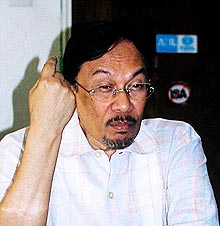 “He had launched the project even before cabinet approval... he had established direct links with ... Ting, bypassing the ministry and agency concerned,” Anwar claimed in the police report.
The company which had never built a dam also failed to convince the market. The rights issue that Ekran launched was under-subscribed and Ting had to fork out RM500 million to purchase all the unsubscribed shares based on his agreement with the underwriters.
Mahathir then used public funds to prop up the project, with the Employees Provident Fund (EPF) and Kumpulan Wang Persaraan (KWAP, for civil servants) being the biggest lenders.
 Ekran collapsed when Malaysia was hit by the East Asian economic crisis in 1997. The project was postponed for the second time and the Finance Ministry took over the project, merely a year after construction began.
However, Ekran was still paid about RM1 billion as compensation for work done.
This payment became another source of controversy because Anwar claimed in his police report that Mahathir had directed him to expedite approval of payment to Ting, thereby disregarding the financial procedures and without prior reference to the auditors.
He also alleged that Ting had demanded compensation amounting to RM2.2 billion, in a letter to Daim. No action has been taken against Ting up to now.
Far-from-convincing open tender
The second episode of the saga started in 2000 when the Finance Ministry formed a wholly-owned company, Sarawak Hidro Sdn Bhd, to develop and manage the dam.
The company named a new main contractor in 2002 - Malaysia-China Hydro Joint Venture (MCHJV) - a consortium led by Sime Engineering Bhd of Malaysia, which is a subsidiary of Sime Darby Bhd and Sino-Hydro Corporation of China.
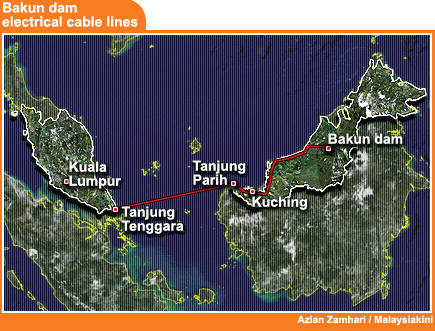
The initial plan to build the world’s longest 670km undersea cable to transmit the excess electricity to Peninsular Malaysia was scrapped due to cost constraints.
 Again doubt was raised over the award of the contract. According to weekly
The Edge
, MCHJV was not on the list of favourites when the tender was called.
Again doubt was raised over the award of the contract. According to weekly
The Edge
, MCHJV was not on the list of favourites when the tender was called.
Then the tender period was extended and MCHJV eventually won with the lowest bid of RM1.79 billion. The reason for extension of the tender period and how MCHJV could quote such a low price is known only to the authorities.
“The price submitted was so low that the Malaysian who was the next lowest bidder was astounded. He simply said it could not be done at that price,” Mahathir - who had stepped down when the tender was awarded - later wrote in his blog.
“Sometimes a very low price would be proposed so as to win the contract. Then as the construction progresses there would be cost overruns and eventually the total cost would be far higher than the price of the bid. The owner of the project would be asked to pay for the new costs.”
Mahathir was proven right. Not only was the project delayed for 39 months, the expected total cost is projected to be RM3.3 billion, according to The Edge , nearly double the RM1.79 billion bidding price.
The ultimate victim of the cost overruns will be the rakyat as the project is mostly funded through loans from the EPF and KWAP, which lent an astounding RM5.75 billion.
Flip-flop over undersea cable
The undersea cable project was revived in 2007, but has since been put off several times until today.
 Dam owner Sarawak Hidro, wholly owned by the Finance Ministry, said it has no plans for it but Sarawak Energy, the electricity provider under the Sarawak government, has expressed interest in taking over the project if it can buy the dam from the federal government.
It announced last year that a tender would be called early this year and that construction would be completed by 2015 at an estimated cost ranging between RM 8 billion and RM 10 billion.
But in April this year, Tenaga Nasional Bhd shot down the proposal again, claiming that Bakun’s power output would be needed by Sarawak.
Just one buyer
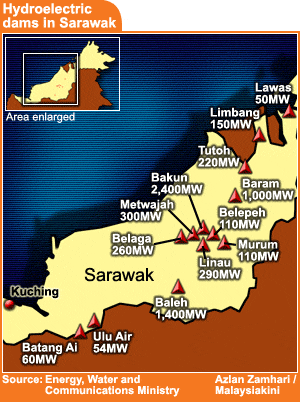
The Sarawak government, which is currently negotiating with Sarawak Hidro over the power tariff, plans to resell most of the 2,400MW of electricity from the Bakun dam to two proposed aluminium smelters.
But the two smelters - Sarawak Aluminium Company (Salco), a joint-venture between Cahaya Mata Sarawak Bhd (CMS) and Australia-based Rio Tinto Aluminium; and Smelter Asia Sdn Bhd, a joint-venture between GIIG Holdings Sdn Bhd and Aluminium Corp of China Ltd - will only start the ventures if offered cheap energy.
CMS is a conglomerate owned by the family of Sarawak Chief Minister Abdul Taib Mahmud.
It is learnt that the state government also aims for a lower power tariff.
Without an undersea cable (map, below) to enable the power to be sold to the peninsula, and with the state government prohibiting Sarawak Hidro from selling electricity directly to buyers including the smelters, the Bakun dam’s prospects look even gloomier.
The state government is now the sole purchaser of power from the dam and, worst, Sarawak Hidro cannot wait any longer to kick off the dam’s operations and start selling power to avoid further cost overruns.
If the state insists on setting the tariff level without considering the cost overruns suffered by Sarawak Hidro, the latter would be left with no bargaining power. And eventually, taxpayers will have to foot the bill.
Can the smelters be trusted?
Another potential crisis for the Land of the Hornbill is the pollution emitted by the aluminium smelters.
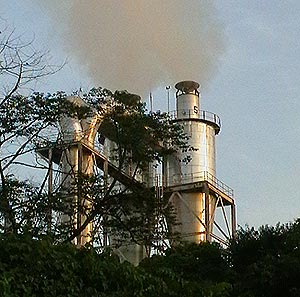 According to Salso’s ‘frequently asked questions’ brochure, the smelting processes will produce ‘small amounts of fluorides and polycyclic aromatic hydrocarbons’, but it will use ‘modern gas collection and treatment technology’ to treat these before release into the atmosphere.
‘Sulphur dioxide is also generated in parts of the smelter and is controlled by limiting the sulphur levels in raw materials used to make carbon anodes.’
On solid waste, the brochure concedes that the cell within which the smelting process takes place will have to be replaced every five to seven years. It will be temporarily stored in a dry enclosed building before incorporating it as a component of cement, which is safe to use.
 Aluminium smelting also emits significant amounts of greenhouse gases which is why developed nations in Europe and North America have been reluctant to have smelters in their backyard in recent years.
But Salco claims that the greenhouse gases will be prevented and minimised by use of technological and operational controls.
What causes environmentalists worry is the scale of the smelter proposed by Rio Tinto in Similajau. It is capable of producing 1.5 million tonnes per year - more than the world’s largest aluminium smelter in Taweelah in Abu Dhabi, at 1.4 million tonnes per year.
State election the turning point?
The problem is compounded by the ‘appalling’ human rights record of Rio Tinto, the world’s largest aluminium producer.
“The co
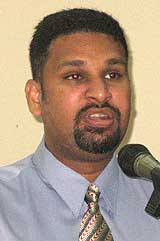 mpany has been regularly embroiled in controversy and accused of corporate misdeeds including suppressing trade unions, taking land from indigenous people without compensation, destruction of the environment, and negligence and complicity in civil war,” wrote Josef Roy Benedict
(left)
, former executive director of Amnesty International-Malaysia, in an article published in 2007 in
Aliran
.
mpany has been regularly embroiled in controversy and accused of corporate misdeeds including suppressing trade unions, taking land from indigenous people without compensation, destruction of the environment, and negligence and complicity in civil war,” wrote Josef Roy Benedict
(left)
, former executive director of Amnesty International-Malaysia, in an article published in 2007 in
Aliran
.
The same worry was shared by PKR’s Padungan assemblyperson Dominique Ng, who described the smelter as a “time bomb” that poses a serious threat to the Sarawak people and their future generations.
“The building of more dams by the state government is not to provide cheap electricity for the Sarawak people but to supply cheap power to develop and sustain aluminium smelters,” he added.
“Other countries are against the building of aluminium smelters but we are treating them as precious foreign investment. This is insane.”
But unless the coming state election - which must be held before next July - can produce a surprising result, nothing can stop Sarawak’s longest-serving chief minister from having his way.
Related stories:
Bakun Dam generates Putrajaya-S'wak tension
Bakun dam ready, but pledges to natives unfulfilled