




NEM won't benefit us, Chinese business says
The Chinese business community has given mixed signals on how receptive they are to Prime Minister Najib Abdul Razak's New Economic Model (NEM), with a majority having the view that their businesses will not benefit from the new policy.
The Chinese business community has given mixed signals on how receptive they are to Prime Minister Najib Abdul Razak's New Economic Model (NEM), with a majority having the view that their businesses will not benefit from the new policy.
A survey of Malaysia's economic situation for the first half of 2010, commissioned by the Associated Chinese Chambers of Commerce and Industry of Malaysia (ACCCIM), reported 61 percent of the respondents as saying they would gain nothing from the NEM.
This is despite a little over half of them (51 percent) saying they understood the goals or aims of the NEM.
The report attributes this to ineffective communication between the
 government and the private sector. The government therefore is saddled with an "enormous task" of convincing the business sector that the NEM goals will benefit both the public and business.
"Accordingly, appropriate and consistent policies, as stated in the NEM, must be drawn up and implemented by the various government agencies throughout all government ministries and agencies," the report said.
Post-NEP trauma
The survey also found that 60 percent of the respondents were severely negative of the NEM's aim of equitable distribution of income, replying that it was "not possible".
The findings were attributed to the legacy of the New Economic Policy (NEP) implemented during the time of Najib's father and former premier Abdul Razak Hussein.
"... after having been in place for many decades, the NEP is still seen by the government that it is still far off from achieving its goals under the affirmative actions taken by the government."
A similar percentage of respondents also feared they would be
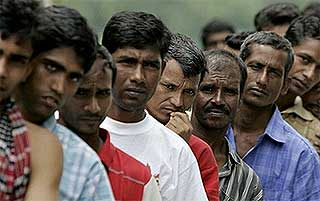 affected negatively by the government's plan to increase the levy on foreign workers, as 63 percent of the respondents were either heavily or somewhat dependent on foreign labour.
Other points of concern highlighted by the report include:
- Over 80 percent of respondents believe that subsidy cuts will lead to high inflation in the immediate term. In addition, 74 percent of them said the proposed cuts will have a negative impact on their businesses.
- Some 75 percent of respondents felt their businesses had been negatively affected by Malaysia's "brain drain".
A silver lining?
However, not all of the suvey findings are negative. The overall reading is that the Chinese business community is cautiously optimistic about Malaysia's economic outlook from this year through to 2012.
The community has been buoyed by improving local sales, overseas orders and other indicators such as staff numbers and stock levels, keeping high their confidence and optimism in the future of the Malaysian economy.
However, ACCCIM president William Cheng pointed out the government needs to reciprocate by engaging the business community in creating a more "pro-business and competitive business environment" and improve the delivery and execution efficiency of the public sector.
"This includes more favourable, transparent and stable legislation
 and policies, and providing more long-term investment facilities and incentives," Cheng (
left
) said when releasing the report at a press conference at the ACCCIM office in Kuala Lumpur today.
and policies, and providing more long-term investment facilities and incentives," Cheng (
left
) said when releasing the report at a press conference at the ACCCIM office in Kuala Lumpur today.
Cheng said this was vital as private investment is projected to grow by an average of 12.8 percent annually, with the bulk coming by way of foreign direct investments (FDIs).
The survey covered respondents from the wholesale and retail, manufacturing, professional, services and construction sectors, with nearly 78 percent of the respondents being domestic market-orientated while the remaining 22 percent focused on either export or both domestic and export markets.


Are you sure you want to delete this comment?
This action cannot be undone.