




Winning Dayak hearts and minds - by blackmail?
COMMENT The political-timber industrial complex in Sarawak has resorted to the unusual tactic of blackmail to win the hearts and minds of the natives in the run-up to the forthcoming state elections.
COMMENT The political-timber industrial complex in Sarawak has resorted to the unusual tactic of blackmail to win the hearts and minds of the natives in the run-up to the forthcoming state elections.
State Minister for Infrastructure Development and Communications Michael Manyin raised eyebrows on Aug 30 with a public warning to fellow Bidayuh to vote for the Barisan Nasional (BN) - or else, according to a report in the local daily Borneo Post, headlined Bidayuhs have much to lose if they don't vote BN.
"Even if the BN loses all the six Bidayuh seats in the coming state election, it will not be affected as there are 71 seats in the State Legislative Assembly," Manyin, a former school headmaster, was quoted as saying. "But if that happens, then the whole Bidayuh community will lose out because the current tempo of development will not be continued by the BN government."
Blackmail in Baram
 Manyin's speech coincided with an announcement by the Swiss NGO advocating Penan rights, Bruno Manser Fund (BMF), that Samling, a Miri-based logging company closely linked to Sarawak Chief Minister Abdul Taib Mahmud (
right
), had threatened Penan villagers in Upper Baram.
Manyin's speech coincided with an announcement by the Swiss NGO advocating Penan rights, Bruno Manser Fund (BMF), that Samling, a Miri-based logging company closely linked to Sarawak Chief Minister Abdul Taib Mahmud (
right
), had threatened Penan villagers in Upper Baram.
According to the BMF, Samling warned that it would prevent Penan schoolchildren and adults from hitching rides on company vehicles, unless the Penan recanted and withdrew their reports of sexual abuse by logging company workers.
The BMF said Samling officials instructed Jawa Nyipa, head of Long Ajeng, an upriver Penan community, to sign a document stating that the women in the region had retracted their allegations of sexual abuse by timber company staff. Otherwise, Samling officials warned him, all transport services for the locals would be stopped.
The village head refused to sign, but the Penan in Upper Baram remain anxious, because they cannot afford private means of transport.
The BMF noted that logging companies operating in Middle Baram, including Samling and Interhill, have stopped providing transport for a number of communities that had voiced their concern over sexual abuse and rape by timber workers. Now, Upper Baram appears to have been targeted.
Harrowing journeys
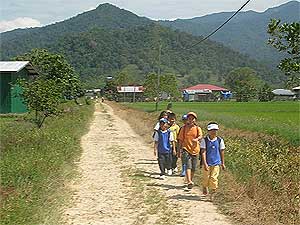
Many Penan villagers remain committed to sending their children for education, often walking for several days with the students to boarding schools and back to their home villages. However, logging roads carved into the Baram forests have increased their reliance on logging vehicles for rides to schools, clinics and administrative centres for MyKad and other registration procedures.
In the past three decades, logging trucks have been offering sporadic transportation to Penan hitch-hikers. Journeys in the trucks take hours instead of days, so traditional paths through the forests have become overgrown and disused.
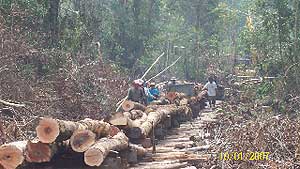
 Logging has also caused siltation of local rivers and streams, making passage of the waterways by villagers' longboats more exhausting - the boats have to be dragged over shallows - and hazardous.
The Penan still prefer walking under the cool forest canopy to trudging along the exposed logging roads. But the government's abject failure to provide basic public services such as transportation, accessible education and health, building materials for housing, electricity, clean water and sanitation, has left a vacuum throughout much of Baram.
The logging companies have exploited this void by providing ad hoc transportation assistance to local communities in an attempt to diminish resistance to their bulldozers' encroachment into the natives' land.
My own experience is that hiking, or riding on the backs of trucks on these scorched, dusty timber tracks in Middle and Upper Baram, is a torment. Even so, most Penan now walk or hitch rides on these timber roads, instead of walking for many days to get to school.
Penan children have become vulnerable as a result. This has led to crimes of rape of girls as young as 10 by loggers, well documented by the government's own ministerial task force last September, and the Penan Support Group's (PSG) NGO fact-finding mission this July.
Although the Penan have been scornfully disparaged as living "like
 animals in the forest" by Taib, former prime minister Dr Mahathir Mohamad and various other ministers, the humanity of the Penan is readily apparent to anyone who has spent time in their close-knit, egalitarian communities. On the other hand, the behaviour of those predators who have sexually assaulted Penan children is truly bestial.
Samling's reported tactics now cast even greater doubt on the credibility of a previous "retraction" of a rape report last year by one "Bibi", a rape survivor named in the ministry's task force report. The PSG has said the "retraction" was made under duress.
"Grossly unethical activity"
Samling Global's multinational conglomerate has an annual turnover of US$480 million (RM1.51 billion) and is listed on the Hong Kong stock exchange. It has parlayed its green gold extracted from Sarawak's forests into diversified commercial and hotel developments, palm oil and forest plantations.
Samling attracted international attention last week: detailed financial records published by the anti-corruption Sarawak Repor t website showed Samling had transferred two luxurious mansions in Seattle in the United States, worth some RM30 million, to Taib and his family.
Two days before this news broke, the Norwegian government's pension fund, one of the world's largest institutional investors, had blacklisted Samling companies from its investment portfolio, "based on the Council of Ethics assessment that they are contributing to or are themselves responsible for grossly unethical activity... the company's forest operations in the rainforests of Sarawak and Guyana contribute to illegal logging and severe environmental damage."
In reply to the Norwegian government's decision, Samling asserted in a
 statement on its website: "We stand by our record in sustainable forest management. We take pride in being the first tropical timber company in Malaysia with an ISO9001:2000 quality management system certification."
Notwithstanding Samling factories' celebrated quality control standards, Samling's logging activities have been condemned by local communities in Sarawak for wanton destruction.
Samling subsudiary fined RM1.5m in Guyana
Samling's subsidiary Barama was fined US$480,000 (RM1.5 million) in 2007 by the government of Guyana, for illegal logging and under-reporting of extracted logs in the country north of Brazil. Barama refused to pay.
Samling employees were also linked to the suspicious death of Kelesau Naan, a prominent anti-logging Penan chief from Long Kerong, Upper Baram. Kelesau was suspected to have been murdered in October 2008. Threats of violence against Long Kerong villagers had been issued three months beforehand by Samling employees from nearby Long Siut. Police investigations were perfunctory and unproductive.
After Kelesau's death, a Samling functionary, Kho Thien Seng, often seen travelling in a Samling helicopter to negotiate with Penan communities over logging concessions, offered Kelesau's son Nick RM25,000 in cash, if Nick would only withdraw police reports alleging foul play in his father's death.
This recurrent leitmotiv raises inevitable questions: if Samling's logging activities are beyond reproach, why would Kho offer Nick a bribe to stop investigations? And why would Samling employees try to blackmail Penan women into retracting their reports of rape?
KERUAH USIT is a human rights activist - 'anak Sarawak, bangsa Malaysia'. This weekly column is an effort to provide a voice for marginalised Malaysians. Keruah Usit can be contacted at keruah_usit@yahoo.com .


