




PKA vs Kuala Dimensi: Court orders open trial
The appellate court has today ordered two suits by the Port Klang Authority (PKA) against Kuala Dimensi Sdn Bhd over a dispute involving payments amounting to RM920 million to go for a full trial.
The appellate court has today ordered two suits by the Port Klang Authority (PKA) against Kuala Dimensi Sdn Bhd over a dispute involving payments amounting to RM920 million to go for a full trial.
 This follows an unanimous decision by the three-member appellate court panel to allow PKA's appeal against a stay order by the High Court, so the two parties can resolve their dispute through closed-door arbitration.
Justice Low Hop Bing, in announcing the decision, ordered Kuala Dimensi to pay costs of RM30,000 and asked that the matter go on trial at the Shah Alam High Court.
The other two judges sitting with Low were justices Syed Ahmad Helmy Syed Ahmad and Zaharah Ibrahim.
Following today's decision the case will revert to the High Court, where a mention date will be fixed for the case to resume hearing or litigate.
Arbitration is an alternative dispute resolution to settle the matter outside court. Normally, it is done in a closed environment where witness are called.
In the two suits against KDSB, the PKA is disputing the amount of money claimed by KDSB and BTA Architect for work done on the Port Klang Free Zone (PKFZ) project. They cite that KDSB had breached its duty and made fraudulent claims.
In all, PKA has filed four suits against Kuala Dimensi to compel the the Port Klang Free Zone (PKFZ) turnkey contractor to return payments made due to alleged overclaiming.
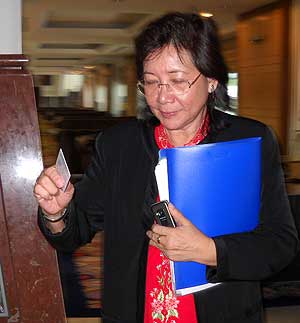 PKA named Kuala Dimensi in three of the suits, while the other suit includes the name of its general manager OC Phang (
right
). All four suits were filed in September 2009.
PKA named Kuala Dimensi in three of the suits, while the other suit includes the name of its general manager OC Phang (
right
). All four suits were filed in September 2009.
Kuala Dimensi at the High Court invoked section 10 of the Arbitration Act 2005, and the court granted a stay of proceedings pending reference to arbitration. PKA, not being satisfied with the order, had filed the appeal which led to today’s decision.
Six agreements struck between 2003 and 2006 between the PKA and KDSB are in question, namely the Principal Development Agreement (PDA) and five Supplemental Agreements.
KDSB wanted to impose clause 11.1 in the PDA for arbitration of the principal agreement, while leaving some clauses in the second and third supplement agreement open for litigation.
Clause 1.1 of the PDA states that any dispute or difference of any kind whatsoever that shall arise between the parties in connection with this agreement, shall if possible be resolved amicably between the parties. Any such dispute or difference which cannot be resolved amicable may be referred to arbitration in accordance with this agreement.
Counsel for PKA submitted that the word “may” in the arbitration clause meant it is only optional and not mandatory, as the parties had not intended it (arbitration) to be exclusive.
However, KDSB’s counsel argued the court had the overriding discretion to decide on and grant a stay.
Appellate Court's decision
Low, in his 46-page judgment, said that he had no doubt the parties have reaffirmed predominant agreement to submit to the court’s jurisdiction and effectively abandoned arbitration.
“There is a conflict in the interpretation of clause 11.1 of the PDA, the arbitration clause and the submission to the court over jurisdiction clauses, with respect to the second and third supplementary agreement in question. They contradict each other because effect could not be given to enable these clauses to function harmoniously,” he said.
“They operate like discordant music in a chorus of legal expressions. It is simply impossible to have a concurrent and combined situation of arbitration and litigation (at the same time). It is either arbitration or litigation,” Justice Low said.
The judge said as the parties’ original intention to proceed via arbitration had been abandoned, as expressed in the two supplementary agreements, neither of them should be allowed to go back on their words.
“Hence, it would be unfair or unjust for KDSB to do so. In other words, the doctrine of estoppel may be invoked.”
The doctrine of estoppel may be used in certain situations to prevent a person from relying upon certain rights, or upon a set of facts, which are different from an earlier set of facts. For example, if a creditor informs a debtor his debt is forgiven, then the creditor may not be allowed ( estopped ) to claim it back if he so asks.
Justice Low said this is one of the exceptional circumstances where estoppel may be appropriately invoked.
“On the above analysis of the authorities and statutory provisions, I hold the parties had eventually intended to resort to litigation... Hence, the High Court has erred in granting the stay. I therefore allow this appeal with costs and set aside the decision of the High Court,” he said.
The other two cases which are not related to this action concern KDSB being sued for another RM720 million for overcharging in the purchase of land for the PKFZ project, while the other is on its general manager OC Phang.


Report this comment
Are you sure you want to delete this comment?
This action cannot be undone.