




Red flag up over Orang Asli rights
All landmark court rulings favouring the Orang Asli in recent years may end up being reversed if the government pushes ahead with its proposed amendments to the Aboriginal Peoples Act (Act 134), according to a senior lawyer.
Steven Thiru, a co-chair of the Bar Council's Orang Asli Committee, said this is a real concern as parliament has the power to enact laws that would nullify whatever the earlier decisions delivered by the courts.
All landmark court rulings favouring the Orang Asli in recent years may end up being reversed if the government pushes ahead with its proposed amendments to the Aboriginal Peoples Act (Act 134), according to a senior lawyer.
Steven Thiru, a co-chair of the Bar Council's Orang Asli Committee, said this is a real concern as parliament has the power to enact laws that would nullify whatever earlier decisions that had been delivered by the courts.
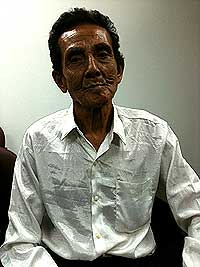 Although the draft of the amendments has yet to be officially released, Steven underscored the possibility that it may contain "provisions which are contrary to what was established" in landmark cases such as the
Sagong Tasi
(
left
) case.
Although the draft of the amendments has yet to be officially released, Steven underscored the possibility that it may contain "provisions which are contrary to what was established" in landmark cases such as the
Sagong Tasi
(
left
) case.
"In Malaysia, the constitution is supreme, and parliament enacts laws... laws can be made to reverse decisions of the courts," he said when taking questions after presenting a paper at a Seminar on Indigenous Rights yesterday.
The Orang Asli Graduates Association (PSOA) earlier this year raised concerns over the proposed amendments to the Aboriginal Peoples Act, saying the community may end up l osing nearly all their land if the amendments are passed.
The proposed amendments were supposed to have been tabled in parliament during the current sitting, but was not included in the order paper, indicating that the soonest it can be made public is the next parliament session in the first half of next year.

Steven ( right) acknowledged that the amendments, if passed, could still be challenged on the grounds that they are unconstitutional but stressed that it would be a "difficult fight".
Orang Asli rights not respected
He pointed out that despite the various landmark court decisions in favour of the Orang Asli, particularly on native customary land title claims; the government still has made no effort to acknowledge their rights.
He said in many cases either their rights are not recognised outright, or officials will use the excuse that if the land in question is not gazetted as either an aboriginal area or reserve, the Orang Asli have no right to their claim.
"You are invariably met with the argument that these are state lands, they belong to the state, (and) we do not recognise your customary title. Are their (Orang Asli) rights respected? Certainly not," he said.
Earlier when presenting his talk at the seminar, Steven said the mere fact that a piece of land is not gazetted as aboriginal land or reserve is not conclusive that it is not the Orang Asli's.
Citing court judgements as far back as 1991, he added that even if a plot of land is only designated and yet to be gazetted as Orang Asli reserve, it is still protected as Orang Asli land.
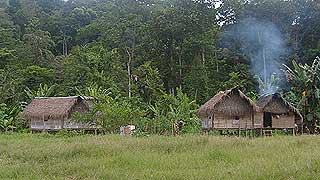 He noted that despite the government setting aside 108,520 hectares to be gazetted as Orang Asli reserves in peninsular Malaysia, only 19,222 hectares have been gazetted as of 2007.
Steven was among four panellists invited to speak at the annual half-day seminar, jointly-organised by Suhakam and the European Union.
The other speakers included Borneo Research Institute (Brimas) executive director Mark Bujang; MHC Plantations Bhd president Mah King Thian and Perak Indigenous People Foundation chief Suki Mee.


