




Breakfast meeting: Anwar misreads the signals
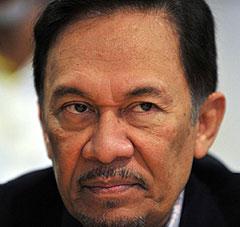
COMMENT Anwar Ibrahim breakfasting with businessman Sng Chee Hua and then disclaiming any political significance to the encounter is disingenuous.
Sure, credence must be granted this maestro of inclusiveness when he says that in politics one must talk to everybody; especially, it won't hurt if that someone has deep pockets...
COMMENT Anwar Ibrahim breakfasting with businessman Sng Chee Hua and then disclaiming any political significance to the encounter is disingenuous.
Sure, credence must be granted this maestro of inclusiveness when he says that in politics one must talk to everybody; especially, it won't hurt if that someone has deep pockets.
 Given what has happened to Sarawak PKR and Sabah PKR in the last year and a half,
Anwar's hobnobbing
with the widely mistrusted Sng in Kuching a week ago continued the pattern of PKR central's misreading of Borneoan signals.
Given what has happened to Sarawak PKR and Sabah PKR in the last year and a half,
Anwar's hobnobbing
with the widely mistrusted Sng in Kuching a week ago continued the pattern of PKR central's misreading of Borneoan signals.
It is the most important reason why the Sarawak National Party (Snap), although a member of the Pakatan coalition in the state, has gathered impetus in the last few months - at the expense of Sarawak PKR.
Several key members of the deregistered Parti Bansa Dayak Sarawak (PBDS), led by Daniel Tajem, until fairly recently an advisor to Sarawak PKR, have enlisted in Snap the past few weeks after viewing with dismay the dalliance between PKR central and Sng.
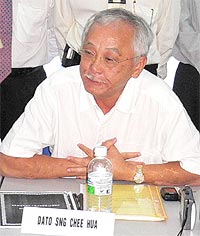 The latter is anathema to this remnant of the deregistered PBDS: they cannot forgive him the way he consistently played both sides in successive phases of internecine battles in PBDS throughout its history (1983-2005).
The fluent Iban-speaking Sng was once vice-president of the PBDS and MP for Julau (1995-99), a heavily Iban-majority seat in the Sarawak interior.
The way a reception room in a Petaling Jaya hotel emptied one evening last November when Sng wafted in upon Anwar's arrival to meet Dayak delegates to the PKR annual congress, should have told the opposition leader something. Even Baru Bian, the Sarawak PKR chapter leader and an ex-PBDS stalwart, was obliged to sidle towards the exit upon sighting Sng.
But carpetbagger Sng is so skilled in the arts of crony cultivation that, even if Anwar had caught the drift, there would been his lieutenant, Azmin Ali's, opinion to consider: Sng, all the way from Kuching, was one of the first arrivals at Azmin's Hari Raya open house in the Klang Valley the previous September.
In extenuation of his meeting with Sng, Anwar held forth on the need to talk to anybody in politics, just so one does not compromise on one's basic principles.
Fair enough. But the problem with Sng, a construction magnate who made his initial wealth from the cock-fighting business in the state, is that one is hard put to know what his principles actually are.
There may be a good reason for that mystery.
Hard-nosed display of realpolitik
As a young man, Sng junior had seen how his father, Cheng Hee, the leader of the Sarawak Chinese Association (SCA) for Kapit in the 1960s, was sacrificed in the deal that saw SUPP join the state BN chapter in 1971, an arrangement that enabled guileful Rahman Yaakob to become chief minister.
The SCA was a rival of the left-leaning SUPP for the electoral allegiance of the Sarawak Chinese population, the second largest ethnic group after the majority Dayaks.
Ong Kee Hui and Stephen Yong Ket Tze, SUPP's founders, insisted to then prime minister Abdul Razak Hussein and Rahman that SCA be the sacrificial goat on the altar of SUPP's induction into the state BN.
SUPP's joining the state BN was considered vital because of the threat of communist activity on the Sarawak-Kalimantan border. Former members of the North Kalimantan Communist Party, who had renounced violence, had joined the SUPP after Indonesia's confrontation with Malaysia had ended in 1965.
But terrorist activity continued despite the withdrawal of the safe haven the reds enjoyed when Sukarno was in power in Indonesia. In contrast, the new Indonesian regime under General Suharto was genocidal towards communists.
The deal between SUPP and a Razak-backed Rahman in 1971 was a hard-nosed display of realpolitik that put paid to Sng Cheng Hee's political career and to the party he led.
The lesson that episode held on political survival could not have been lost on Sng junior. Henceforth, his antennae would be acute to which way the political winds were shifting, the better he could align himself to further his business interests.
A master in backroom politics
A Hokkien in a state whose businesses are dominated by the clannish Foochow, Chee Hua is adept at cultivating operatives on both sides of the political divide in Malaysia, especially if the latter have a taste for the luxurious life.
In the lounge in Parliament in 1995, a fellow MP was greatly bemused to observe a scene one day when the neophyte MP from Julau crocked his right index finger at an Umno MP across the room and in mock serious fashion, motioned him over to his side.
This was in the age when the term ‘Melayu Baru' was in vogue, so the sight of an Umno MP scampering to the side of a man whose shaky command of the English language and even shakier grip of the Malay one, was something to mull for its subterranean ripples.
Suffice this scion of Cheng Hee, skilled in the wheeling and dealing of backroom politics is a veteran of just the sort of arrangements that governance - Pakatan Rakyat-style - would like to see consigned to the dustbin of history.
That he is largely persona non grata to the forces for change in both Sarawak and Sabah is a measure of their desire for a new politics; that he is still tenable to the forces for change on the peninsula is a reflection of the chasm that separates both territories.
Bridging that gulf is the key to electoral success in Borneo.
TERENCE NETTO has been a journalist for close on four decades. He likes the occupation because it puts him in contact with the eminent without being under the necessity to admire them. It is the ideal profession for a temperament that finds power fascinating and its exercise abhorrent.


Report this comment
Are you sure you want to delete this comment?
This action cannot be undone.