




Merlimau: Pakatan's failed experiment in Malacca
ANALYSIS The BN victory in Merlimau paves the way to a snap general election, but this is bad news for the defeated PAS along with its Pakatan Rakyat partners who showed that they are not ready to face a statewide fight, let alone a nationwide affair.
ANALYSIS The BN victory in Merlimau paves the way to a snap general election, but this is bad news for the defeated PAS along with its Pakatan Rakyat partners who showed that they are not ready to face a statewide fight, let alone a nationwide affair.
Although Merlimau has a Malay majority of 64.9 percent, the constituency also has significant amount of non-Malay voters. This, coupled with its semi-rural demographic, makes it a typical seat in the state of Malacca.
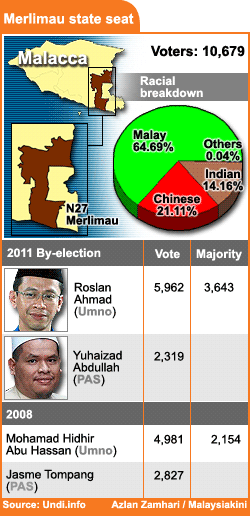 Conceding approximately 13 percent more votes in its first by-election in Malacca to BN means that Pakatan is unable to even retain the support it received in 2008, nor has it made any inroads into the state.
Neither does it bode well for PAS which has been losing a string of by-elections, since winning Kuala Terengganu, Bukit Gantang, Permatang Pasir and Manik Urai.
In Merlimau, as it is likely in other semi-rural areas, it is the Malay Muslim voters who appear to need further convincing of PAS’ ability to serve them.
PAS’ support in areas with more than 1,500 Malay voters, Pengkalan Samak, Permatang Serai and Chinchin, were consistent with their 2008 performance except in Chinchin where they conceded about 100 votes more.
‘PAS for all’ rebranding backfires
Anticipating an assault on the ability to safeguard the special position of Malays, PAS and DAP kicked off their campaign on the defensive, attempting to explain rationally that the number of seats that DAP is contesting will not allow them to take over.
But this message appeared to only stop at the seemingly members-only night rallies, with many in the crowd confessing to be from out of town.
 BN leaders have now come out to say that the big win of a majority of 3,643 votes is an endorsement of Prime Minister Najib Abdul Razak’s 1Malaysia message and transformation programme.
Yet for most parts of the campaign, BN’s focus was more on its psychological war with ‘deviant, extremist’ and ‘sell-out’ PAS, which has made a pact with the devil that is DAP, as a common enemy.
Billboards, banners, home-delivered leaflets, mobile text messages, social media campaign and speeches, including that of top BN leaders like Deputy Premier Muhyiddin Yassin, were timed to a tee, turning the ‘PAS for all’ rebranding effort on its head.
Pakatan poorly coordinated
While PAS did invest in banners and billboards, some of which reminded voters that their votes are confidential and that Chief Minister Mohd Ali Rustam cannot trace it back to them as threatened, other print material were lacking.
Door-to-door campaigning, argued by PAS to be more ‘personal’, failed to cut it against the barrage of campaign material, official or otherwise, by BN.
Lack of a consistent campaign message also pointed to poor machinery, planning and coordination on Pakatan’s side despite Merlimau being the 15th fought as a coalition.
DAP, which has a good standing in urban Malacca, started work early on their traditional Chinese supporters, PAS was slow to kick off and PKR was almost completely non-existent until the last rounds of campaign.
 PKR’s most obvious ‘contribution’ was being campaign fodder for BN, who went to town with the young party’s faulty party polls, string of defections and
de facto
leader Anwar Ibrahim’s sodomy trial.
PKR’s most obvious ‘contribution’ was being campaign fodder for BN, who went to town with the young party’s faulty party polls, string of defections and
de facto
leader Anwar Ibrahim’s sodomy trial.
While Anwar drew crowds of a few thousands in his visit midway through the campaign, he left PAS, DAP and to a lesser extent PKR in Merlimau to defend him as BN trained its crosshairs on the former Umno leader after his visit.
None of Pakatan’s assaults hit their target, as much of it was focused on apparent high-brow ideals which at the end of the day did not speak to the voters who felt safe and secure in Merlimau with its abundant facilities and development.
BN rules rural Malaysia
A BN stronghold, Merlimau proves that the ruling coalition is strongest in semi-rural and rural areas where demands are simple and bigger picture arguments do not stick.
The opposition coalition’s reasonable appeal for another person on the Malacca opposition bench of five also fell on deaf ears, with bread and butter issues being the utmost concern.
 The only national issue brought up by Pakatan which appeared to have a footing was that of inflation, but BN was quick to put this fire out by splashing goodies and aid.
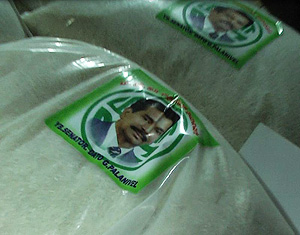
Hundreds of sacks of rice with MIC president G Palanivel’s face printed on them were distributed by MIC on the final night of campaign, for example, while the state government went door-to-door to fix leaky roofs for free.
The seemingly knee-jerk reaction may not offer a long-term solution for the lower-income voters of Merlimau but were enough to sway them.
With gratitude being BN’s campaign theme in the more rural areas of the constituency, the mostly Indian lower income voters of Jasin Lalang paid back by slashing PAS’ support there to a mere 15.5 percent, down from 40.7 percent in 2008.
Some swing to BN, but Chinese stay with Pakatan
The swing to BN in more urban areas of Merlimau is less apparent, with Ayer Merbau and Merlimau Pasir recording about a 10 percent swing respectively, while town area Pengkalan Samak tallied about the same ratio as in 2008.
The numbers in Ayer Merbau, which has the largest proportion of Chinese voters, is unrepresentative of the community’s voting pattern as a whole as many of the 300-odd Chinese voters there are MCA stalwarts, having been members of the local branch.
MCA has less of a presence in Pengkalan Samak (which has about 600 Chinese voters) and Merlimau Pasir (about 500 Chinese voters), indicating that the community is still more or less backing Pakatan.
The same can be said in other parts of Malacca, with DAP’s five assembly seats located in town areas, and in Malaysia where Pakatan’s idealistic appeal seems to still have a hold on urban voters.
But with much of Malaysia still partly rural, and a large proportion of parliament and state seats being in such areas, hope of a regime change in the upcoming polls is waning.


