




Bid to cool reactors: Copters fail, water cannon next
Japanese crews grappling with the world’s worst nuclear incident since Chernobyl contended with a new fire used army helicopters to dump water on the stricken Fukushima nuclear plant.
Japanese crews grappling with the world’s worst nuclear incident since Chernobyl contended with a new fire used army helicopters to dump water on the stricken Fukushima nuclear plant.
However, high radiation levels prevented the helicopters from flying to the site to drop water into the No 3 reactor - whose roof was damaged by an earlier explosion and where steam was seen rising earlier in the day - to try to cool its fuel rods.
In a sign of desperation, the police will instead try to use with water cannon, normally used to quell riots.
Workers at the troubled plant were battling multiple problems, including No 4 reactor where spent fuel rods are kept under water.
France's ASN said, "The state of the fuel rods stored in this pool (at Fukushima's No 4 reactor) ... is not known."
"The evaporation of water in the pool is continuing," the ASN said.
If the tanks run dry, the rods can overheat and the metal sheaths that surround the fuel can be ruptured, the ASN said.
Workers were ordered to withdraw briefly from the Japanese nuclear power plant after radiation levels surged, a development that suggested the crisis was spiralling out of control.
"Around 10:40am (9.40am Malaysian time), we ordered the evacuation of workers... due to the rise in (radioactivity) data around the gate" of the ageing plant, a nuclear safety agency official said at a televised news conference.
However, the workers were allowed back in after radiation levels fell. The plant operator said there were 180 workers on site as of 0230 GMT (10.30am Malaysian time).
Just hours earlier another fire broke out at the earthquake-crippled plant, which has sent low levels of radiation wafting into Tokyo in the past 24 hours, triggering both fear in the capital and international alarm.
Workers were trying to clear debris to build a road so that fire trucks could reach reactor No 4 at the Daiichi complex in Fukushima, 240km north of Tokyo. Flames were no longer visible at the building housing the reactor, but TV pictures showed rising smoke or steam.
 The plant operator described No 3 as the "priority" and said the situation at No 4, where the fire broke out, as "not so good".
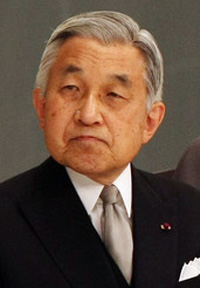
Japanese Emperor Akihito ( right ) made an unprecedented televised address today, saying he was "deeply worried" by the crisis at damaged nuclear reactors and urging people to help each in difficult times.
Looking sombre and stoic, the 77-year-old Akihito said the problems at Japan's nuclear-power reactors, where authorities were battling to prevent a nuclear catastrophe, were unpredictable and that he was "deeply worried" following an earthquake he described as "unprecedented in scale".
"I sincerely hope that we can keep the situation from getting worse," Akihito said an address that marked the first time he has intervened in a national crisis.
With nerves on edge across the world’s third-biggest economy and beyond, people across Asia have been stripping shelves of essentials for fear of a major emission of radiation from the stricken Fukushima nuclear power plant.
 However, after the Tokyo stock exchange’s biggest two-day sell-off in 24 years sparked a global market rout, the headline Nikkei share index recovered 4.37 percent this morning as investors snapped up bargains.
The Bank of Japan pumped another 3.5 trillion yen (US$43.3 billion) into the financial system, adding to trillions spent this week since Friday’s 9.0 magnitude earthquake and tsunami crippled a large swathe of the economy.
Authorities are staring at a staggering death toll. The devastation in tsunami-hit areas such as the small fishing town of Minamisanriku is absolute, with the northeastern settlement missing about half of its 17,000 residents.
“Ten of my relatives are missing. I haven’t been able to get in contact with them,” 54-year-old Tomeko Sato, who lost her house in the disaster, told AFP.
“I was very surprised by the power of the tsunami... next time, I will live on the hill and hope it never happens again.”
 At the crippled Fukushima atomic plant 250km northeast of Tokyo, live TV footage showed a cloud of white smoke rising high into the clear blue sky.
The containment vessel around reactor number three may have suffered damage, and the “likeliest possibility” for the white cloud was that steam was escaping from the vessel, chief government spokesman Yukio Edano said.
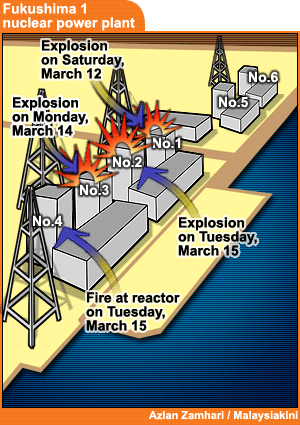
The number-three reactor was hit by a blast on Monday that tore off the outer structure of the reactor building.
Fire crews fought a new blaze early today at reactor number four, operator Tokyo Electric Power (Tepco) said, but it was later extinguished.
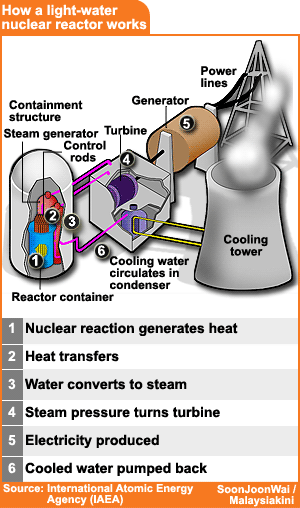
Engineers have been desperately battling a feared meltdown at the 40-year-old plant since the earthquake and tsunami knocked out cooling systems and fuel rods began overheating.
There have now been four explosions and two fires at the complex, with four out of its six reactors in trouble.
Disaster now equates six on the seven-point scale
France’s Nuclear Safety Authority said the disaster now equated to a six on the seven-point international scale for nuclear accidents, ranking the crisis second only in gravity to the level-seven Chernobyl disaster in 1986.
 Yukiya Amano, the Japanese chief of the UN’s atomic watchdog, said yesterday there might be limited core damage at the second reactor but repeated that he did not think the situation could escalate to rival Chernobyl in Ukraine.
“I continue to think that the Chernobyl and Fukushima reactors are different,” the head of the International Atomic Energy Agency said.
Amano reiterated that unlike Chernobyl, the Fukushima reactors have primary containment vessels, and had also shut down automatically when the earthquake hit, so there was no chain reaction going on.
Japanese crews said they may pour water from helicopters, if necessary, to stop spent fuel rods at Fukushima from being exposed to the air.
Eight experts from the US Nuclear Regulatory Commission were heading to Japan today to help advise on the crisis.
President Barack Obama, who has dispatched a naval flotilla led by a US aircraft carrier to aid in the quake-tsunami rescue operation, said he was “deeply worried” about the potential human cost of the crisis.
Obama also vowed to “further improve” the safety of US atomic facilities, while several European nations announced reviews of their own nuclear installations and Germany temporarily shut down seven reactors.
Yet, the Obama administration - joining a roster of countries undaunted by the continuing atomic crisis in Japan - has also said it still wants to expand nuclear plant construction, as part of its drive to secure clean energy alternatives.
France, one of the world's biggest users of nuclear power, said the crisis in Japan will not scare it away from atomic energy.
"France has made the choice of nuclear energy, which is an essential element of its energy independence and the fight against greenhouse gases," President Nicolas Sarkozy said in a statement.
Hoax emails and text messages warning of radiation drifting south from Japan, meanwhile, set off a run on essentials such as bottled water and fresh milk in places as far afield as the Philippines.
Japan’s government has warned that panic-buying could hurt its ability to provide aid to areas devastated by Friday's natural disaster, which has left 3,373 confirmed dead. Many thousands more are still missing.
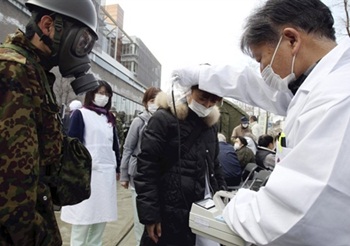
But scared Tokyo residents filled outbound trains and rushed to shops to stock up on face masks and emergency supplies amid heightening fears of radiation headed their way.
Radiation levels around the Fukushima facility again rose strongly this morning before falling, officials said, while in Tokyo they see-sawed yesterday without ever reaching harmful levels.
More than 200,000 people evacuated
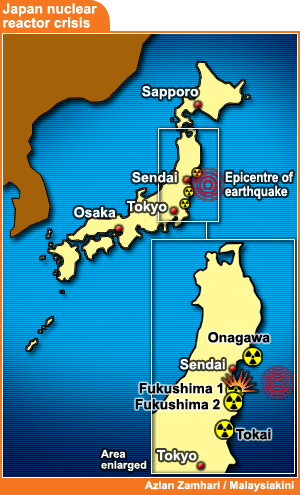
The government has warned people living up to 10km beyond a 20km exclusion zone around the nuclear plant to stay indoors. More than 200,000 people have already been evacuated from the exclusion zone.
 In the only country in the world to have experienced a nuclear attack - two bombs dropped by the United States during World War II killed some 200,000 people - Japanese citizens are gripped by dread of nuclear catastrophe.
“What we most fear is a radiation leak from the nuclear plant,” Kaoru Hashimoto, 36, a housewife living in Fukushima city, 80 kilometres northwest of the power plant, told AFP by phone.
Hashimoto said supermarkets were open but shelves were bare. “Many children are sick in this cold weather, but pharmacies are closed. Emergency relief goods have not reached evacuation centres in the city.
“Everyone is anxious and wants to get out of town, but there is no more petrol,” she said.
Snow and freezing rain in the northeast are compounding the misery of countless thousands who lost everything to nature's fury.
Millions in Japan have been left without water, electricity, fuel or enough food and hundreds of thousands more are homeless.
The machinery of modern life has been crumpled almost beyond recognition in the hard-hit city of Sendai - cars are stuck incongruously into the few remaining structures or balanced on top of wrecked homes.
“We were expecting a major earthquake on the coast here and had put plans in place to protect lives, but the level of this calamity is beyond what we planned for,” says Sendai mayor Emiko Okuyama.
“It is extremely painful for me.”
- AFP
JAPAN'S NUCLEAR CRISIS
Energy minister coy on nuke plans
What’s happening in Fukushima?
Japan nuclear crisis worse than Three Mile Island
Dr M: M'sia had bad experience with nukes


Are you sure you want to delete this comment?
This action cannot be undone.