




Najib asks Muslims to set their house in order
Prime Minister Najib Abdul Razak today called on Muslims to set their house in order first before they can become the guiding light for mankind, like their forefathers.
Prime Minister Najib Abdul Razak today called on Muslims to set their house in order first before they can become the guiding light for mankind, like their forefathers.
He said Muslims must acknowledge the need for them to be introspective and to take corrective action.
"Evidently, the problems faced by Muslims are within. They may seem difficult to manage but the solutions can be found by reverting to the true teachings of Islam," he said at the opening of the Wasatiyyah Convention at the First Millennium of Islam in the Archipelago in Putrajaya.
Also present were Higher Education Minister Mohamed Khaled Nordin and ministers in the Prime Minister's Department Jamil Khir Baharom and Dr Koh Tsu Koon.
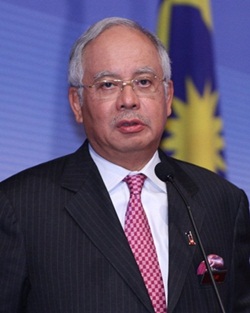 Najib asked why Muslims, as a people with dignity, should allow Islam to be looked down upon because of their inability to manage their own problems.
"The question one must ask is why is it that a third party, usually not an Islamic state, is entrusted to be the mediator of disputes.
"Why is it that corruption, maladministration, mismanagement and inefficiency are often associated with the administration of an Islamic state when we know that Islamic teachings, as contained in the Quran and sunnah of the prophet, can serve as guidance?" he said.
The prime minister said that of late there had been some disruption in the harmony among people of different faiths in Malaysia due to the attempts by some quarters to politicise religion among Muslims or non-Muslims.
He said that in a multiracial country, religious polemics should be managed with prudence and care because arguments over religion could fan the emotions of everyone.
"Indeed, in a democratic country, every individual has the freedom to express their opinions, provided they do not contravene the laws.
"Expressing views that one knows can incite people of other religions will invite provocative reaction and is not a responsible action.
Muslim nations stereotype
"Therefore, all quarters should exercise caution and adopt a wise approach for the sake of national stability. In fact, this is what every religion preaches," he said.
Najib said that in this era, people of various races, religions and cultures live and interact in a country and in the international community and, as such, unity and tolerance were the primary factors which supported national development and world peace.
He said unity and tolerance among the races and countries would facilitate the implementation of the community development agenda for common benefit while their absence would lead to chaos.
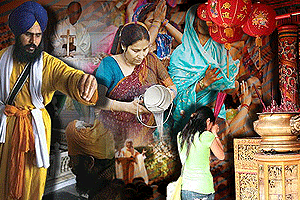 Najib said that in managing ethnic and religious relations in Malaysia, the government had, since independence, opted to be guided by the philosophy of integration rather than assimilation.
He also said that by adopting the wasatiyyah (moderation) approach over decades, Malaysia had emerged as a democratic Islamic nation and a modern industrialised country with a medium-high income.
Najib said Malaysia had also succeeded in disproving the stereotype assumption that Islamic countries were usually undemocratic, autocratic, rich in natural resources but poor in managing them well, and lacking in social justice.
Besides, he said, in the national and international arenas, Malaysia had shown that the government did not resort to mere rhetoric but undertook implementation in the right way.
Also, at the global level, Malaysia was friendly with all countries, both Islamic and non-Islamic, but the government, as a matter of principle, did not shy away from stating the truth by defending what was right and admonishing what was wrong.
"As a result, we have shaped a competent and capable Islamic nation which has sent peacekeepers under the United Nations (UN) and North Atlantic Treaty Organisation (Nato) banners to protect Muslims in Bosnia Herzegovina and maintain peace in Somalia.
"We have also stationed peacekeepers in southern Lebanon and sent women doctors to Afghanistan," he said.
- Bernama


