




Defence minister refutes spiralling OPV costs
Defence Minister Ahmad Zahid Hamidi has refuted his former fellow minister Zaid Ibrahim’s allegation of spiralling costs in off-shore patrol vessels (OPVs).
Defence Minister Ahmad Zahid Hamidi has refuted his former fellow minister Zaid Ibrahim’s allegation of spiralling costs in off-shore patrol vessels (OPVs).
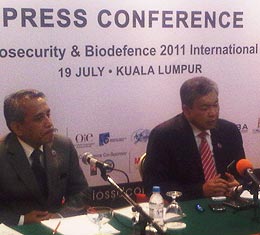 Ahmad Zahid (
right in photo
) said the ministry has just signed a letter of intent for the project.
Ahmad Zahid (
right in photo
) said the ministry has just signed a letter of intent for the project.
“We (the ministry) have not agreed on a suitable price for the project or the main contractors involved or its sub-contractor to provide the systems for the OPVs,” he said.
“How could Zaid know about this when there is nothing concrete being worked out yet. It seems he knows more than us and there is no deal finalised," said the defence minister.
Ahmad Zahid was responding to an allegation of allegedly spiralling costs of the OPVs, the project for which has been awarded to Boustead Naval Shipyard Sdn Bhd, with French based DCNS possibly being roped in.
 DCNS is the company which had delivered the two Scorpene submarines to Malaysia.
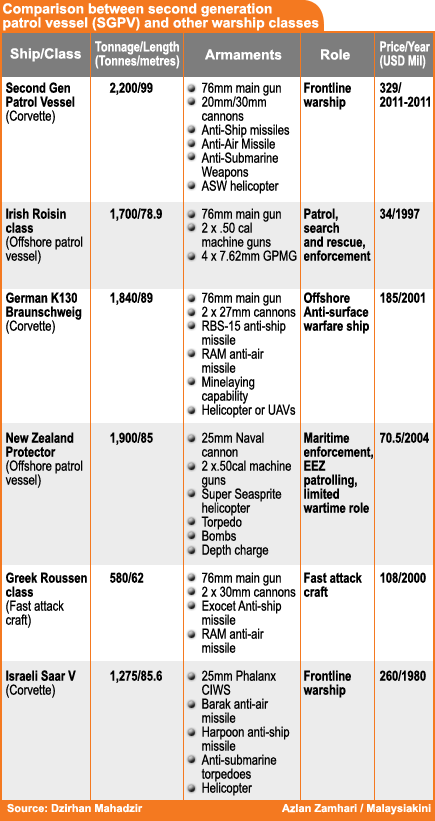
Zaid, who is now the president of Parti Kita, has alleged that the cost of the six OPVs has escalated from possibly RM6 billion to RM10 billion, citing a possibility of another Scorpene submarine scandal in the making.
Petaling Jaya Utara MP Tony Pua had first raised the high costs of the OPVs when he cited that the Royal New Zealand Navy had made similar purchases from "world-renowned global defence security company BAE Systems" last year at only NZ$90 million (RM210 million) each.
Ahmad Zahid was speaking to reporters after representing the prime minister in officially opening the Biosafety, Biosecurity and Biodefence International Congress 2011 (BioSSD 2011).
Also present in the event were the ministry's Secretary-general, Dr Ismail Ahmad. and Institut Penyelidikan Sains dan Teknologi Pertahanan Director-General Dr Abdul Ghaffar Ramli.
New Biosafety and Biosecurity Act
Ahmad Zahid, who had just returned from Europe accompanying Prime Minister Najib Abdul Razak, said the country is developing new laws on biosafety and biosecurity to ensure no facilities in the country or scientists here are being used to develop biological weapons.
The minister said as Malaysia is progressing tremendously in the field of biotechnology, there is concern the technology would be misused or the facilities used to produce biological weapons.
"Malaysia are among the first states to sign-up for the Biological Weapon Convention, in 1972, Having such laws would certainly be a right step forward to prevent the use of such dangerous weapons by terrorists."
"Such laws are being looked at by the ministry officials and the Attorney General Chambers. Possibly, such laws will be introduced in parliament by the second half of next year," said Ahmad Zahid.
He pointed out that Australia and the United Kingdom have such laws to ensure biosafety and security.
Asked how ready Malaysia was to face such attacks, Ahmad Zahid agreed that the country's preparations had to be stepped up further.
He revealed that besides hospitals, the country had little to fall back upon.
"However, Malaysia has never faced such an attack. Indeed the last time biological weapons were used, was during World War II. However, we must be vigilant and prepare for such eventualities," he said.
Three components required
In reading the prime minister's text, Ahmad Zahid said a number of groups had attempted to acquire and use such weapons in attacks against civilians.
"Nearly all past efforts to carry out biological terrorism have either been unsuccessful or were limited in their effect, suggesting that the technical hurdles to acquire mass-casualty capability are significant.
"At the same time, though, technological advances are gradually eroding these barriers. This means the threat of bioterrorism has the potential to grow incrementally in the coming decades," he said.
Ahmad Zahid it was urgent for countries to develop an appropriate framework for policy makers to understand and counter this threat.
He pointed out the country's bio-defence science and response capabilities are not up to the mark, with insufficient vaccines and therapeutics on hand.
Ahmad Zahid said three major components required immediately are vaccines and therapeutics, research needs and response infrastructure.
Zaid: Keep an eye on 'blockbuster' scandals


Report this comment
Are you sure you want to delete this comment?
This action cannot be undone.