




'Appointment of judges now more transparent'
Outgoing chief justice Zaki Azmi maintains that the appointment of judges and judicial commissioners (JC) to the higher courts through the Judicial Appointments Commission is now more transparent than previously as it is now carried out by secret balloting.
Outgoing Chief Justice Zaki Azmi maintains that the appointment of judges and judicial commissioners (JC) to the higher courts through the Judicial Appointments Commission (JAC) is now more transparent than previously as it is now carried out by secret balloting.
Prior to the appointments through the JAC, Zaki said the burden of appointing judges fell on the executive and the chief justice.
The JAC is therefore been a welcome relief, he added.
“In the JAC, I have had my recommendations (for appointment) of judges being turned down.
“At times, I thought it would go this way, but the outcome turned out to be another. The JAC is more fussy, as all this is done by secret balloting and there are no serial numbers, and hence, you do not know who (voted for whom).
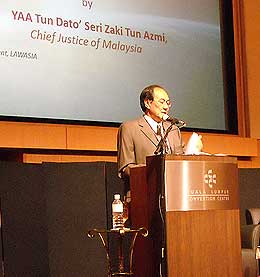 “Hence, I would say the appointment of judges and JCs and elevation is more transparent,” he said.
Zaki ( left ) also revealed that more people from the private sector - about “six or seven” - had entered the judiciary compared to previously.
The JAC has former CJs, former senior judges and former attorneys-general as commissioners.
The JAC was first mooted under the premiership of Abdullah Ahmad Badawi in 2009 and was passed by Parliament that same year. It is presently chaired by Zaki and has Chief Judge of Malaya Arifin Zakaria, Chief Judge of Sabah and Sarawak Richard Malanjum and Federal Court judge Zulkefli Ahmad Makinudin among its members.
Zaki said previously JAC was for the appointment of judges from the High Court and above.
“Now it is expanded to cover the appointment of JCs. Prior to this, most of the judges come from within the Judicial and Legal Service,” said the CJ.
Some of the new judges appointed from private service included former Bar Council chairperson Justice Mah Weng Kwai, Justice Mohd Ariff Mohd Yusof, Justice Hamid Sultan Abu Backer, Justice Lee Swee Seng, Justice Anantham Kasinater and Dr Prasad Sandosham Abraham.
Justice Anantham, who has been elevated to the Court of Appeal, had once presided over the case involving the various government linked corporations’ suit against former Malaysia Airlines chairperson Tajudin Ramli.
‘An honourable and respected job’
Zaki said besides some of the better perks of being a judge compared to private practise, there are some entering into the fold because they view it as an honourable and respected job.
“They feel they can make their own perception (of giving out judgments) without interference. I am not joking and that is why some of them told me that they opted to enter the judiciary service.
“During my tenure, we have the largest number of people from private practice entering the judiciary,” he remarked.
He also said during his time as CJ, the judiciary has managed to reduce the backlog of cases and cases are being fast-tracked.
There are only six cases left from the pre-1990 period and this, he stressed, is not due to the existing system but to the appeals from the cases being brought up and then transferred below for trial.
Zaki said at the end of 2008 there was a backlog of 95,523 civil cases, some dating back as far as 1987, and 4,554 criminal cases, some registered as far back as 2000.
“The civil cases pending have now been reduced to 27,723, a reduction of 71 percent, and for criminal cases, the pending cases are now reduced to 3,803, a reduction of 16 percent,” he said.
“The disposal of backlogs includes disposal of current and newly registered cases,” he said.
The parting CJ said the judiciary has closed 36 court rooms including nine High Courts, two Sessions and 23 magistrate’s courts and judges and judicial officers are transferred to cover heavier areas.
“A High Court costs the government RM1 million annually while a Sessions court costs RM500,000 annually for the payment of judges, officers and other perks.”
Concurring with incoming CJ Arifin, Zaki said ultimately the judiciary wants to see civil cases being disposed of within nine months and criminal cases within a year.
“This is something we are working on and this is the target we intend to achieve and we think it is reasonable.
“For habeas corpus cases, if previously it may have taken two years, by which time almost all of them would have been released, we have decided that it would be disposed off within a month of filing and on appeal at the Federal Court, the matter should be heard within a month,” he said, adding that even that he felt was too slow.
Zaki noted that judges now may feel they are under pressure following this demand and benchmark set, but this has to be done.
Arifin will give his vision on Wednesday
When asked whether the government should continue with the practice of appointing someone from private practise to become senior judges as had been done in his own and Gopal Sri Ram’s cases, Zaki said it was not for him to comment on this.
“It is not for me to say as it would depend on the government,” he said.
During the press conference Arifin was also asked on his aspirations and the direction which he would bring when he assumes the post of CJ next Wednesday.
Arifin, 61, however replied that he will reveal all on Wednesday after he took the oath of office.
He, however, maintains that he will continue with the good work laid by Zaki including continuing the practise of appointing senior judges as court managers, which had been successful in reducing the backlog of cases.
“I also will work with other colleagues as a team as had been practised before by Zaki.”


Report this comment
Are you sure you want to delete this comment?
This action cannot be undone.