




RM26mil wasted due to 7-year delay in campus
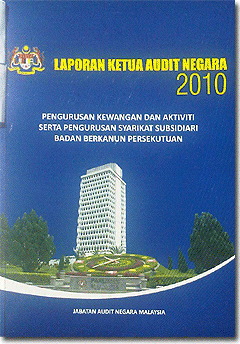
Universiti Malaysia Pahang's seven-year delay in the completion of Phase 1A of its campus in Pekan - the parliamentary constituency of Prime Minister Najib Razak - resulted in an additional of RM22.31 million borne by the government, said to the Auditor-General's Report 2010.
The report also criticised the poor workmanship of the contractors and questioned the university's decisions which resulted in the delay and extra costs...
Universiti Malaysia Pahang's seven-year delay in the completion of Phase 1A of its campus in Pekan - the parliamentary constituency of Prime Minister Najib Razak - resulted in an additional of RM22.31 million borne by the government, said to the Auditor-General's Report 2010.
The report also criticised the poor workmanship of the contractors and questioned the university's decisions which resulted in the delay and extra costs.
 "UMP should properly plan and take into account consumer needs and obtained a feasible ceiling price. The scope of the project should have been determined at the planning stage to avoid additional costs and delays," the report states.
It also noted that there were several items which did not meet contract specifications, including lightning protectors.
The report commented that defects, such as the lack of water outlets for rainwater and air-conditioning, should have been brought up while the building was still under warranty.
Other defects listed included improper building materials used. It also noted that the exterior paint of the buildings appeared faded and not of good quality.
The auditor-general proposed those buildings that showed signs of fungal growth be repainted.
Construction of two faculties
Phase 1A of the project is for the construction of two faculties - mechanical engineering and electronic and electrical engineering.
The university, which was previously the Kolej Universiti Kejuruteraan dan Teknologi Malaysia, began operations on May 1, 2002 and was renamed UMP in Feb 1, 2007.
The buildings were built at a cost of RM161.16 million and there was a delay of 28 months in finalising the deal. As a result of financial constraints and changes to its scope, the student's hostel was not built.
The report noted while the Finance Ministry had agreed to appoint a contractor by giving a letter of intent on March 2002, it was found in December 2004 that the contractor did not submit a proper proposal - there was no structural drawings, the mechanical and electrical drawings were too simplistic, while the infrastructure drawings did not include drainage, sewerage, roads and water supply.
There were further losses suffered by UMP when the nursery, which was completed in Phase 1, lost all of its trees. In 2005, the auditor-general found that the contractor had relocated the trees.
Further checks in December 2010 by the auditing team found that the nursery site was used as a project development site.
"UMP informed that the plants transferred to the nursery were damaged or had died resulting in losses of RM480,000.
"In the auditor's opinion, Phase 1A should have been conducted quickly so that the payment of RM480,000 for the preparation of the nursery and landscape could have achieved its purpose and the government would not have to absorb the added costs of maintenance," the report states.
Gov't could have saved money
To make matters worse, UMP spent an additional RM1.03 million for landscaping and turfing.
"The audit team found that the landscape did not follow the concept stipulated in the sketch. UMP found that the land is not suitable, resulting in trees and grass not growing well. In our opinion, UMP should have done feasibility studies.
"The land should have been rehabilitated for two or three years further before the trees were planted."
The auditor-general said that if Phase 1A was completed on schedule, UMP could have saved RM26.31 million.
"This comes from RM11.77 million from renting dormitories, and the remaining RM14.54 million from the renting of the administration block, lecture classes and study facility.
"The delay also resulted in students not being able to stay in dormitories and the university's administration to be based at its temporary campus in Gambang and not at UMP, Pekan.
"This resulted in officers having to shift to and fro from Gambang to Pekan - a distance of 62km - for matters related to administration, teaching and observation. This affected their performance and led to a rise in travel and administration expenses."
The report noted that hostel which could accommodate 2,000 students, was completed in June this year but there is still a need to accommodate close to 5,000 students from five faculties in Gambang.


Report this comment
Are you sure you want to delete this comment?
This action cannot be undone.