




M'sia 'below average' in graft perception index
Malaysia has been ranked ‘below average’ in a survey on the likelihood of its companies to bribe when doing business abroad.
Malaysia has been ranked ‘below average’ in a survey on the likelihood of its companies to bribe when doing business abroad.
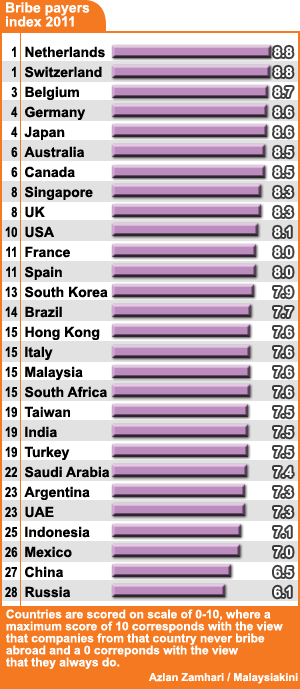
The Transparency International survey of 28 countries found that Malaysia scored 7.6, below the average of 7.8 out of a possible 10 (totally unlikely to bribe).
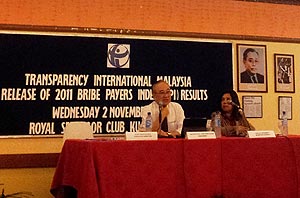 "This is a typical performance for Malaysia, where we are either slightly above or below average,” Transparency International Malaysia president Paul Low noted.
"But Malaysia, although small, has a high degree of participation in international trade... so there is still a lot of room for improvement. (Its) performance in this area is not satisfactory.”
The survey sampled 3,000 businesses, including 148 companies based in Malaysia, involved in international trade.
However the result shows a marked improvement since 1999 when it scored a dismal 3.9. It indicated that Malaysian businesses were likely to bribe other companies and officials abroad.
However, consistent improvement has been recorded since the country scored 4.3 in 2002 and 5.6 in 2006.
The current score is the highest since the index was first compiled in 1999, and shows Malaysian businesses are unlikely to bribe abroad.
It did not qualify for the index in the previous edition of the Bribery Perception Index in 2008 due to poorer economic performance.
"This improvement is in line with countries in the region," said TI-M executive director Alan Kirupakaran.
Indonesia, which debuted on the Bribery Perception Index this year following a growth in its economy, showed a commendable performance of 7.1.
Singapore scored 8.3, several spots behind leaders Switzerland and the Netherlands.
‘Act against companies’
Russian and Chinese businesses were ranked most likely to give bribes when trading overseas, scoring 6.1 and 6.5 respectively.
Low said this was important to note as China is a big trading partner of Malaysia, which shares the 15th spot with Hong Kong, South Africa, Brazil and Italy.
 "I think the largest overseas investment for many companies in Malaysia is in China... which could explain why Malaysians may pay bribes, but the index does not capture this," he said.
Low conceded that Malaysia's improvement in the index could also be due to stricter international regulations against bribery.
In the UK, he said, the Anti-Bribery Act states that companies whose employees bribe abroad are also held accountable.
For example, Siemens was fined more than EUR1 billion for bribery abroad.
"In Malaysia, prosecution is against individuals, who may have the blessings of people on top (of the company) who will just say ' Aiyoh , sorry my employee did this'," he said, calling for stricter regulations against companies.
TI-Malaysia is also adopting international practices of policy for good governance, like the OECD Convention on Anti-Bribery, and continued diligent implementation of the UN Convention Against Corruption.
The findings of the survey, Low added, would be tabled at a roundtable discussion with regulators, Bursa Malaysia and private businesses "hopefully in a month's time".
Related stories
Pakatan MPs dispute Ng's direct negotiations view
DAP rep wants independent accountability panel
'GST will not save Malaysia from bankruptcy'
MACC: No irregularities in purchase of binoculars
EPF says procedures followed in 13 mega-loans


