




More power to state governments
COMMENT Malaysia is currently at the political and administrative crossroads. The malfunctioning of the government is simply too glaring to ignore. The government is failing, which will result in grave repercussions for the country.
The 13th general election presents Malaysia's contesting coalitions a rare opportunity to reform the government, to make it a functioning and effective democracy once again. The key to this is decentralisation and people empowerment...
COMMENT Malaysia is currently at the political and administrative crossroads. The malfunctioning of the government is simply too glaring to ignore. The government is failing, which will result in grave repercussions for the country.
The 13th general election presents Malaysia's contesting coalitions a rare opportunity to reform the government, to make it a functioning and effective democracy once again. The key to this is decentralisation and people empowerment.
Over the past several decades, the spring of democracy has swept across a number of countries in the region. From Indonesia to India, from Thailand to Nepal, governments are embarking on rapid decentralisation.
Even communist China is implementing a series of decentralisation policies, which outshines many democracies. It is only Malaysia that has gone the other way round towards centralisation.
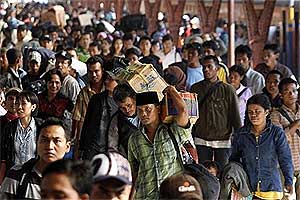 Take Indonesia. Since the fall of Suharto's dictatorship, this country has reversed direction from a centralisation policy towards rapid decentralisation. They called this decentralisation process ‘the Big Bang Policy'.
The main objective is to empower citizens in line with rapid democratisation. The central government rapidly transferred power to local governments. Some 2.1 million civil servants were successfully transferred to regional and state governments. The shifting of powers was followed by a gradual transfer of government structure, personnel, money, offices and documents.
The central government now wields only six areas of absolute power - defence, foreign affairs, police, monetary, justice and religious affairs. Most other functions have been transferred to local governments or shared between the different tiers of government.
Jakarta also transfers money to support local and regional governments through a series of block grants and specific grants. They are still in the process of harmonising the laws in order to make the smooth transfer of power complete.
Even China is for decentralisation
Now take China. It has implemented decentralisation policies since the 1980s. It is now the most decentralised country in terms of fiscal expenditure.
In 2011, local governments spent 84.9 percent of the total budget, while the central government in Beijing spent a mere 15.1 percent on defence, foreign affairs and R&D (research and development). At the start of decentralisation, the central government had spent about 55 percent of the entire budget.
 Social security, usually the federal government's responsibility, was transferred to local governments. In 2010, the local governments were responsible for 95 percent of spending on social security while the central government spent 5 percent. More money means more power, hence, local governments are very powerful.
In 1994, China introduced a tax-sharing reform scheme that divided taxation into central taxes, shared taxes and local taxes. This provided local governments with the authority to collect their own taxes for local spending.
In terms of tax collection, a degree of imbalance still exists. The local government collects roughly 50 percent of budgetary revenues, but spends up to 85 percent. This gap is filled mainly by central fiscal transfer to local governments. The central government collects 50 percent of taxes, but spends only 15 percent. Beijing then transfers the ‘surplus' to local governments.
No instability in government
Both Indonesia and China have huge populations with enormous challenges. However, they are able to form stable governments that respond to the people's needs.
Last year, a huge number of uprisings took place in various provinces in China on environmental and security issues. These resulted in serious challenges to local authorities. But the central government remained stable and economic growth was unaffected.
In recent years, both economies have taken off to greater heights, thanks to local governments that are friendly to investors and able to respond quickly to solve local issues.
However, decentralisation is not without its own challenges. In Indonesia, many accused the central government as being reluctant or half-hearted in releasing its grip on power. Many local governments are ill-equipped in dealing with broad powers.
There is also a certain degree of mistrust between the federal and local governments in handling administrative and financial issues. It will take longer to harmonise laws to smoothen the transition of power. In Indonesia, it has taken more than a decade to achieve decentralisation of power and ‘the Big Bang Policy' remains in effect.
Critics often argue that decentralisation may not result in the most efficient government, for example in India and Indonesia. In many cases, decentralisation is followed by decentralisation of corruption and money politics, considering the case of China and Indonesia, where corruption is entrenched in society.
However, in mature democracies, such as Australia and Germany, the government is decentralised, clean and efficient.
From time to time, there will be reports of certain conservative mayors in Indonesia implementing certain unpopular policies. These often created uproar in society.
Decentralisation may have such challenges. However, if the local government is elected through clean and fair elections, it may fall if such policies are not welcome.
Malaysians must find confidence
In Malaysia's context, a strong civil society and moderate culture will be able to avoid these shortcomings. The federal government, state governments and local governments will have to decide to what extent decentralisation is to be implemented.
Malaysians should be confident enough to steer Malaysia to a better path of decentralisation. It will take courage, confidence and political will to push through the implementation process. Malaysia has no choice but to embark on decentralisation path based on our own political system and culture.
The Pakatan Rakyat state governments have already shown they are adamant about wresting more power from the federal government.
 In Penang for example, the state government has set up George Town World Heritage Incorporated to compete with the Culture and Heritage Ministry. Penang Global Tourism is competing with federal agencies in the tourism sector.
Frustrated by recent water shortage problems, the Selangor government has proposed to buy back Syabas from federal government.
The battle to decentralise has begun but not on a large scale, and it is haphazard without a clear goal of achieving decentralisation. All thinking lawmakers on both sides of the divide must rethink the future of Malaysia. How do we embark on decentralisation and democratisation?
Putting decentralisation on GE agenda
Imagine education being a state government's responsibility. This would provide the different state governments with the impetus to compete to produce better schools and better curricula, in order to produce more talents to serve their states.
Industrialised states like Penang would focus on science and mathematics. Schools in Sarawak would emphasise modern agriculture. Today, it is a ‘one size fits all' curriculum.
The rakyat will decide on the state government's performance on important matters like education rather than trivial issues like filling up potholes. State governments that fail to perform in education will definitely lose power.
Allow the imagination to run on to the issue of tax collection. With more revenue from taxes, state governments and local authorities would be able to spend more on the rakyat.
Could hot environmental issues like the Lynas rare earths refinery be resolved by the state government instead of Putrajaya? Surely the Pahang government would be more than willing to listen, as the Pahang rakyat would be voting for or against it in the next election.
Political parties in Sabah and Sarawak have put forward their request for more autonomy. It is in fact a decentralisation proposal.
With Peninsular Malaysia likely to be split equally between Pakatan and BN, any coalition which wants to come to power will have to renegotiate terms with Sabah and Sarawak political parties. Decentralisation can be a key policy to put on the negotiation table. The rest of the states in the peninsula would likely want to follow Sabah and Sarawak in gaining more autonomy.
Selangor Menteri Besar Abdul Khalid Ibrahim has proposed the restructuring of the current federal grant system by an Independent Grant Commission to ensure greater fairness in distributing federal grants, taking into consideration the size of the population, growth and regional development.
The Penang government has led the pact to decentralise state powers by passing a law in 2012 to restore local government elections. Once implemented, elected local councillors would wield greater power and likely make local councils more independent and responsive to ratepayers.
Decentralisation is the right thing to do for Malaysia's democracy. We must put it on 13th general election agenda.
Yesterday: Time to reverse federal squeeze on state powers
SIM TZE TZIN is PKR's state assembly representative for Pantai Jerejak. He is frustrated by how little the state government can do for the rakyat. This commentary is part of the ‘Jiwa Merdeka' project by young PKR leaders who want real change for Malaysia.


