




Klang MP's bid to review electoral roll rejected
Klang MP Charles Santiago's bid for a review of the principal and supplementary electoral rolls for his parliamentary constituency was dismissed by the High Court in Shah Alam today.
Klang MP Charles Santiago's bid for a review of the principal and supplementary electoral rolls for his parliamentary constituency was dismissed by the High Court in Shah Alam today.
Judge Vernon Ong said the court was bound by the Section 9A of the Elections Act 1958, in that it cannot review a gazetted electoral roll.
The court also could not compel the Election Commission (EC) to respond to the queries of the MP, Justice Ong said, as there was no provision in the Act for it to do so, and hence this does not comply with the Specific Relief Act as cited in Charles’ application to seek such relief.
The court, he ruled, therefore found Charles' application to be frivolous and vexatious.
"Hence the court dismisses the application, and as this case is of public interest the court decides not to make any order as to costs," Justice Ong said.
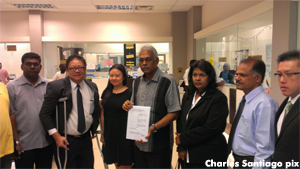
 Responding to the decision, Charles (
right in photo
) said the court had failed to address the key issue that Section 9A is ultra vires the federal constitution.
Responding to the decision, Charles (
right in photo
) said the court had failed to address the key issue that Section 9A is ultra vires the federal constitution.
He said that he had raised sufficient grounds to show the existence of phantom voters in the electoral rolls.
"What the court decided today is the legalising of phantom voters," Charles said.
The central issue is Section 9A, which was controversially introduced into the Elections Act 1958 after the High Court in Kota Kinabalu declared the Likas by-election of 2001 null and void.
The Kota Kinabalu High Court judge ruled that there were discrepancies in the electoral roll.
This landmark judicial decision led to the government amending the Elections Act by bringing in a new Section 9A.
This section states that after an electoral roll has been certified or re-certified, and notice of the certification or re-certification has been published in the gazette as prescribed by regulations under the Act, the electoral roll shall be deemed to be final and binding, and shall not be questioned or appealed against in, or reviewed, quashed or set aside, by any court.
Bar Council chairperson Lim Chee Wee has also voiced his concern over Section 9A, when asked about the on-going Sabah royal commission of inquiry on illegal immigrants.
Charles was represented by John Fam, while senior federal counsel Suzana Atan appeared for the EC.
Charles in his application for leave (permission) asked the High Court to compel the EC to review the principal and supplementary electoral roll for the fourth quarter of 2012.
He also wanted the commission to perform its statutory duty and functions under the Elections (Registration of Electors) Regulations 2002 to review the electoral rolls and also for the EC to be compelled to respond to his queries made last December.
‘A sad day for voters’
Charles described today’s decision as a sad day for voters as the court has denied their fundamental right to vote.
He said illegal phantom voters had become a norm in Malaysia, for he felt he had produced enough evidence in court on those who had not registered themselves as voters.
This included the case of Premila Menon, who resides in Dublin, Ireland, and found her name in the electoral roll even though she never registered as a voter.
 The Klang MP said other evidence included the statutory declaration of a Pandamaran resident stating he is the only voter registered at his address - but the address also lists another 60 voters, of other races, there.
“The court completely dismissed this. This is a disservice and injustice to Malaysian voters. It’s a very sad day, for we produced evidence and statutory declarations.
“We pointed out that there are people not living in the address stated in Pandamaran. However, the court did not deal with the matter.
“Neither did the court deal with the constitutional question, and whether the delineation of the constituency must get the approval (of Parliament).”
Charles said the court ruling came as a shock to him, as after four days the court also found the application to be frivolous and vexatious.
Fam said they would consider taking the matter to the Federal Court, but admitted that time was not on their side.
“We will have to get the grounds of judgment and study it first,” he said.
Fam explained that under Article 113 of the federal constitution, when the delineation of an electoral constituency takes place, it must be brought to Parliament and must get at least slightly more than 50 percent approval from the House.
This issue, he added, was not touched on at all by the court for consideration.


Report this comment
Are you sure you want to delete this comment?
This action cannot be undone.