




Only 5 Asean countries invited to observe GE13
The Election Commission (EC) has decided to invite up to 42 foreign delegates from five Asean countries and the Asean secretariat to observe the 13th general election, and requests from other countries for such a mission will not be entertained.
The Election Commission (EC) has decided to invite up to 42 foreign delegates from five Asean countries and the Asean secretariat to observe the 13th general election, and requests from other countries for such a mission will not be entertained.
The five Asean countries are Thailand, Indonesia, Cambodia, the Philippines and Burma.
Each country, as well as the Asean secretariat, can send up to seven delegates, making the maximum number of foreign observers invited to 42.
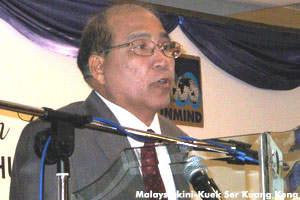 The announcement came from the EC deputy chairperson Wan Ahmad Wan Omar (
left
) when briefing the Foreign Correspondents Club Malaysia in Kuala Lumpur last night.
The announcement came from the EC deputy chairperson Wan Ahmad Wan Omar (
left
) when briefing the Foreign Correspondents Club Malaysia in Kuala Lumpur last night.
The reason for inviting these five countries was simply due to reciprocity as they had invited Malaysia to observe their polls before, he explained when queried.
He claimed that Singapore is not in the list as the island city-state did not invite Malaysia to observe its general election last year.
The invitations will be sent out by the foreign ministry soon, said Wan Ahmad.
Asked whether other countries can request to join in, Wan Ahmad's answer was in the negative.
"I'm sorry... their requests will not be entertained but they can always observe the election outside the restricted areas," he said.
Polling centres, nomination centres and votes tallying centres are considered restricted areas under electoral laws where only authorised personnel can enter.
The opposition has been lobbying hard to bring in foreign observers from countries with mature democracy including the European Muslim Election Assessment Committee and Australia, but it had been futile.
On Feb 16, the home ministry even blocked Australian senator Nick Xenophon from entering Malaysia and deported him when on a mission to examine the Malaysian electoral system.
Wan Ahmad hoped the five Asean countries invited will send credible delegation probably led by a senator, minister or judge.
The delegation will arrive two or three days before polling day and arrangements will be made for them to observe polling centres in both rural and urban areas in the company of local protocol officers, he elaborated.
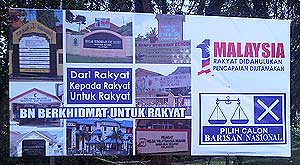 On the issue of political parties of both sides breaching electoral laws by putting up flags and banners before beginning of the election campaign period, Wan Ahmad said the EC has no power to take action against them as it falls under the jurisdiction of local governments.
The EC can only form joint enforcement teams with the police and local governments once the campaign period begins, he explained.
Asked whether the EC can call on local governments to act against such violations, Wan Ahmad replied that the commission chose to respect the responsibilities of other government agencies.
“There are thousands of local governments in Malaysia. They have their own by laws, they have their own ways of making decisions.”
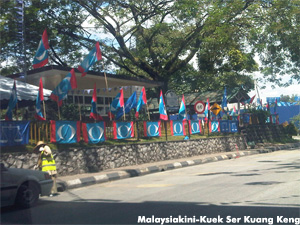 He revealed that some local administrations allow political parties to put up flags during their political events but the political parties did not remove them after the events, while others allowed campaign materials to be displayed at certain areas.
Wan Ahmad also pointed out that local governments would not dare to challenge the state government when their s ruling parties want to hold party functions and put up their flags.
MMore to followmmooMMMMore to follow


Report this comment
Are you sure you want to delete this comment?
This action cannot be undone.