




Post-GE13, what can you and I do?
ANALYSIS One of the greatest things that took place on May 6 was an outpouring by Malaysians citizens greatly affected by the general election result and who started asking themselves a burning question: "This cannot go on. What more can I do to create the Malaysia we all deserve?"
This last part in this series of articles addresses that very question: what can we, as normal Malaysian citizens, do?
One of the three quotes I started this series with was: "Don't get mad, get organised."
 There is nothing wrong with getting angry. However, mature individuals always try to channel their anger into something positive, something that will yield change.
Our actions must first be guided by wisdom and understanding. Before we charge into the battle, let us study the battlefield carefully and thoroughly...
ANALYSIS One of the greatest things that took place on May 6 was an outpouring by Malaysians citizens greatly affected by the general election result and who started asking themselves a burning question: "This cannot go on. What more can I do to create the Malaysia we all deserve?"
This last part in this series of articles addresses that very question: what can we, as normal Malaysian citizens, do?
One of the three quotes I started this series with was: "Don't get mad, get organised."
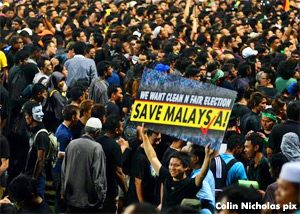 There is nothing wrong with getting angry. However, mature individuals always try to channel their anger into something positive, something that will yield change.
Our actions must first be guided by wisdom and understanding. Before we charge into the battle, let us study the battlefield carefully and thoroughly.
We must understand how our political system works. All the evidence suggests that we must win via this system, before we can change the system into something better and more democratically representative.
I posit that the most important thing we need to understand is that expanding Pakatan's seats in Parliament is all about three things: rural areas, rural areas, rural areas.
Most, though certainly not all, who clamour for change are urbanites. All the numbers show that this demographic is all but saturated. Stand on any tall building in any Malaysian city, and the odds are that Pakatan will have won in every area as far as your eye can see.
Winning rural Malaysia
What can an urbanite do to influence the vote in rural Malaysia?
There are simple, obvious ways. Spend more time in rural Malaysia, and try to influence those who live there.
That can take the form of spending more time with hometown communities, leafleting in remote areas, and so on.
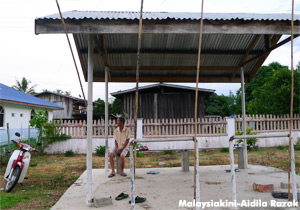 Do remember: do not expect rural Malaysians to think like urbanites, and most important of all, do not be angry with people who have a different perspective - that would only be akin to Umno being angry at the Chinese, post-GE13.
Instead, do your best to understand where they are coming from, and how best to meet their needs and aspirations.
There is another, more controversial method. In Malaysia we have freedom of movement. We can register ourselves as voters wherever we like, as long as there is a valid address - say a grandparent's home.
This is something to think on for those of us who live in constituencies which won whopping five-digit majorities. The inequality of our system makes our votes much less valuable in these areas.
After all, there are many urban seats that were won with majorities that were larger than the total number of voters in certain seats. For example, the number of registered voters in every single parliamentary seat in Perlis is lower than the majority with which Teresa Kok won Seputeh (by 51,552 votes).
Changing Malaysian politics
While there may be more to be said on this in time to come, I want to briefly discuss one other major area where Malaysians can make a difference post-GE13.
We would do well to remember this political fact: in a Westminster system such as ours, a politician must conventionally lead his/her party before potentially leading the government.
This is in stark contrast to, say the American presidential system, where the president need not necessarily lead the party, but must to win the party primary to be picked as the candidate. The people then directly vote for their president.
In the Westminster system, party elections are as important as national elections in terms of deciding who will be head of state.
Najib Abdul Razak has instantly gone from fake ‘moderate' to racist firebrand for that very simple reason: if he fails to retain the presidency in the coming Umno elections, then he will no longer be prime minister.
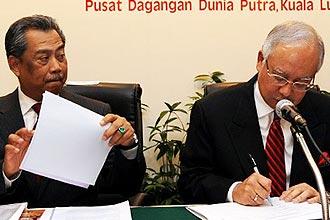 Najib may have beaten Anwar Ibrahim to Malaysia's greatest prize, only to lose to it to Muhyiddin Yassin.
So now Najib's fate lies in the hands of Umno members and delegates. Those of us who are not Umno members have absolutely no say now as to whether it will be Najib or Muhyiddin who will emerge as prime minister. We are disempowered and disenfranchised from that decision.
That said, there is a path to empowerment and enfranchisement, should we so chose.
In Malaysia, there is a stigma (especially among urbanites) towards joining political parties. I will perhaps address this in detail another time. Suffice to say for now that it does not involve as much selling of one's soul as one may think.
In all major Malaysian political parties, save one, joining does not immediately grant you the powerful voting power. This is because they operate via a delegate system - where each local party division elects a certain small number of delegates, who in turn elect their national leaders.
The exception is PKR, which in its last election granted direct voting powers to all of its members. This means that the top posts in PKR are determined by every single one of its members directly, not via the tiered delegate system practised by the other parties.
As we evaluate the evolving post GE13 landscape, let us for now leave that as something to mull upon.
The race game
It is hard to shut racists up. But it is not so hard to prove them wrong.
Now is the time for displays of cross-ethnic solidarity and affection. One initiative I saw was a group of Chinese Malaysians who sent flowers to the PAS headquarters after the election results.
This is the type of activity that bridges the gap, and immediately dispels the notion that some sort of major racial divide was sparked off in GE13.
If anything, GE13 has been an outpouring of multi-racial solidarity. Now, all that remains for us is to prove it - again and again, in every way we can imagine and in every facet of our everyday lives.
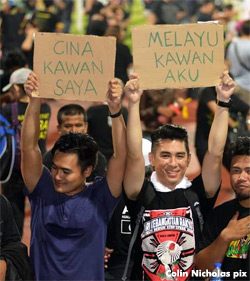 Take the time to expand your circle of friends. Reach out and build on this new common ground. Never wait for the ‘other side' to make the first move, be the change you wish to see.
It may not be as easy as it sounds because, once again: we should not expect everyone to have exactly the same point of view nor have the same things resonate in the same ways for everyone. Nevertheless, if we truly open our hearts and minds and reach out sincerely, the bonds we build will be those of tomorrow's great, united Malaysia.
I have detailed above some ways in which we, as ordinary citizens, can begin to take Malaysia back. There is an immense amount of data to process and analyse, as well as a lot of reflection and soul searching that need to be done in the weeks and months ahead.
As we begin this journey, let us always endeavour to anchor ourselves in the things that truly matter: just principles, the familial bonds that hold this nation together and a sincere concern for the welfare of every Malaysian.
As long as we keep our eyes open and stay true to our moral compass, there will be nothing that can prevent us from creating the better Malaysia that we all truly deserve.
Part 1: Of geography, race and a BN merger
Part 2: Whither Pakatan?
NATHANIEL TAN believes in #TsunamiCintaMalaysia. He tweets @NatAsasi.


