




Former CJ laments ineffectiveness of EAIC
Former Chief Justice Abdul Hamid Mohamad today questioned the effectiveness of the Enforcement Agency Integrity Commission (EAIC), which since its formation in Sept 2011 and until the end of 2012, had only ordered one disciplinary action and two warnings to civil servants.
Former Chief Justice Abdul Hamid Mohamad today questioned the effectiveness of the Enforcement Agency Integrity Commission (EAIC), which since its formation in September 2011 and until the end of 2012, had only ordered one disciplinary action and two warnings to civil servants.
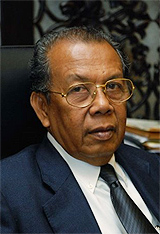 The commission focuses on the 19 enforcement agencies and Abdul Hamid (
left
) said for a budget of RM14 million for two years, it is a costly venture.
The commission focuses on the 19 enforcement agencies and Abdul Hamid (
left
) said for a budget of RM14 million for two years, it is a costly venture.
"In establishing a new agency, you need to recruit new officers. They lack experience and the expertise. To overcome that problem, you either recruit officers from other agencies or you may need to borrow them.
"How senior are they? It depends on the grades of the posts you have. Do you think those agencies will give their best officers?
"Do you think that officers who think that they have the potential to go very high up in their service would want to apply to be a permanent officer of the EAIC where the chances of promotion is very limited," he asked.
Abdul Hamid also pointed out that the EAIC is supposed to have six investigators to look into complaints lodged on enforcement agencies but at present it only has one since May 16.
And even if there were more, they would be based in Putrajaya. "But the complaints and the witnesses could be from all over the country," he said.
The former CJ was speaking on the topic ‘A critical analysis of the EAIC' at the Integrity forum today.
He noted that since EAIC's establishment in September 2011 until the end of 2012, it has received a total of 347 complaints and after preliminary investigations 110 were rejected, nine were referred to Malaysian Anti Corruption Commission (MACC), 15 were referred to appropriate disciplinary authorities, four were referred to appropriate disciplinary authorities and MACC; 60 or 17.2 percent were directed for full investigation and 149 required further preliminary investigation.
Abdul Hamid said the EAIC had directed 60 complaints to be referred for full investigations, which, under the Act, should be done by the task force.
“However the commission has not established any task force yet (on those),” he said.
“So far full investigations were done on three cases, and from these three, (as above) only one has been referred to the disciplinary authority of the police while the two cases were closed due to double jeopardy as the complaint had been heard and punished by the appropriate enforcement agency, namely Rela and the Road Transport Department.
Can EAIC handle other matters than corruption?
Abdul Hamid said with the exception of the chairperson of the commission, Heliliah Mohd Yusof, who was once a solicitor general, none of the commissioners had experience in scrutinising investigation papers. Heliliah is also a former Federal Court judge.
The former CJ also pointed out with the exception of corruption cases, the EAIC is required to handle or investigate other complaints even if it falls under the Penal Code, based on the EAIC Act 2009.
This, he added, raises questions on whether the EAIC could handle complaints of disciplinary or criminal in nature involving 160,000 (enforcement) personnel and even if the public decide not lodge police reports but channel their complaints to the EAIC, can the six investigators or at present, one, handle them all?
“The commission (EAIC) has been lucky so far because the public, due to ignorance or otherwise, choose to lodge police reports instead of complaining to the commission. Furthermore, does the investigation officer (IO) have the expertise, experience, facilities and equipments to carry out investigation of offences under all laws?” he asked.
Abdul Hamid said based on what he had put forward, some relevant and pertinent questions should be asked on the EAIC functions namely, whether its scope and functions should include criminal offences, and wouldn’t it be better to leave to the agencies entrusted to do it via the disciplinary committees to handle them.
He also asked can’t we rely on the Police Force Commission or the Public Services Department, the chief secretary to the government (KSN), and others, over disciplinary matters rather than the EAIC.


Report this comment
Are you sure you want to delete this comment?
This action cannot be undone.