




Lawyers: No provision to cancel passports in Act
The Passports Act 1966 does not provide for the cancellation of Malaysian passports as claimed by Immigration Department director-general (DG) Alias Ahmad, lawyers said.
The Passports Act 1966 does not provide for the cancellation of Malaysian passports as claimed by Immigration Department director-general (DG) Alias Ahmad, lawyers said.
“Looking at the Passports Act, I really cannot find which provision allows (Immigration to revoke passports),” lawyer Syahredzan Johan said.
 In fact, he said, he does not know of any law which allows the government to cancel a Malaysian passport.
“As far as I can find there is nothing to allow the cancellation of passports. But individual laws do provide powers to bar people from leaving Malaysia, for example under the National Higher Education Act (PTPTN) 1997 and Bankruptcy Act 1967, and also if you are bailed for a criminal offence,” Syahredzan ( left ) said in a text message to Malaysiakini .
However, he stressed that these Acts only allow barring individuals from leaving the country, but not the revocation of valid Malaysian passports.
David Matthews, who specialises in the area, said that the barring of individuals under these separate laws, however, cannot be done administratively by the DG but must be through an order of the court.
“The Passports Act is really an administrative law and does not deal with citizenship, etc. It only allows the DG to remove non-citizens who have unlawfully entered Malaysia, and does not apply to citizens,” he said when contacted.
‘Tarnishing country’s image’ reason won’t stand
He said that the DG may argue that under Section 12D of the Act he could be given such powers by the minister, but this refers more to policy matters.
“But any such direction has to be reasonable in an adminsitrative law sense and also fair. ‘Tarnishing the nation’s image abroad’ is vague and can hardly stand as a proper reason to cancel a passport,” he said.
In the area of revocation of citizenship, he said that these is dealt with in the federal constitution, but can only be triggered if a citizen does things which nullifies his or her citizenship.
 “These include things like taking up citizenship in another country or performing the rights of citizens of another country, like voting.
“But it is not revocation per se. One cannot be deprived of the right of citizenship,” he said.
He added that if the 6,564 people referred to were charged in the foreign countries, they would have to face legal penalties there.
Meanwhile, Bar Council president Christopher Leong ( left ) said that the Immigration DG can only invoke the Passport Act to seize and retain passports.
But this too, only applies to offences that are made in relation to the travel document itself, like "forging or tampering of passport or falsely representing oneself as a person whose passport has been issued".
 "If the DG had, in fact, said that he has such power under the Passports Act (to cancel passports), then he is mistaken and was ill-advised," Leong said in a text message.
He added that the authorities are wrong to "resort to threats of administrative action", even if views expressed by dissenters are wrong or rude.
Yesterday, Alias ( right ) was quoted by Berita Harian as saying that its department will revoke the passports of 6,564 Malaysians for, among others, “tarnishing Malaysia’s image abroad”.
He told the Malay-language daily that this is in accordance with the Passports Act, but did not specify which section of the Act.
'Ignorance of the law'
He, however, contradicted his earlier statement, by saying that the law only allows the government to bar Malaysians from leaving the country, and not to stop them from entering Malaysia.
On Monday, he was reported by Berita Harian as saying that Malaysians who protested abroad could be barred from returning home and could have their passports cancelled under Section 8 of the Immigration Act 1959/1963.
“It is shocking for him to say this as it shows an ignorance of the law. The entire Section refers to immigrants... The way he is moving from one (Act) to another shows that he does not know what he is talking about,” Matthews said.
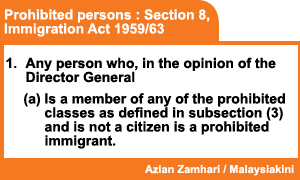 Section 8 of the Immigration Act states that the Immigration DG can classify any non-citizen as a prohibited immigrant, as defined in Section 8(3) of the same Act, and bar him/her from entering the country.
In one prominent case, the government had cancelled the passport of Hindraf leader and now deputy minister P Waythamoorthy, forcing him to live in exile in London.
The United Kingdom Border Agency, in a written reply to an application by Waythamoorthy’s lawyers under the Freedom of Information Act, said that the passport was “cancelled because the Malaysian authorities were seeking (Waythamoorthy’s) arrest to face criminal charges”.
Malaysiakini had repeatedly attempted to contact Alias for clarification of which section of the Passport Act he intends to invoke to cancel the passports, but cannot reach him as yet.
Criticism of government not criticism of country
Meanwhile, PKR communications director and Seri Setia assemblyperson Nik Nazmi Nik Ahmad said that Alias’ statement is “utterly misguided” and “infringes on one of the most fundamental rights as a citizen”.
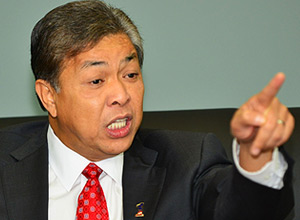 Charged with failing to give police 10 days notice about the mammoth May 8 Kelana Jaya rally, he also noted that the Immigration Department falls under the purview of Home Minister Ahmad Zahid Hamidi (
left
), “who has been cracking down on dissent”.
Charged with failing to give police 10 days notice about the mammoth May 8 Kelana Jaya rally, he also noted that the Immigration Department falls under the purview of Home Minister Ahmad Zahid Hamidi (
left
), “who has been cracking down on dissent”.
“Criticism of the government does not equate criticism of the country. More than at any time in history, Malaysians across the world are expressing their desire for democratic reforms and free and fair elections. That should be celebrated, not shunned,” he said in a statement.


Are you sure you want to delete this comment?
This action cannot be undone.