




Govts complicit on violence against domestic workers
COMMENT By agreeing that recruitment agents should be given the power to resolve the deep-rooted issues surrounding the recruitment of domestic workers, the governments of Malaysia and Indonesia, led by PM Najib Abdul Razak and President Susilo Bambang Yudhoyono respectively, have demonstrated that they believe that the lives, dignity and rights of Indonesian women should be placed in the clutches of agents and recruitment companies whose main purpose is to maximise the amount of profit they can make through the trade of women’s labour.
COMMENT By agreeing that recruitment agents should be given the power to resolve the deep-rooted issues surrounding the recruitment of domestic workers, the governments of Malaysia and Indonesia, led by PM Najib Abdul Razak and President Susilo Bambang Yudhoyono respectively, have demonstrated that they believe that the lives, dignity and rights of Indonesian women should be placed in the clutches of agents and recruitment companies whose main purpose is to maximise the amount of profit they can make through the trade of women’s labour.
According to the reports in Malaysian newspapers on Dec 20, 2013 ( The New Straits Times / The Star ) both governments maintain that market forces should determine the recruitment and wages of domestic workers, and that the details of the process should be handled by recruitment agencies.
If we had any doubt that domestic workers have been turned into commodities for export, the doubt is cleared in the following statement by the Malaysian Human Resources Minister, Richard Riot: “The government-to-government method did not seem to work and (the problem would be) be better handled at business-to-business level as the factor here is the money” (p.2, The Star ).
How can money be the deciding factor when this entire process affects the rights and lives of women? Are domestic workers now “on sale”, to be bargained and traded as commodities to the highest bidder sanctioned and approved by the governments of Indonesia and Malaysia?
Recruitment agents have been key culprits in violating the rights of domestic workers. They have falsified the age of young girls so that they can work “legally” as domestic workers; they’ve stripped and searched domestic workers upon arrival in Malaysia to ensure they do not have information of support services or organisations they can contact for help on them; they have threatened domestic workers with arrest, detention and deportation if they do not remain subservient to their employers even when she is abused; they have failed to produce clear contracts between the domestic worker and the employer so that both are clear of their responsibilities and rights.
Domestic workers rescued by Tenaganita have told us how agents will cut their hair short, tell them that they cannot wear any earrings or accessories, and that they shouldn’t spend more than five minutes on themselves; the identity must be stripped, and it is reinforced that their sole duty is to serve their employer.
To say that there are “good recruitment agents” is to deflect from the violence embedded in the system, the tacit approval granted to agents and employers to do as they wish with the women working in their homes.
Nothing of substance has changed in the legal environment that domestic workers in Malaysia have to exist in. Domestic workers are still not recognised as workers but are instead deemed as servants under the Malaysian Employment Act. There is no standard contract, they do not enjoy even one day off a week, and their passports are kept by the employers.
In short, the Malaysian government has created a fertile work environment for abuse and rights violations of domestic workers and placed the domestic worker in a very vulnerable situation.
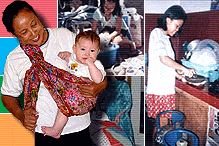 From 2012 to 2013, Tenaganita received 313 cases involving domestic workers, with over 1200 forms of rights violations including non-payment of wages, withholding of passports, isolation, denied the right to communicate with anyone out of the home, physical, verbal and sexual violence, food deprivation and forced extension of contract.
It is frightening that 32 percent of the women alleged sexual abuse and rape; 30 percent of the domestic workers when rescued were severely malnourished due to denial of decent and sufficient food; 80 percent had their wages not paid for more than six months; many workers complained that they were forced to work beyond their two year contract as employers found it difficult to get replacement, and in 100 percent of the cases their passports were held by their employers.
Domestic work a form of bonded labour
These cases and the trends and patterns that we can draw from them reflect how domestic work is a form of bonded labour in Malaysia.
This information has been consistently shared with the governments of Malaysia and Indonesia for the past five years at least, and yet it is still ‘money’ that drives their decisions, and not the human rights of the women who work in our homes.
The Malaysian government ratified the Convention to Eliminate All Forms of Discrimination Against Women (CEDAW) in 1995, thereby agreeing to the global standards on rights protection and equal treatment for all women, including enacting and enforcing laws and policies that will ensure substantive equality and enjoyment of rights for ALL women within Malaysia, regardless of nationality or immigration status.
The Pontius Pilate act of washing one’s hands of responsibility and accountability in protecting domestic workers’ rights goes against the commitment to meet the basic standards of the Convention they have committed to. This act only illuminates the fallacy and hypocrisy of the government and its position on rights protection, on addressing abuse and violence against women and workers.
Dr Olivier de Schutter, the Special Rapporteur on the Right to Food, on Dec 18, 2013 when speaking on his preliminary findings after his 10-day official mission to Malaysia, expressed concern over the exclusion of the domestic service sector from minimum wage requirements. He stated that individuals employed in domestic service are often the most vulnerable to abuse from their employers.
Because of the nature of their work in the home, they are hidden from society and unable to seek redress for human rights violations. The Special Rapporteur believes that Malaysia should amend the National Wages Consultative Council Act 2011 to include domestic workers, and to ensure that provision of room and board are considered additional allowances not to be calculated as part of minimum wage.
The end to forms of slavery and violence against domestic workers can only be realised when governance of recruitment and placement of domestic workers is determined by recognising domestic work as work, by protecting fundamental rights of domestic workers and by ensuring a system of employment where there is decent wage and decent work with respect for dignity of all persons.
That must be the factors that influence the framework of recruitment, placement and employment of domestic workers.
Women’s bodies are not commodities to be traded. The work of domestic workers needs to be valued, respected and protected. Governments which fail in doing that must face the severest consequences of their actions.
DR IRENE FERNANDEZ is executive director, Tenaganita.


Report this comment
Are you sure you want to delete this comment?
This action cannot be undone.