




Pak Lah tables a quiet budget, emphasis on basics
A four-pronged strategy was unveiled by Prime Minister Abdullah Ahmad Badawi today in his budget for 2005 aimed at promoting economic growth and reducing the nation's fiscal deficit which has continued for the eight years in a row.
A four-pronged strategy was unveiled by Prime Minister Abdullah Ahmad Badawi today in his budget for 2005 aimed at promoting economic growth and reducing the nation's fiscal deficit which has continued for the eight years in a row.
Tabling his maiden budget after taking over from Dr Mahathir Mohamad last year, Abdullah outlined a number of changes, among others, to review the tax system, liberalise the capital market, promote agriculture and the upgrading the rakyat's quality of life.
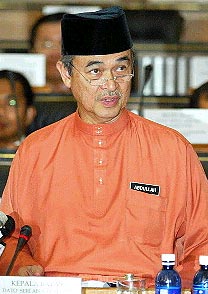 Clad in pastel red Baju Melayu with a matching samping, Abdullah, who is also finance minister, said that the government would work to revamp outdated work systems and legislation, as well as inculcate a positive culture to improve competitiveness.
He added that his government would also continue to promote growth and provide an environment of opportunities in various economic activities for all.
"I am determined to ensure that every rakyat will be able to live in peace and harmony, regardless of race, religion and status. This is my aspiration, my objective and my pledge to you.
"The government is fully cognisant of the challenges ahead, in particular arising from the uncertainties and turbulence in the external environment, which will constantly test our ability to achieve our development goals," he said in his one hour and 45 minute budget speech.
"Hence, developing human capital, increasing productivity, enhancing research and development (R&D) capabilities and identifying new sources of growth are indeed crucial. Ensuring a dynamic private sector is another major challenge in our efforts to increase the nation's resilience," he added.
Tax changes
To start off, Abdullah said the government would review the consumption tax mechanism by replacing the current sales and services tax with a single Goods and Services Tax (GST) beginning Jan 1, 2007.
He claimed that the new tax, based on the value-added concept, would be more 'comprehensive, efficient, transparent and effective', thereby enhancing tax compliance.
"Given that, under the new system, companies need to keep orderly accounts, the government's revenue collection is also expected to increase," he said.
He also said that the government wanted to ensure that the taxation system was more efficient, equitable and business friendly, as well as capable of generating a stable source of revenue.
With this in mind, Abdullah said he proposed the establishment of a taxation system review panel comprising representatives from the public and private sectors.
"This panel will review the tax system, including the provisions of the Income Tax Act 1967. The focus of their review is to ensure that tax provisions remain relevant. Existing provisions will be amended to improve clarity and transparency of tax administration."
Revamping agriculture
One of the first changes introduced by Abdullah after assuming power last year was to promote the importance of agriculture. He kept the focus on that sector today by focussing on revamping the agriculture industry to make it the nation's third engine of growth after the manufacturing and services sectors.
He said that he wanted to increase agriculture income and reduce dependence on imports, particularly food items.
For this, he proposed that a fund of RM300 million be set up to encourage the private sector, especially government-linked companies (GLCs), to be a catalyst in the commercialisation of the agriculture sector.
In addition, Abdullah said he wanted to set aside RM1.5 billion for agricultural projects, especially for projects benefiting smallholders.
"Several tax incentives have been provided to encourage the modernisation and commercialisation of the agriculture sector. These incentives include a 100 percent deduction on capital expenditure, pioneer status or investment tax allowance for five years and reinvestment allowance for 15 years," he said.
Islamic finance
Abdullah also proposed to make further inroads into the Islamic financial system arena towards making Malaysia an international hub for it.
"An international financial training institute will be established to produce experts in Islamic financial. To further strengthen the Islamic financial system, the government will also issue Islamic Treasury Bills.
"Currently, Treasury Bills are only issued in conventional form. Government Investment Issues, issued based on syariah principles will also be increased next year," he added.
He also said that overseas branches of local banks would be requested to establish Islamic banking counters and that the government would further back them up by developing Islamic financial and capital market products.
He also proposed that taxes and duties be exempted on selected Islamic products, on a case by case basis, to ensure tax neutrality with conventional products.
On his strategies to strengthen the capital market, Abdullah said the government would not allow up to five major foreign stockbrokers to operate in Malaysia so that they can 'bolster the distribution network' as well as increase liquidity.
Abdullah also said the government wanted to allow up to five leading global fund managers to operate in Malaysia.
"We also propose to allow 100 percent foreign ownership for futures broking companies to increase liquidity and capital market risk management.
"Similarly, 100 percent foreign ownership will be allowed for venture capital companies in the Information and Communication Technology (ICT) sector to increase funding and expertise to promote investments."
Boosting tourism
Abdullah also said that the government wanted to promote tourism by establishing Kuala Lumpur as an international arts centre with tax exemption for arts and cultural performances.
He also said that there was a great potential for growth in health tourism with a total of 103,000 foreigners spending RM58.3 million for this purpose alone in 2003.
"To further increase this number, the government will organise health tourism packages through coordinating efforts between hospitals and hotels as well as establishing an international referral network."
He said local hospitals would be encouraged obtain international accreditations and forge strategic alliances with leading medical centres around the world.
Touching on education, Abdullah said the government would promote education tourism by expediting approvals and accreditation of courses by private institutions of higher learning, as well as ranking the performance of public and private learning institutions based on international standards.
He added that the government's objective was to enable the nation's education system to achieve world-class status.
Education was granted the largest allocation under the 2005 budget - a grand total of RM21.5 billion (RM16.3 billion for the Education Ministry and RM5.2 billion for the Ministry of Higher Learning).
Schools and houses
The prime minister said that the government would continue to strengthen the country's education system by teaching science and mathematics in English and expanding ICT through a computerisation programme and Schoolnet, a ICT initiative for schools.
"A total of 85 secondary schools, 45 primary schools, seven fully residential hostels and 32 new hostels will be operational in 2005 ... several incentives and facilities have also been provided for teachers.
In addition, to inculcate and nurture the reading habit, the government also proposes that the tax relief given to individual taxpayers for the purchase of books be increased from RM500 to RM700.
Abdullah also announced that the government wanted to eradicate hardcore poverty - presently involving 52,900 households - by formulating specific programmes to eradicate the scourge.
For this, the government would allocate RM94.2 million, with another RM205 million for the implementation of a tuition voucher scheme for schoolchildren from the lower-income group.
He also said that a total of RM77.3 million would be set aside to enhance the standard of living of the Orang Asli.
For the disabled persons, the government would build more disabled-friendly facilities and increase tax relief for them from the present RM5,000 to RM6,000.
Abdullah said the government would also allocate RM778 million for the construction of 21,000 units of low-cost houses under the Projek Perumahan Rakyat for squatters in Kuala Lumpur and other major towns.
Sin taxes up
On health and health and medical services, Abdullah said about RM7.9 billion would be allocated next year to build five new hospitals, 13 health clinics and a health laboratory.
"A sum of RM48.3 million is provided for treatment facilities in Intensive Care Unit, the establishment of haemodialysis units and cancer treatment programmes. An additional sum of RM19.2 million is provided for the Public Health Programme."
And to promote a healthy lifestyle, Abdullah said that excise duty on cigarettes would be increased from RM58 to RM81 per 1,000 sticks - an increase of about 50 sen per box of 20 cigarettes - while excise duty on liquor be increased from between 5 sen and RM23.40 to between 10 sen and RM28 a litre.
In light of the recent increase in crime, Abdullah revealed that police presence in residential areas and business centres would be enhanced while police personnel would be allocated RM107 million for salary adjustments.
The government would also increase the daily expenditure on food for police trainees to ensure they have balanced and nutritious food, he added.
Recognising the contributions of the civil servants - numbering about one million - Abdullah said the government would pay a bonus of between one month and one and a half months salary in two installments, the first in October and the second December this year.
This would come in tandem with an increase in housing allowance for civil servants.
Abdullah also said that the government proposed to streamline the public transport system and had allocated RM500 million to maintain public infrastructure.


