



Documenting convicts reborn through dance
When Indrani Kopal discovered the inspiring story of Susan Slotnick, who taught dance to prison inmates, things began to click for the documentary filmmaker.
MALAYSIANSKINI When Indrani Kopal discovered the inspiring story of Susan Slotnick, who taught dance to prison inmates, things began to click for the documentary filmmaker.
A Fulbright scholar at the Documentary Studies and Production at Hofstra University in New York, she was exploring subject matter for her final thesis in Master of Fine Arts in Documentary Studies and Production.
She had decided earlier it would be about “rehabilitation”, and being a trained dancer, she decided to marry the two subjects.
“I was interested to do a documentary about rehabilitation through arts, and the art form was about dance.
“The main theme in my documentary is about inspiring others and (also about) hope. I wanted this particular piece to inspire others as well, and my character, Susan Slotnick ( photo ) does exactly that!”
Slotnick, an arts education graduate, had spent years teaching dance to neighbourhood children, and later expanded her classes to juvenile correctional facilities.
The dance teacher’s career ‘highlight’, she said in an interview with Huffington Post , is spending hours every weekend volunteering to teach male convicts at the Woodbourne Correctional Facility in upstate New York how to express themselves through dance.
“When I learnt about her, Susan was going up to the medium security men’s prison teaching modern movement or dance to the prison inmates.
“The dances involve lyrical movements and a lot of expressions and emotions,” Indrani said in an interview with
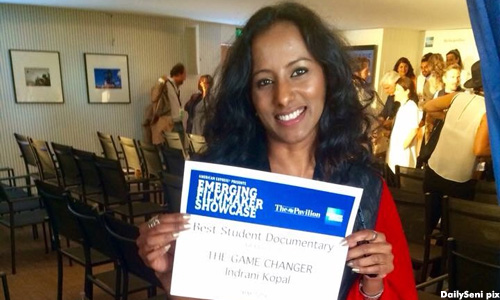
Indrani ( photo ), now based in New York, was back in Malaysia for a stopover after her 17-minute documentary film, ‘ The Game Changer’ was crowned ‘Best Student Documentary’ at the American Pavilion’s Emerging Filmmaker Showcase during the Cannes Film Festival recently.
A former journalist with Malaysiakini , she agreed to show her documentary at the @Kini office for the Malaysian audience, after winning the award. Malaysiakini had started a crowdfunding project to send Indrani to Cannes.
A tool for social transformation
Indrani has always been interested to do a documentary about rehabilitation programmes in places many would least expect, such as prisons, juvenile centres, and psychiatric facilities.
Rehabilitation programmes, like the one run by Slotnick under the Rehabilitation Through the Arts umbrella, are common in the US.
Indrani noted this type of programme - using creative arts for social transformation - was lacking in Malaysia. She hoped that sharing the documentary and the making of it would inspire others to follow Susan’s footsteps.
In her award-winning documentary, Indrani interviewed six men from Susan’s dance rehabilitation programme in the prison.
They had been released from prison for two years and instead of the classic recidivism - where ex-convicts commit crimes and get sent back to prison or get involved in drugs - the ‘graduates’ of Woodbourne Correctional Facility’s dance programme took their training seriously.
“They are now performing all around Manhattan, (New York,). Every single performance you go to, you will see a standing ovation. To me, that is simply amazing!” said Indrani.
The arts rehabilitation programme has given the ex-convicts new hope in life and people have started to see them in a completely different light.
“You know, people started saying that they are not just former prisoners but are artists. They have this new identity to re-enter society (with) and this is huge!
“None of them went back to prison or drugs. They are actually moving on with their lives; meeting new people, getting new jobs, buying houses and cars, and all that,” she added.
In using their bodies to create beautiful performances, Slotnick’s former students have gained respect from the public.
“These men are returning to our world after being incarcerated for 20 years. It’s not normal for them. Even doing laundry and using a smartphone (is a new experience). They don’t even know what Facebook is.
“To me, everyone in the story is so special. At some point, it will be normal for them. To me, this transformation is quite phenomenal.”
Indrani will be producing a sequel, ‘The Incarcerated Rhythm’, in the next two years as her first feature-length documentary, focusing on five of Slotnick’s former students who were released from prison three years ago.
Indrani’s inspiration
Indrani had her first taste for documentary filmmaking in the early days of Malaysiakini about 10 years ago under the tutelage of Shufiyan Shukur, someone whom she called a ‘visionary’.
“Shufiyan ( photo )was my boss and he was the guy who inspired me. I was producing documentaries at Malaysiakini for four years after I left to DC (Washington D.C.) for my first fellowship at the George Washington University Documentary Centre.”
Then, it was just news features and daily news. Indrani said her boss had a vision - that Malaysiakini will be the first to produce online multimedia news features.
“You are talking about 10 to 20 minutes long feature stories, just like you see on TV, but online. Back then, it was just us; not many competitors,” she recalled.
It was around the time when internet video hosting sites such as YouTube was first launched in 2005. Indrani noted no one was really keen to watch documentaries online for free and it was a very new concept - even for Malaysiakini - back then.
“We started pairing up (videographers) with journalists to do stories. We were slowly making a transition from daily news to video feature stories. It became our theme and we started getting a lot of views after that. It was great!” Indrani said, in recalling her stint with Malaysiakini TV.
'It’s all about the storytelling'
Indrani felt that film schools need to encourage students to participate in film festivals in order to showcase their work to those from the film industry.
“Just give it a try. Your work may get attention from potential film buyers during the festivals and it may go to places after that. Submitting films to festivals is not a popular practice for some people. It turned out to be quite a remarkable experience for me and I have met so many people (through that experience).”
“I think after the ‘The Game Changer’ showcase at the American Pavilion, I might consider running a course here to share my experiences on how to submit documentaries to film festivals,” she joked.
She encouraged those who are interested to make documentaries to give it a go.
“The success of your work is all about the person behind the camera. Don’t wait. If you have an idea, just go and pursue your story. At the end of the day, everything comes down to the storytelling.
“Money (or the lack of it) should never stop you from pursuing your dream in filmmaking. Start somewhere. Start today!” shared Indrani, when asked about her advice to aspiring documentary filmmakers.


Report this comment
Are you sure you want to delete this comment?
This action cannot be undone.