




Pass freedom of information law, govt told
Participants of the recent Workshop on Freedom of Information Legislation in Malaysia have called on the government to pass a comprehensive freedom of information law .
Participants of the recent Workshop on Freedom of Information Legislation in Malaysia have called on the government to pass a comprehensive freedom of information law .
In a press statement today, they said the law must be in accordance with 10 minimum standards.
1) The law should be passed based on the rights to information which establishes the principle of maximum disclosure.
"Access to information is a basic necessity and right, not a luxury indispensable to the aim of Malaysia to become an information society," said the statement.
2) Public bodies should routinely make available a wide range of information of public interest. A commitment should be made, over time, to publish all information which anyone might wish to access.
"This information should be made available on an equal, non-discriminatory basis."
 A specific commitment should be made to ensure that all individuals and groups affected by a project, development or policy be provided with all the necessary information in an appropriate language and medium.
3) An independent administrative oversight body should be formed with a mandate to oversee implementation of the law, to adjudicate and decide on appeals against refusals to disclose information.
"Members should be elected on the basis of credibility, expertise and qualifications. The election process should be open, transparent and involve the civil society."
Apart from this, the body should be given the mandate and adequate resources to provide central training, resources and support for officials of public bodies on the application of the law.
Criminal offence
4) Public bodies must make adequate provisions to train their officials on the application of the law and training manuals for this purpose must be developed in association with the civil society.
These bodies should be required to adopt procedures to maintain records in an orderly fashion.
"The law must make it a criminal offence to obstruct access to information willfully, including by destroying or altering documents or by providing incomplete disclosure."
5) Exceptions to the right of access should be set out clearly and narrowly in the law. It should be limited to the protection of legitimate interests in the areas of law enforcement, privacy, national security, commercial and other relationships premised on confidentiality, public or individual safety and integrity of government decision making process.
"Access should not be refused unless disclosure would pose a real risk or significant harm to one of the protected interests."
6) The law should set out minimum procedural rules relating to the processing of requests, for example, in relation to time limits, notice of and grounds for refusals to grant access and the like.
Cost, which must be approved by the independent administrative oversight body, for access should be limited to the duplication of information and public bodies should have the discretion to waive costs in matters or public interests or other reasons.
7) The law should establish a general presumption that official meetings are open to public.
"This presumption may only be overridden by a specific decision of the meeting and that such a decision is to be made public. Details regarding the time, date and venue of these meetings should be made easily available."
Secrecy laws
8) The freedom of information law should prevail in cases of conflict between itself and any secrecy laws.
"All secrecy provisions in other laws and guidelines should be reviewed, amended and/or repealed within three years or they should lapse. The Official Secrets Act 1972 should be prioritised as a matter of urgency".
9) Whistle-blowers should be protected from any legal, administrative or employment related sanctions for releasing information on wrongdoings.
10) The law should provide for its own comprehensive and transparent review by Parliament at least every five years.
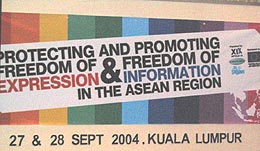
The workshop held on Sept 27-28 in Kuala Lumpur, was jointly organised by human rights organisation Suaram together with the London-based campaigner for free expression Article 19 and Forum-Asia.
 According to Suaram executive-director Cynthia Gabriel, the aim of the workshop was to bring together local and international law experts, activists, media practitioners and freedom of information specialists to discuss the importance of securing right to information via effective legislation.


