




Govt agencies : No directive to spare refugees in 2005 dragnet
There have been no directives to spare refugees during next month's blitz on illegal immigrants, government officials told the Human Rights Commission of Malaysia (Suhakam) round-table talks on refugees in Kuala Lumpur today.
There have been no directives to spare refugees during next month's blitz on illegal immigrants, government officials told the Human Rights Commission of Malaysia (Suhakam) round-table talks on refugees in Kuala Lumpur today.
On Nov 10, the United Nations High Commissioner for Refugees (UNHCR) Volker Turk said the government has assured him that refugees will not be affected by the crackdown beginning Jan 1.
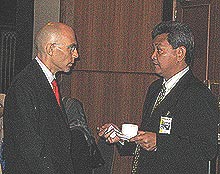 However, participants at the discussion were surprised to find out that relevant enforcement agencies such as the immigration department and police have not been given any such orders.
The crackdown, a prelude to a mass deportation of illegal immigrants, will be carried out by immigration and police personnel who will be assisted by some half a million members from neighbourhood watch groups ( Rukun Tetangga ) and auxiliary police units ( Rela ).
At a press conference later, Turk expressed UNHCR's concern that important players in the round-up exercise were not yet briefed. He was however confident the promise would be kept.
"Yes we are worried, from UNHCR's perspective, but I am confident we will get the cooperation from the police.
"However it's a different situation with the other agencies but we are going to meet the Rela head on Friday," he said, adding that it has been difficult to fix an appointment with the immigration department.
He said the assurance had come from Home Minister Azmi Khalid and added that he also had successful talks with Inspector-General of Police Mohd Bakri Omar.
Directed by the government
Earlier, reacting to Turk's speech, immigration department representative Ramli Halim and police representative Supt Abdullah Hamid said their respective departments have yet to receive any directives on the matter.
"We (immigration department) are one of the (many) enforcement agencies here today. Our function is to enforce laws such as the Immigration Act and Passports Act. We are directed by the government and that is as it stands now," said Ramli.
However, he said if Turk's claim was true and if a directive is issued to his department, it will be abided by. Similarly, the police department ensured its compliance if it was made official.
"We will toe the line and ensure that we'll do what we're told to and not unnecessarily arrest and detain them, once we get directives from the top," said Abdullah.
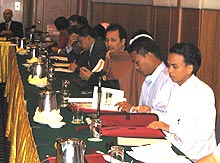 The police officer, however, criticised Turk's argument that Malaysia was subject to international law despite not being a signatory to the United Nations'1951 Refugee Convention which governs rules that protect asylum seekers.
"Don't quote principles of international law to us. When it comes to refugees in Malaysia, international law to us is dead," he said.
Turk had said that even though Malaysia was not a party to the convention, the government has accepted the fundamental principle of ' non-refoulement ' - the principle not to return individuals to situations of danger and human rights violations - by being a UN member state.
He also urged that the non-interference principle of governments within the region be revisited. This should not be a cause for political tension but be addressed to ensure refugees are given humanitarian assistance.
Malaysia has been criticised in the past - by the local and international community - for detaining and forcibly returning refugees from Burma and Aceh.
Constructive developments
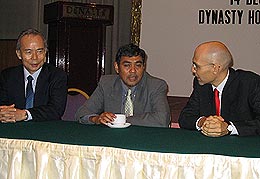 On a positive note, Turk acknowledged that there have been recent constructive developments in Malaysia including the government's announcement to
grant identity cards
to Burmese Rohingyas - a stateless Muslim community.
On a positive note, Turk acknowledged that there have been recent constructive developments in Malaysia including the government's announcement to
grant identity cards
to Burmese Rohingyas - a stateless Muslim community.
To date, there are close to 30,000 refugees in the country who are lumped together with about 1.2 million illegal immigrants.
Suhakam and UNHCR have suggested that the government emulate moves by neighbours Thailand who have granted Burmese refugees working rights effectively regularising them from illegal immigrants to legal migrants.


