



Can we still afford corruption at the state-level?
COMMENT I am asking this question, “Can we still afford corruption at the state-level?”
Before anyone starts interpreting this as being ‘naïve’, let me qualify my statement by saying that I am now focusing on state-level corruption involving land matters and natural resources, following the bauxite controversy in Pahang and the arrest of several land officers by the Malaysian Anti-Corruption Commission (MACC).
We have already seen what happened in Sarawak during the two decade-long reign of former chief minister Abdul Taib Mahmud. Much of the state’s rainforests are now gone forever, but Taib is still free and holding an even more senior position as its Yang DiPertua Negeri.
The people who suffer are the state’s own bumiputera, who continue to give the BN administration votes even after they have been exploited.
COMMENT I am asking this question, “Can we still afford corruption at the state-level?”
Before anyone starts interpreting this as being ‘naïve’, let me qualify my statement by saying that I am now focusing on state-level corruption involving land matters and natural resources, following the bauxite controversy in Pahang and the arrest of several land officers by the Malaysian Anti-Corruption Commission (MACC).
We have already seen what happened in Sarawak during the two decade-long reign of former chief minister Abdul Taib Mahmud. Much of the state’s rainforests are now gone forever, but Taib is still free and holding an even more senior position as its Yang DiPertua Negeri.
The people who suffer are the state’s own bumiputera, who continue to give the BN administration votes even after they have been exploited.
In some of these cases, the federal government appears to be ‘powerless’, claiming that land is a state matter and therefore its hands are tied, unable to interfere.
Perhaps the bauxite controversy in Pahang is a good case in point, since everyone is now awakened after Kuantan MP Fuziah Salleh had highlighted the issue in Parliament last year.
Losses of the state
In the past when Selangor was under BN, its sand mining contributed pittance to the state’s coffers until (much to his credit) former MB Abdul Khalid Ibrahim managed to raise the state’s revenue from sand mining.
However, exploitation of the natural resources should only be done in a sustainable manner. As pointed out by Sahabat Alam Malaysia (SAM) in a letter, the “exploitation of sand resources will soon render the country with increasing environmental problems and socio-economic consequences.”
It is not only sand mining, as we know there are other threats to our environment. It involves other forms of exploitation of Mother Nature and its rich natural resources.
Unless it is done sustainably with careful planning by the Natural Resources and Environment Ministry, permits for land clearing activities and logging concessions will continue to be issued at the state level without taking into consideration the people’s livelihood, and causing serious pollution to the environment.
It is not that the procedures are not there, but I suspect - as in the case of the illegal bauxite mining - there are parties trying to enjoy the cake by allowing their hands to be greased. This is the reason why the state and its people are not enjoying the fruits of the land, and why we are constantly faced with illegal mining.
Those tasked to protect the land have failed in their jobs, which is largely due to corruption at the top as well as the failure of federal agencies, ministries - and the PM himself - to regulate state matters, especially when MBs are appointed by the prime minister.
Based on statistics obtained by SAM in 2011, “A total of 1,036 permits were given out for extraction of sand and gravel with the total production amounting to 37,339,082 tonnes. Besides these official figures, millions of tonnes of sand and gravel would have been pilfered through illegal sand-mining activities and miners not abiding conditions stipulated in their permit.”
That is just how bad the situation is, based on just one year’s record.
A mere slap on the wrist
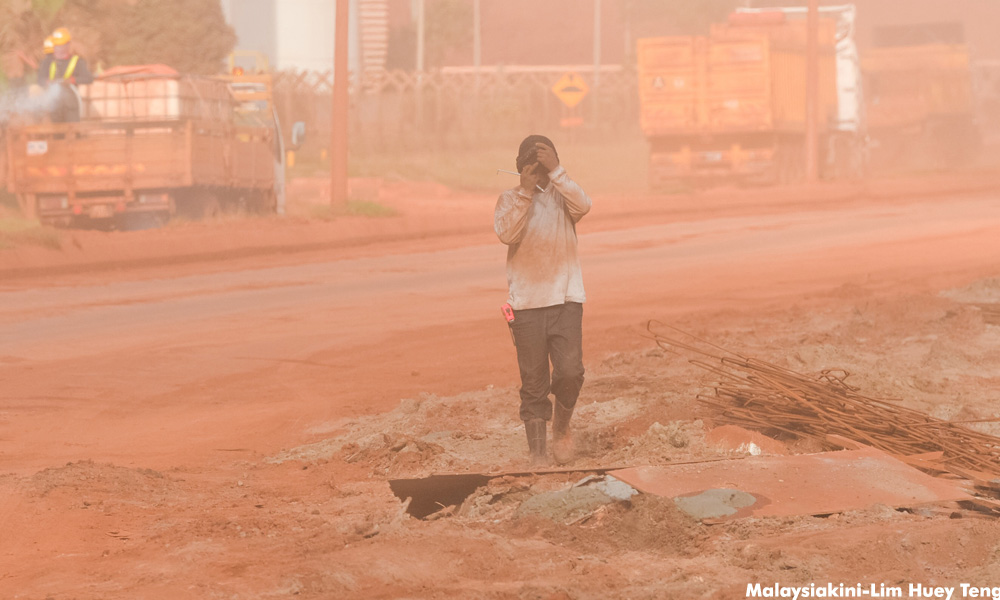
In the case of the aluminium rush in Kuantan, the situation is far worse because people’s health may be badly affected by the contamination of the waters and red dust covering the area.
Instead of claiming that there is “nothing unusual” for fishes to die in big numbers, the Fisheries Department should investigate further on such occurrences and prevent it from happening. Fishes are in fact our environmental barometer; when they die in big numbers, it means our environment (the waters) is polluted.
In the days when I was a laboratory manager with Union Carbide, we had visited our China plant. Their water treatment is linked to a pond where fish are bred, and the treated effluent is discharged into the pond before leaving the plant. The moment they spot any dead fish, they know that their treatment plant had to be shut down.
Therefore, the three-month moratorium from Jan 15 for bauxite mining announced by both Natural Resources and Environment Minister Wan Junaidi Tuanku Jaafar and Pahang Menteri Besar Adnan Yaakob is just a slap on the wrist after all the brouhaha.
Despite the issue affecting the livelihood of fishermen, and the health of Kuantan folk possibly affected as a result of the aluminium rush, with at least one report saying that exposure to the metal could cause Alzheimer’s disease , Adnan’s response has not been very positive or at least befitting an MB.
What he appears to care for is the export royalties paid to the state government, which he claimed, has hit RM46.7 million. In his media appearance with Wan Junaidi, or at least based on what was reported, he was not even giving much thought to the general population living in the state of Pahang.
One wonders what has given Adnan the justification for lending his support to the bauxite mining companies, promising them more riches instead of being concerned that the capital city of the state, Kuantan, is now blanketed in red dust.
As an MB, what should have been Adnan’s priority? I am surprised that he has not said a word about protecting the people’s interests. Instead, he is talking about enriching the people (or perhaps, the cronies) behind companies responsible for the environmental pollution due to the uncontrolled bauxite mining in the state.
While export royalties paid to the state government have jumped to RM46.7 million in 2015 compared to just RM2.4 million in 2014, estimates made by the MACC said that the royalties should have been five times higher! This sounds familiar based on the Selangor experience.
The report said included among the MACC's findings were that there had been no proper criteria on who can apply for a bauxite mining licence, and there were no requirements for those granted a licence to furnish technical reports, along with the absence of any open tender. This has to do with the highest authority at the state administration.
It is sad that what was happening in Sarawak during Taib’s time is now happening in other states, where the state chief pays no heed to the protection of the environment. Where is the failure? Is it at the state level or the federal level?
For example, we have highlighted about the possible encroachment into the forest reserve in Tambun, Perak, behind the Haven Residences and Permai Lakeview Apartments, yet land clearing activities continue unabated. Residents, as well as state assemblypersons, have complained that they are not in the know about any possible de-gazettement of the forest reserve. Part of the Matang mangrove swamp is gone permanently due to indiscriminate town-planning work at the state level.
As former international trade and industry minister Rafidah Aziz said: “Questions were asked as to whether planners understood the topography of the area. Did they not know that the houses and other buildings were going to be constructed upon a flood plain, which would be the natural outlet for water collecting around the area?”
Ultimately, Najib and cabinet are responsible
There is no doubt that the bauxite mining industry will go on, but it should have been done in a more sustainable manner and when it is being done unsustainably, we can only blame the PM and his federal government for the failure.
In the case of Perak and Pahang, both MBs are appointed by the sitting prime minister. If there is sufficient evidence that the MBs failed to act and listen to the people’s complaints, the first course of action is to haul up the state chief.
If after several warnings have been made and the MB fails to respond positively, then a revamp is necessary to remove said MB and have a new state cabinet appointed. This is, of course, within the jurisdiction of Prime Minister Najib Abdul Razak at the moment.
However, we have to ask these questions: “How many times have Najib warned Adnan before the Lynas issue cropped up previously, and now the bauxite rush? What has Najib done to help improve the living conditions of the people?”
So much for his ‘People First’ policy, only the contrary appears to be the case since Najib became prime minister in 2008.
STEPHEN NG is an ordinary citizen with an avid interest in following political developments in the country since 2008.


