




Suhakam tells govt to walk the talk
The Human Rights Commission of Malaysia (Suhakam) today launched a report containing strong recommendations for specific laws and systems to be put in place to address human rights violations that occur when trafficked women and children are victimised.
The Human Rights Commission of Malaysia (Suhakam) today launched a report containing strong recommendations for specific laws and systems to be put in place to address human rights violations that occur when trafficked women and children are victimised.
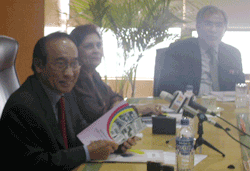 Suhakam chairperson Abu Talib Othman said trafficked foreign women and children - often duped into prostitution and other vices - must not be further victimised by enforcement agencies and the system.
"It's unfair to put them in prisons, even as witnesses against their traffickers. It's a human rights violation when someone is detained to ensure justice is done but treated as criminals," he told a press conference at the Suhakam headquarters in Kuala Lumpur.
He attributed the gross abuses to glitches in the judicial system and the non-existence of specific trafficking laws.
"There is the slow prosecution process... this is the trouble when courts are not sensitive to the troubles faced by victims," he said.
Since January 2003, Suhakam has been conducting research, dialogues and workshops on the "increasingly booming business", which is deemed a crime in many other countries.
Abu Talib, who was sympathetic towards the issue, attributed skewed interpretations of the law by public prosecutors and the courts as a cause for acquittals of many traffickers.
"They are let-off on technicalities," he explained.
He urged the government to allow some degree of liberalism in proving the guilt of traffickers' and other involved parties' as opposed to allowing a miscarriage of justice by further victimising innocent victims.
 "I hope the government will walk the talk and respect human rights by enacting anti-trafficking laws. There should be an implementation of laws and respect for rights done without fear or favour.
"I know of one victim that has been detained in prison - as a witness - for five years," he exclaimed.
Authentic victims
Asked if the women were truly 'innocent victims', he said they were. This was based on dialogues Suhakam has had with them and the fact that many were found "caged" by their employers.
The report carries many real-life accounts of women being promised regular jobs such as maids but end up being violently forced into criminal activities such as prostitution.
The 159-page report indicates that many victims involved in vices are arrested not only during enforcement officers' raids but also detained for not having proper travel documents after having escaped from their captors.
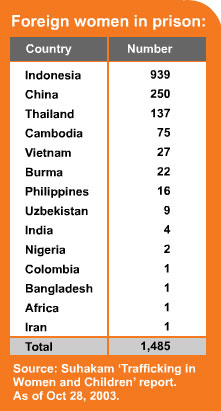
It also centres-in on a large number of foreign women imprisoned in the country.
It looks at women in the Kajang Women's Prison where a majority arrested for prostitution allege that they were tricked into coming to Malaysia for real work but end up forced into the flesh-trade.
 "Out of the 58 women we have spoken to, 23 said they were cheated or trafficked into the country and into prostitution," said Suhakam commissioner Dr Raj Abdul Karim.
She added that there is a lot of violence involved in trafficking and that the poor and uneducated were usually the ones who fall into the trap.
Urging more protection for victims, Raj said "there really needs to be an identification and victim protection system" in the country's prison system, where those trafficked are not subjected to further abuses by enforcement officers and prison authorities.
Suhakam's report, a copy of which has been sent to the government, adds that there are existing laws which attempts to carry jurisdiction on trafficking issues but it is non-specific and piecemeal.
The government, however, has thus far failed to implement most of the many proposals made by Suhakam since its inception in 1999.
Prime Minister Abdullah Ahmad Badawi has promised to tackle various human rights issues after taking over in October 2003 but has since then come under fire from various quarters for inaction.
The premier also signed the Asean Declaration Against Trafficking in Persons Particularly Women and Children on Nov 29 last year, which is a reaffirmation of an earlier declaration - in 1998 - to address transnational crimes including trafficking women and children.


Are you sure you want to delete this comment?
This action cannot be undone.