




Jerit takes long list of grouses to PMs office
The Marginalised People's Network (Jerit) took its grouses to Prime Minister Abdullah Ahmad Badawi's office in Putrajaya but left disappointed, as its members were unable to meet him.
The Marginalised People's Network (Jerit) took its grouses to Prime Minister Abdullah Ahmad Badawi's office in Putrajaya but left disappointed, as its members were unable to meet him.
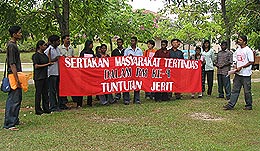 Some 40 people had gathered outside the building at 10.30am to present their demand for issues affecting "oppressed citizens" to be included in the Ninth Malaysia Plan.
According to Abdullah's press secretary Teoh Ai Hua, the premier was attending an official function, while other officers were not present at the office.
Jerit members, some of whom had travelled from Ipoh, were not satisfied with the reason given.
"These are very serious issues we have brought here today, including minimum wage, the welfare of factory workers and a whole range of other pertinent matters affecting the poor and oppressed," Jerit representative Sevan Doraisamy told Teoh.
Public feedback
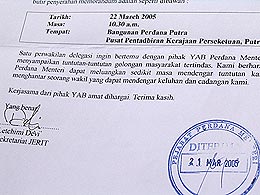
He also took the PM's office to task for not having an officer on duty to meet and discuss the group's concerns as Jerit had handed in a letter yesterday, informing the office of its plan.
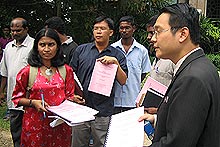 However, Teoh countered that a proper appointment should have been fixed.
When pressed by the group, the press secretary gave his word that Abdullah would receive the memorandum.
"Please call me on Monday and we can take it from there," he said.
The group left the Perdana Putra building compound at 11.10am under the watchful eyes of half a dozen police personnel.
Sevan told malaysiakini that he was extremely disappointed that the government has not shown any urgency over the matter.
"This is what the PM asked for....feedback from the public on the Ninth Malaysian Plan. We really hope he receives and studies the document. We have, on numerous separate occasions, passed other memos to various ministries," he said.
He added that the group would follow up the matter with the PM's office on Monday.
The resolutions
Among the contents of the memorandum - endorsed by over 130 organisations from various estates, plantations, indigenous groups and NGOs - were recommendations by Jerit to alleviate the suffering of the lower-income group.
 "Most of the recommendations made in this document are not new. It consists of pleas from citizens of the lower income group. Pleas which have failed to reach the highest levels of government," read the summary.
It said these were from communities which are not represented in government and have a weak political voice, as "their pleas are drowned out by the rich elite".
This, Jerit said, was why the government's attention and action were imperative.
The document urged the premier not to burden these communities by privatising basic amenities such as water, electricity, health, education, telecommunications and road construction.
Statistics were also provided on housing woes faced by urban settlers and longhouse communities.
It showed how the government, from the Second to the Seventh Plans, had only achieved between 30-51 percent of its low-cost housing targets. The Ninth Plan, effective Jan 1, does not specify plans for low-cost housing.


