




Be more guarded about suicide reporting, media told
The media should play its role in preventing suicides by reporting its occurrence with sensitivity and a larger perspective in mind while understanding the problem, said dignitaries at a seminar on 'Suicide and its impact on society' in Kuala Lumpur today.
The media should play its role in preventing suicides by reporting its occurrence with sensitivity and a larger perspective in mind while understanding the problem, said dignitaries at a seminar on 'Suicide and its impact on society' in Kuala Lumpur today.
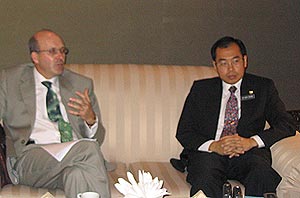 Speaking to reporters after their opening addresses, Ministry of Health Parliamentary Secretary Lee Kah Choon and the Delegation of the European Commission (EC) in Malaysia chief Thierry Rommel encouraged the press to supplement efforts in preventing suicides in the country.
"Prevention is vital in reducing suicides. The press' role should not be just to highlight suicides as a matter of fact. It needs to also provide information on crisis lines and should positively encourage people to seek help from various bodies," said Lee.
In his speech earlier, Lee quoted an Oxford University professor's study 'Suicidal Behaviour and the Media' which provided points which the media should bear in mind when reporting on suicides.
"Reports and portrayals of suicides in the media can lead to an increase in suicidal behaviours, particularly if given prominence, is repeated or the methods described in detail. Young and elderly people are particularly vulnerable to this type of media influence.
"It is (also) often not apparent from media reports that the vast majority who kill themselves have significant psychiatric illnesses at the time of death," Lee told the150-odd participants attending the seminar organised by Era Consumer Malaysia.
Responding to a question, Rommel said the advise was not an attempt to cover up realities or rates of suicides but rather to encourage an accurate depiction of such occurrences while addressing certain perspectives which would in-turn educate the public.
Promote life and hope
Lee also encouraged the media to depict celebrities or fictional characters dealing with emotional distress, which is one of the many suicide causes, in constructive ways.
He added that it is a good opportunity for the media to promote "life and hope".
In a paper presented later, Prof Maniam Thambu from University Malaya said when there is sensationalised reporting - especially on celebrity suicides and deaths - suicide rates among 'vulnerable persons' increases.
"One effect of media reporting is imitation suicides. Vulnerable persons are those already contemplating suicide but without real intention.
"When it's sensationalised and if the quality of reporting is poor, the contemplation becomes reality," said the Malaysian Psychiatric Association president.
Maniam told the audience that efforts have already been taken to inform members of the media, in particular chief editors, news editors and senior journalists, of encouraged guidelines for media reporting on suicides.
"In co-operation with government and other bodies, we have conducted a workshop with the media. We continue encouraging the use of guidelines such as providing phone numbers (in articles), of help groups such as Befrienders," he said.
Asked if he had statistics on how many suicides were triggered by media reports, Maniam said there were none available locally but international researches have shown that it amounted to two percent of suicides worldwide.
However, he related examples of two of his patients who had failed in their suicide attempt. When asked how they had tried to commit suicide, they showed him local newspaper cuttings of graphics showing steps taken by a previous successful suicide.
"There were photos in these paper clippings of each step. From the car, the gas tube area, the body," he said.
Complex causes
 In an earlier presentation Prof Mohamad Hussain Habil, UM Head of Psychological Medicine, revealed a map which chartered countries that recorded various suicide rates. Malaysia and several other regional nations did not record a number.
"The problem is there is no reliable data. Sometimes the parties close to the deceased succeed in changing the recorded cause of death as suicide bears a heavy cultural connotation and burial rites issues," he clarified during a question-and-answer session.
In his paper, Mohammad Hussain listed common suicide causes. He submitted that the causes were multi-factorial and complex.
"One cause is the excessive feeling of individualism, loneliness, disintegration from traditional and cohesive relationships, extended to nucleus family and urban migration," he presented.
One other major cause is 'half education' where the 'straight A' culture - found apparent in Malaysia - does not create broader views of life among students.
There are also pressures on youths to perform extremely well in examinations which lead to suicides and partial suicide cultures when these academic tests are failed.
Partial suicide involves cigarettes, drug and alcohol consumption leading to addiction, he defined.
"Depression and chronic medical illnesses as well as genetics are often also seen among victims of suicide," he added.
The participants were told that the majority of suicide cases here involved youths. Ethnically, Malaysian Indians have the highest suicide rates followed by the Chinese and Malays.
However, the speakers revealed that suicide among Malays were on the rise.
The Befrienders (suicide and crisis support organisation) 24-hour hotline is reachable at 03-7956 8144 or 03-7956 8145.


Are you sure you want to delete this comment?
This action cannot be undone.