


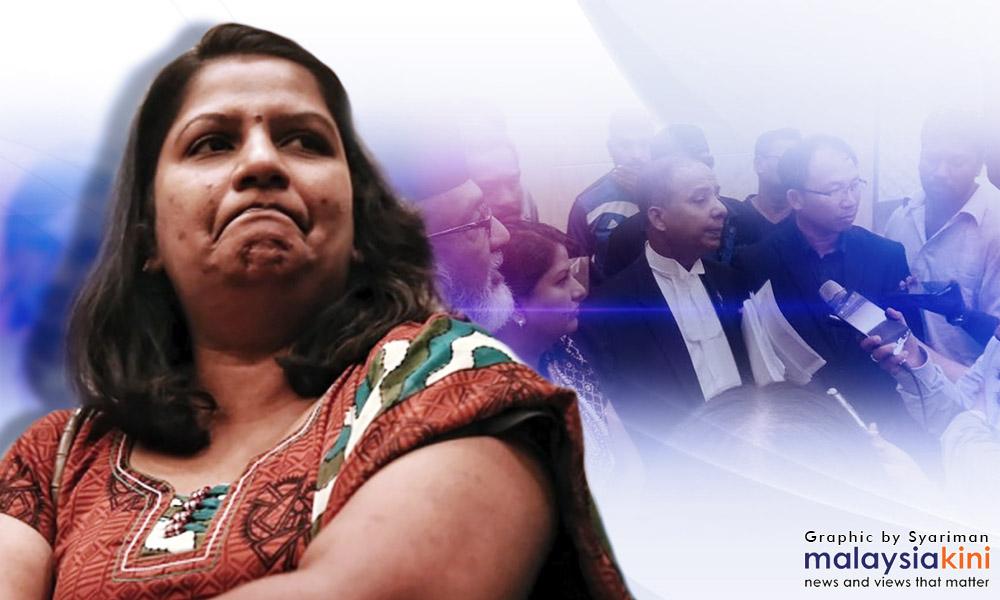

No word yet on nine-member bench call for Indira's appeal
As kindergarten teacher M Indira Gandhi sets to appeal her three children's unilateral conversion to Islam by her former husband in the Federal Court, less than a week away, her lawyers are still in the dark as to whether their request for a nine-member bench will be entertained.
The 41-year-old's final appeal is fixed for a two-day hearing, beginning next Monday (Nov 13 and 14).
However, her lawyer Aston Paiva told Malaysiakini there is no reply on whether the apex court has agreed to their request for an increased number of judges to hear such an important case.
As kindergarten teacher M Indira Gandhi sets to appeal her three children's unilateral conversion to Islam by her former husband in the Federal Court, less than a week away, her lawyers are still in the dark as to whether their request for a nine-member bench will be entertained.
The 41-year-old's final appeal is fixed for a two-day hearing, beginning next Monday (Nov 13 and 14).
However, her lawyer Aston Paiva told Malaysiakini there is no reply on whether the apex court has agreed to their request for an increased number of judges to hear such an important case.
“We have not received any reply, despite the case having been fixed for two days next week,” Aston said.
Sometime in August, when the hearing dates were fixed, Indira Gandhi's lawyers, including Aston and Ipoh Barat MP M Kulasegaran, applied for a nine-member bench to sit for the important matter which may have a bearing on other unilateral conversion cases in the future.
This case grabbed public spotlight in light of past unilateral conversion cases.
Besides this case, there were the S Deepa vs N Viran case in Negeri Sembilan, S Shamala vs Dr M Jeyaganesh case and the R Subashini vs T Saravanan, all of which also involved the unilateral conversion of minor children.
Indira Gandhi had named her former husband K Pathmanathan @ Muhammad Ridhuan Abdullah, the Education Ministry, the Perak Registrar of Muallafs, the Perak Islamic Department and the Perak government as respondents in the scheduled appeal.
The youngest child, Prasana Diksa (Ummu Habiba) was taken by Ridhuan when she was 11 months old in 2009 and the apex court had on April 29 this year ordered that the child be found.
The Ipoh High Court had then ruled that the conversions of Indira Gandhi's three children were null and void as it went against international norms and ruled the Registrar of Muallaf's was wrong to register the conversion.
The Court of Appeal had overturned the decision in a 2-1 majority on Dec 30, last year resulting in this appeal. Hence, the huge focus in this case next week in the latest religious tussle.
The three questions of law to be decided on Nov 14 by the apex court are:
Whether the High Court has exclusive jurisdiction, pursuant to Sections 23, 24 and 25 and the Schedule of the Courts of Judicature Act 1964 (read together with Order 53 of the Rules of Court 2012) and/or its inherent jurisdiction to review the actions of the Registrar of Muallaf or his delegate acting as the public authority in exercising statutory powers vested by the Administration of the Religion of Islam (Perak) Enactment 2004;
Whether a child of a marriage registered under the Law Reform (Marriage and Divorce) Act 1979, who has not attained the age of 18 years, must comply with both Sections 96 (1) and 106 (b) of the Administration of the Religion of Islam (Perak) Enactment 2004 (or similar provisions to state laws throughout the country), before the Registrar of Muallaf or his delegate may register the conversion to Islam of that child; and
Whether the mother and father (if both are still surviving) of a child of a civil marriage must consent before a certificate of conversion to Islam can be issued in respect of the child.


Report this comment
Are you sure you want to delete this comment?
This action cannot be undone.