



Tracking the East Coast Rail Line
KINIGUIDE The East Coast Rail Line (ECRL) came under scrutiny by opposition representatives long before Prime Minister Najib Abdul Razak made the official announcement.
The rail line aims to connect the less developed east coast to the more developed west coast of Malaysia, which is otherwise difficult to reach due to the Titiwangsa mountain range standing in between the two regions.
What is the ECRL all about and how did it become so controversial? Malaysiakini explains the issues in this latest instalment of KiniGuide.
What is the ECRL?
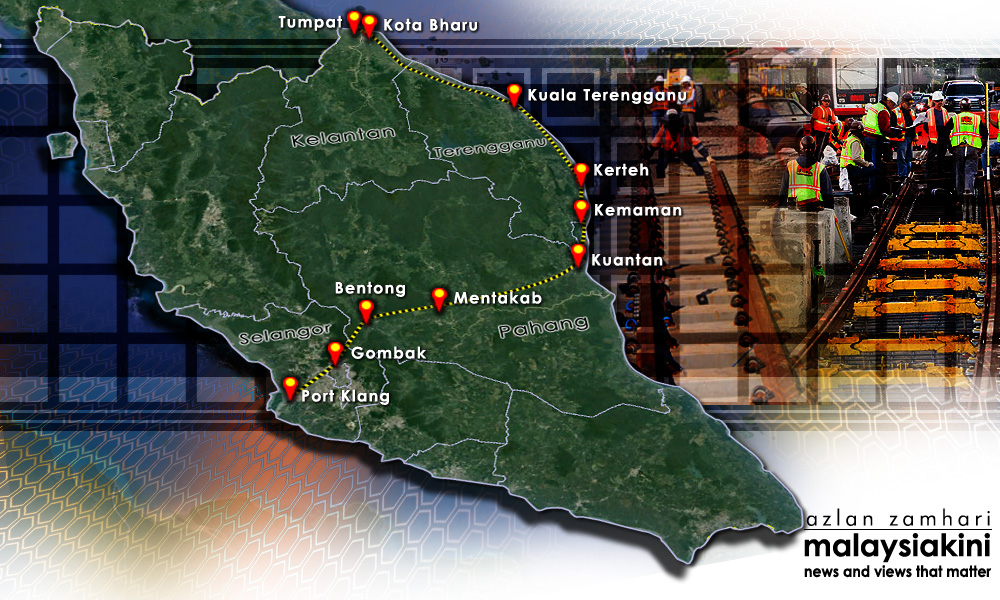
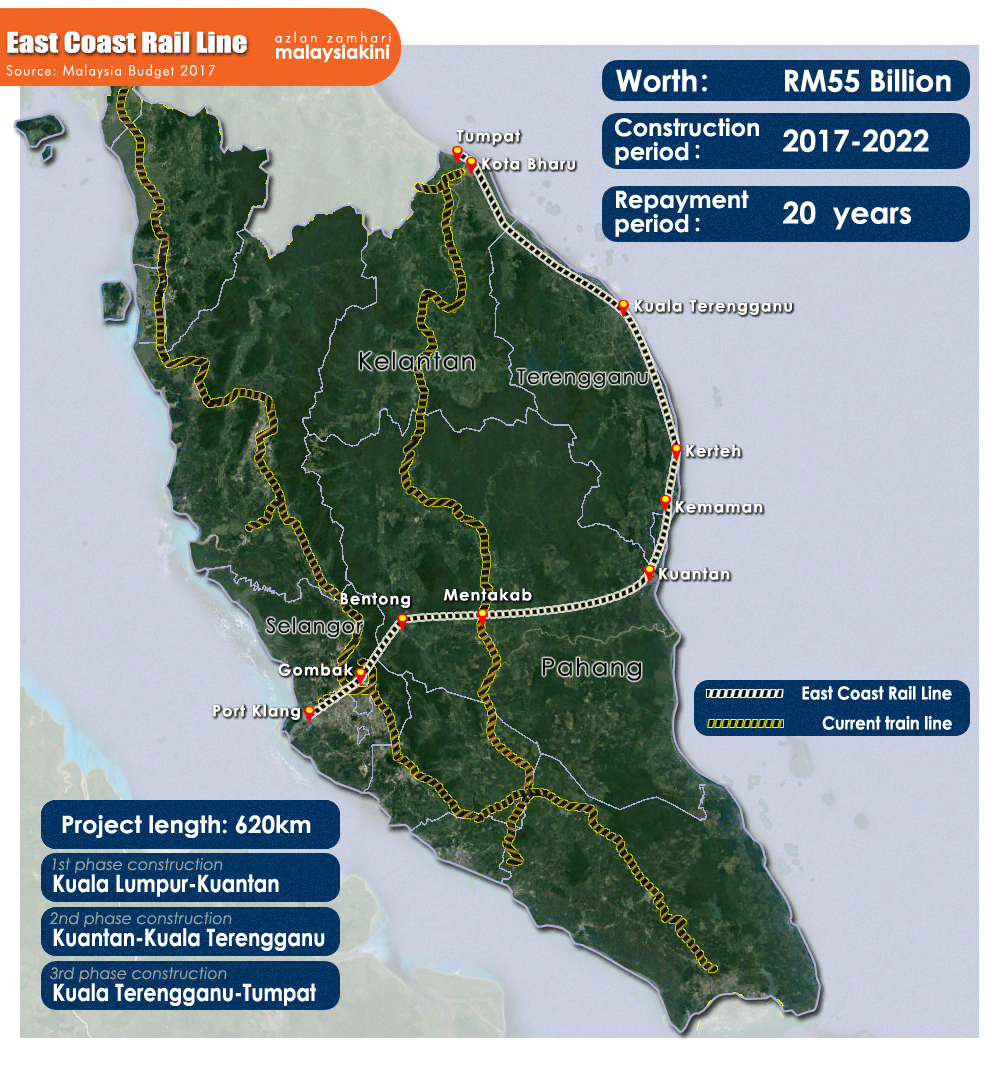
The East Coast Rail Line in its current incarnation is a planned double-tracked, electrified rail line from Tumpat, Kelantan to Port Klang, Selangor.
The route would cut across the Titiwangsa mountain range, and will connect among others, the Gombak Integrated Transport Terminal, Bentong, Mentakab, Kuantan, Kemaman, Kerteh, Kuala Terengganu and Kota Baru.
Reports vary on whether it is 688km long, 620km long, or 600km long.
According to Minister in the Prime Minister’s Department in charge of the Economic Planning Unit Abdul Rahman Dahlan - who had cited the 688km figure - the project would include building multiple bridges totalling 110km in length, and multiple tunnels totalling 50km in length.
The project is slated to begin early next year and be completed by 2022, with RM55 billion often cited as the total cost.
How long is it and how much does it actually cost?
Najib cited an estimate of RM55 billion for 600km in his 2017 Budget speech on Oct 21.
Various news reports about the deal as it was being signed in China early this month quoted a figure of RM55 billion for 620km.
However, Transport Minister Liow Tiong Lai was quoted by Sinchew Daily saying that the RM55 billion refers to the value of the Financing Framework Agreement for the project, not the construction cost.
Meanwhile, The Star quoted Liow on Nov 1 saying that the project is estimated to cost "a similar amount" to the RM55 billion loan to be provided by China.
China Communications Construction Company (CCCC) - the main contractor for the project – however quoted a RM46 billion figure for the project on its website.
Abdul Rahman, who cited the 688km figure for ECRL’s length, said the RM46 billion is only for the Gombak-Kuantan-Tumpat portion of the line.
The Port Klang-Gombak portion had yet to be finalised, he said...
KINIGUIDE The East Coast Rail Line (ECRL) came under scrutiny by opposition representatives long before Prime Minister Najib Abdul Razak made the official announcement.
The rail line aims to connect the less developed east coast to the more developed west coast of Malaysia, which is otherwise difficult to reach due to the Titiwangsa mountain range standing in between the two regions.
What is the ECRL all about and how did it become so controversial? Malaysiakini explains the issues in this latest instalment of KiniGuide.
What is the ECRL?
The East Coast Rail Line in its current incarnation is a planned double-tracked, electrified rail line from Tumpat, Kelantan to Port Klang, Selangor.
The route would cut across the Titiwangsa mountain range, and will connect among others, the Gombak Integrated Transport Terminal, Bentong, Mentakab, Kuantan, Kemaman, Kerteh, Kuala Terengganu and Kota Baru.
Reports vary on whether it is 688km long, 620km long, or 600km long.
According to Minister in the Prime Minister’s Department in charge of the Economic Planning Unit Abdul Rahman Dahlan - who had cited the 688km figure - the project would include building multiple bridges totalling 110km in length, and multiple tunnels totalling 50km in length.
The project is slated to begin early next year and be completed by 2022, with RM55 billion often cited as the total cost.
How long is it and how much does it actually cost?
Najib cited an estimate of RM55 billion for 600km in his 2017 Budget speech on Oct 21.
Various news reports about the deal as it was being signed in China early this month quoted a figure of RM55 billion for 620km.
However, Transport Minister Liow Tiong Lai was quoted by Sinchew Daily saying that the RM55 billion refers to the value of the Financing Framework Agreement for the project, not the construction cost.
Meanwhile, The Star quoted Liow on Nov 1 saying that the project is estimated to cost "a similar amount" to the RM55 billion loan to be provided by China.
China Communications Construction Company (CCCC) - the main contractor for the project - however quoted a RM46 billion figure for the project on its website.
Abdul Rahman, who cited the 688km figure for ECRL’s length, said the RM46 billion is only for the Gombak-Kuantan-Tumpat portion of the line.
The Port Klang-Gombak portion had yet to be finalised, he said.
Who is in charge?
The project will be built by the China state-owned China Communications Construction Company (CCCC) on condition that it would collaborate with local companies on the project.
The CCCC is also responsible for designing the rail line and procuring materials for it, together with its Malaysia-based subsidiary China Communications Construction Company (M) Sdn Bhd.
The Export-Import Bank of China (Exim) is to provide a 20-year soft loan for the project, with no repayment for the first seven years. There is no official figure on the interest rate so far.
Also among the signatories of the Engineering, Procurement, Construction and Commissioning agreement signed on Nov 1 is Malaysia Rail Link Sdn Bhd (MRL).
According to Abdul Rahman, MRL is owned by Minister of Finance (Incorporated) and Federal Lands Commissioner (FLC), although two Ministry of Finance senior officials were its initial shareholders.
The project would be overseen by the Economic Planning Unit, Finance Ministry, and Transport Ministry.
Why is it being built?
The main purpose of the ECRL is to facilitate the movement of goods and peoples between the west coast and the east coast of Peninsular Malaysia.
This is supposed to bring down transportation costs and spur growth in the East Coast Economic Region (ECER), which is considered to be less developed compared to the west coast.
According to the East Coast Economic Region Development Council’s (ECERDC) website, the region spans from the Kelantan-Thailand border in the north and Mersing, Johor in the south, covering 4.43 million people as of 2014.
Abdul Rahman said ECRL would contribute an additional 1.5 percent annual GDP growth to the east coast over the next 50 years, with the main beneficiaries being the rural and semi-rural people in east coast states.
Why is it all over the news now?
The ECRL and its precursors had been mooted for some time; according to Abdul Rahman - as far back as 1981.
The proposal was cast in stone when Najib announced it during his 2017 Budget speech on Oct 21, followed by his trip to China early this month where the deal to build the ECRL was signed on Nov 1.
Opposition MPs had been questioning the cost and lack of transparency in the awarding of the contract since.
How does one compare the cost of a rail line?
Depending on which figure you use for the length of the railway, the ECRL’s cost ranges from RM79.9 million per kilometre to RM91.7 million per kilometre (assuming that the RM55 billion figure is the correct one).
However, comparing the costs between different rail projects is no straightforward matter, as each project presents a unique set of challenges.
Generally, railroads are cheapest on flat, firm ground, more expensive in hilly terrain, and most expensive in densely packed urban areas.
Likewise, elevated railways can drive up costs compared to tracks laid at ground level, and tunnels even more so. This is why train lines in cities like New York are often the most expensive, since deep tunnels would have to be used almost exclusively in the project.
Other features and complications such as signalling equipment, electrification, the number and the type of railway stations, and the need to relocate residents in the project site can also affect the cost.
Is it really too expensive?
For the reason mentioned above, it’s hard to say for sure without knowing the details of the project but that has not deterred others from trying.
A report published by The Edge on Nov 8 quoted unnamed analysts and construction industry executives arguing that at RM91.67 million per kilometre, this may be the most expensive interstate rail and cargo line in the world.
The financial weekly’s sources quoted prices between RM32 billion and RM36 billion for the entire project, including the cost of tunnelling through the Titiwangsa range.
ECERDC’s Jebasingam Issac John was also quoted by The Malaysian Reserve in 2014 citing RM30 billion as the estimate cost of the ECRL.
Meanwhile, Abdul Rahman explained that the various studies conducted since the ECRL project was proposed in 2007 provided estimates ranging from RM30 billion to RM70 billion.
The RM55 billion not only covers the construction costs, he said, but also to conduct studies and to enable the transfer technology to local companies.
He said the construction would also be among the "most challenging engineering and construction projects in Malaysia to date", as it requires tunnelling through hard rock, building bridges spanning the Titiwangsa mountain range, and laying tracks in dense jungle.
What concerns are being raised about the CCCC?
The CCCC is currently blacklisted by the World Bank from its projects for an eight-year period starting from Jan 12, 2009 until next year.
This is for alleged fraud in a World Bank-funded road construction project in The Philippines, which was contracted to CCCC’s precursor, the China Road and Bridge Corporation (CRBC).
However, Abdul Rahman highlighted that the CCCC has a good track record in delivering projects in Malaysia, such as the Sultan Abdul Halim Muadzam Shah Bridge (also known as the Penang Second Bridge) in 2014.
What concerns are being raised about MRL?
The Pandan MP Mohd Rafizi Ramli noted that MRL is owned by Finance Ministry officials rather than being directly owned by a government entity.
He said a similar scheme had been used by SRC International, which was established by 1MDB in 2011 and then borrowed RM4 billion from Retirement Fund Incorporated (KWAP).
The government then took over the company a year later, along with its debts. The company is now the subject of money-laundering investigations abroad, including the US, Singapore, and Switzerland.
Abdul Rahman denied this, saying that the MRL shares had been transferred from the two officials - Ahmad Suhaimi Endut and Yusof Ismail - to the Minister of Finance (Incorporated) and Federal Lands Commissioner (FLC) on Oct 12.
These changes won't be reflected on the Companies Commissions' records until MRL submits its annual returns to the commission. This is why the two officials are still listed in the records as shareholders, he said.
What about that 1MDB conspiracy theory?
The whistleblower site Sarawak Report claimed in July that the ECRL project would be awarded to CCCC, but the cost would be inflated from RM30 billion to RM60 billion. This was just shy of the RM55 figure that Najib revealed.
The inflated cost is purportedly to pay off debts incurred by companies related to tycoon Low Taek Jho, better known as Jho Low, including 1MDB.
However, Works Minister Fadillah Yusof had reportedly denied the allegation on July 27.
When contacted by Malaysiakini however, Fadillah said the project is not under his ministry. Transport Minister Liow and Land Public Transport Commission (SPAD) chairperson Syed Hamid Albar have yet to respond to Malaysiakini’s queries on the allegation.
This instalment of KiniGuide is compiled by KOH JUN LIN.


Are you sure you want to delete this comment?
This action cannot be undone.