




A pervasive culture of fear
 special report
Six years ago, I obtained a first degree from University Sains Malaysia in Penang (USM). While memories of my student days have faded, some things have changed a lot since then.
special report
Six years ago, I obtained a first degree from University Sains Malaysia in Penang (USM). While memories of my student days have faded, some things have changed a lot since then.
In my time there, students were allowed to wear t-shirts, but with a collar, when they went to the library. Female students had wider options as we were allowed to wear dresses and skirts or pants with blouses.
The security guards at the campus did double duty as the 'wardrobe police', having been given powers to check on the state of 'decency' of our attire.
Those found to be inappropriately dressed would be barred, embarrassingly so, from entering the library. I saw this happening to some of the students and I was once issued a summons as well.
"Your denim pants are too tight, tak sopan (not decent)," said a female security guard as she subjected me to a top-to-bottom visual inspection.
I did not blame her after all, she was just doing her job. One could argue that a dress code is part of social norms, and I have no disagreement with this. But is it more important than learning or creating knowledge?
I don't know the current dress code at USM, but it appears that t-shirts remain acceptable attire at Universiti Malaya (UM).
 special report
Six years ago, I obtained a first degree from University Sains Malaysia in Penang (USM). While memories of my student days have faded, some things have changed a lot since then.
special report
Six years ago, I obtained a first degree from University Sains Malaysia in Penang (USM). While memories of my student days have faded, some things have changed a lot since then.
In my time there, students were allowed to wear t-shirts, but with a collar, when they went to the library. Female students had wider options as we were allowed to wear dresses and skirts or pants with blouses.
The security guards at the campus did double duty as the 'wardrobe police', having been given powers to check on the state of 'decency' of our attire.
Those found to be inappropriately dressed would be barred, embarrassingly so, from entering the library. I saw this happening to some of the students and I was once issued a summons as well.
"Your denim pants are too tight, tak sopan (not decent)," said a female security guard as she subjected me to a top-to-bottom visual inspection.
I did not blame her after all, she was just doing her job. One could argue that a dress code is part of social norms, and I have no disagreement with this. But is it more important than learning or creating knowledge?
I don't know the current dress code at USM, but it appears that t-shirts remain acceptable attire at Universiti Malaya (UM).
During orientation week last year, new students received a t-shirt each bearing the new Barisan Nasional (BN) slogan cemerlang, gemilang, terbilang (excellence, brilliance and outstanding) that was also on a huge banner displayed on the grounds.
"We are a university. Why we should associate ourselves with BN? It makes me think I'm in a sekolah menengah (secondary school)," said a student who did not want to be named.
Politicisation of varsities
The 'politicisation' of public universities has been a work in progress that has been stepped up over the years, to quell youthful 'anti-establishment' sentiments and to instil a higher profile for the ruling coalition.
In 2002, all students and staff, including academic staff, were forced to sign the Akujanji pledge of loyalty on the government's stipulation.
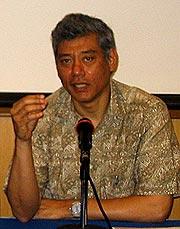 At a recent public forum in Kuala Lumpur, former UM economics professor Dr KS Jomo took a dig at the "government's obsession" with controlling universities.
"If you want to become a VC (vice-chancellor) or DVC (deputy vice-chancellor), you don't have to lobby the prime minister or deputy prime minister, but Umno or the MCA education bureau," he said to laughter.
Public universities have not escaped the taint of cronyism either. According to a department head, certain teaching staff members were given jobs because "certain ministers or authorities had called up the university" (to 'recommend' them).
"There are cases where applications had been rejected but those concerned were still able to get into the universitythey were able to pull strong 'cables'," he said in frustration.
The process of politicisation of public universities begins at the top, because VCs are traditionally appointed by the prime minister.
The close relationship between the university management and government has left lingering doubts about the independence, transparency and quality of leadership in tertiary institutions.
Outspoken former academic - now Penang state executive councillor - Dr Toh Kin Woon is among those who hold this view.
"The government does not seem to cast net wide enough in selecting VCs. The issue of loyalty to the government should not arise in such appointments," he said in an interview.
"I think if someone is academically very sound, and is able to provide academic leadership, even if he has independent political views, the person is acceptable as a VC."
Independent views?
Are independent political views really acceptable in public universities, which are haunted by a pervasive culture of fear?
Already the constraints cut into academic freedom to carry out research. One academic said that a colleague who had attended a PAS assembly as part of research work was warned by the university not to go to functions organised by opposition parties.
About a year ago, I heard the presentation of a very interesting paper on Malaysian politics at a regional academic conference which I thought would be worth reporting in malaysiakini .
I asked the presenter a university lecturer for permission to use the information. She agreed but posed the question: "Do you think would it be offensive to the government? Would I be in trouble later?"
I had no assurance for her.
On another occasion, a young lecturer who delivered a paper at a public forum on sexuality turned down my request to use the material.
She said: "I signed a lot of documents including Akujanji when I joined the university. If my paper is published in malaysiakini , it would be viewed 'differently'...."
 I was not able to rebut this to her satisfaction.
It is also telling that almost all those who provided comments for this special report would only speak on condition of anonymity there were also others who refused outright to share their views.
Racial landscape
The country's racial landscape has unavoidably permeated administration of public universities as well, according to non-bumiputera lecturers.
It appears to be the unwritten rule in most of these institutions to reserve high-profile positions of department heads, deans or vice-chancellor for bumiputeras.
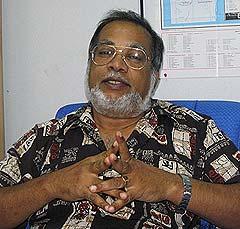 Political scientist Prof R Ramasamy pointed to the dearth of non-Malay academic staff in public universities.
"I was teaching in a university for 24 years but I'm still not sure how the academic staff are recruited," said the former lecturer who retired in May and who has since been re-employed on contractual basis at Universiti Kebangsaan Malaysia.
However, Malay academics generally dismissed the notion of racial discrimination on campus. A lecturer at UM said it is favourism, not racial discrimination, that is the entrenched practice.
In an interview, he said: "There is favouritism in some faculties as alleged by (economics lecturer Edmund Terence) Gomez (in the arts and social science faculty). To get a promotion, you must have connections."
An academic revealed that one way to obtain a promotion is to play golf and "be pally" with the VC.
"Be pro-government, apple-polish the VC and you will get your promotion," he said with some disgust.
 Toh said that, while it is important to maintain social equality, the quota system based on ethnicity and which has been used for a long time has thwarted the progress of the higher education.
"There is this general perception that there has been some decline (of quality) because recruitment of staff and students has not been done strictly based on merit," he said.
He also said it is a general perception that the standard of public universities has dropped as a result of the 'problematic' education system.
"The products of the universities are largely reliant on quality of the intake," he added.
This is compounded by intellectual inertia among some of the academic staff, as highlighted by their peers.
At a discussion during a recent public forum, an ambitious young academic from UM related her frustration about "academics who do not carry out researchThey do not hold to ideology or worse, they don't understand the ideology they believe in".
Another senior academic from UKM said at the same forum that many do not have the commitment "to do their work seriously".
Jomo said an applicant told an interview panel the reason she wanted the job was because "it is a kerja mudah (easy work)".
"She told me that working in a university is easier than working in secondary schools as you don't have to be in the varsity the whole day," he said.
"Because of political reasons and the status of universities, these are no longer a place to develop knowledge but to earn a living," he added.
Even as the declining quality of tertiary students is deplored and they are labelled as being spoon-fed, passive and lacking in creativity it should not be forgotten that the students are the products of their educators.
Part 1: Politics of promotion in UM
Part 3: Stranglehold over undergrads


Are you sure you want to delete this comment?
This action cannot be undone.