




Malaysia, Thailand fail to break deadlock
Malaysia and Thailand failed to break a deadlock over the fate of 131 displaced Thai Muslims yesterday, with Malaysia insisting Thai authorities must convince the group it is safe for them to return.
Malaysia and Thailand failed to break a deadlock over the fate of 131 displaced Thai Muslims yesterday, with Malaysia insisting Thai authorities must convince the group it is safe for them to return.
The 131 men, women and children crossed the border into Malaysia in August, saying they feared for their lives in the region which is in the grip of a Muslim insurgency, and triggering a diplomatic tussle over their fate.
"The important thing is for the 131 to feel confident about going back," Deputy Prime Minister Najib Razak told reporters after talks with his Thai counterpart Chidchai Vanasathidya designed to establish their status.
 Najib said Chidchai had reiterated the Thai government's assurance that if the displaced people were ready to return they would be assured of their safety, but that the onus was on the Thai government to convince the 131 of that.
"That is the crux of the matter because if the basis of them going back is on a voluntary basis, then the 131 must feel confident. And whatever fears that they have will be assuaged by the assurance given by the Thai government that their safety will be guaranteed," he said.
The United Nations refugee agency has also interviewed the 131, despite protests from Thailand which said they included militants as well as innocent people who were duped into fleeing in order to "internationalise" the conflict.
Still being interviewed
Malaysia and Thailand have exchanged barbed comments over the issue, culminating in Thai Foreign Minister Kantathi Suphamongkhon declaring last week that he had cut off contacts with Malaysia over the row.
Najib, who is also defence minister said it was not clear how long the group would be allowed to remain in Malaysia, and that Thai officials were still interviewing them.
"We do not know yet. It all depends whether they (Thailand) can convince the 131 to go back to Thailand," he said.
"This is a process. We have to allow them some time to continue with their interviews. This is just the early stage because then they have to continue to talk to them and we have to facilitate that process."
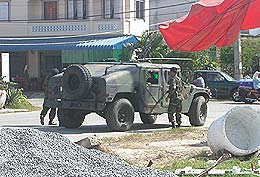 The Thai Muslims are being detained at a detention centre in northeastern Kelantan state which borders Thailand.
Give them time
Najib said it would take some time for them to overcome their fear of returning to southern Thailand, where some 1,000 people have been killed since January 2004 in nearly-daily attacks.
"You have to give them a bit of time because they have come over here with a high degree of anxiety and so forth and so that requires a bit of time for them to feel reassured that they can go back to Thailand," he said.
Najib said that Thai officials attempting to convince the migrants to return home must clarify issues like whether they will return to their homes.
"There are matters of details like where do they go back to. Do they go back to their original homes or do they decide to go somewhere else," he said.
The spate of shootings, bombings and arson attacks in majority-Muslim southern Thailand is blamed by analysts and authorities on a complex mix of Islamic separatism, local corruption and organised crime.


